NAZA, moral certainty, and the question haunting me since October 8
Nearly three years later, I am still trying to understand October 8.
Understand is too polite a word. It gnaws at the foundation of what I believe. It keeps me up at night.
Not the date. The thing that happened on it. Israeli families were still calling phones that would never be answered, still waiting to hear whether someone they loved was murdered, taken, or burned, and already the accusation had turned toward the Jews.
For some people, Gaza was not the origin of the animus. It was the permission slip for something already waiting.
I know it was waiting because I heard it years earlier, in my own circle. A young couple came into the library in which I work, the man wearing a kippah, and halfway through a conversation about a book, he interrupted me: “You need to go to Jerusalem.” I went. When I told friends, several of them said that by going I was endorsing ethnic cleansing and condoning apartheid. One warned me that Israelis “don’t know what is going on, they’re so steeped in propaganda.” Another told me not to be a neocon dupe. There was no war on. It was simply there.
I am not Jewish. I am a Zionist. I have stood in Sderot, and at Netiv HaAsara with the sea a few hundred meters away. None of that gives me the right to look away from a dead Palestinian child. And no dead child gives anyone the right to put Jews in the dock.
I am not asking why Israel is criticized. It must be. I am asking why criticism of particular Israeli decisions slides so easily into a verdict on Jews.
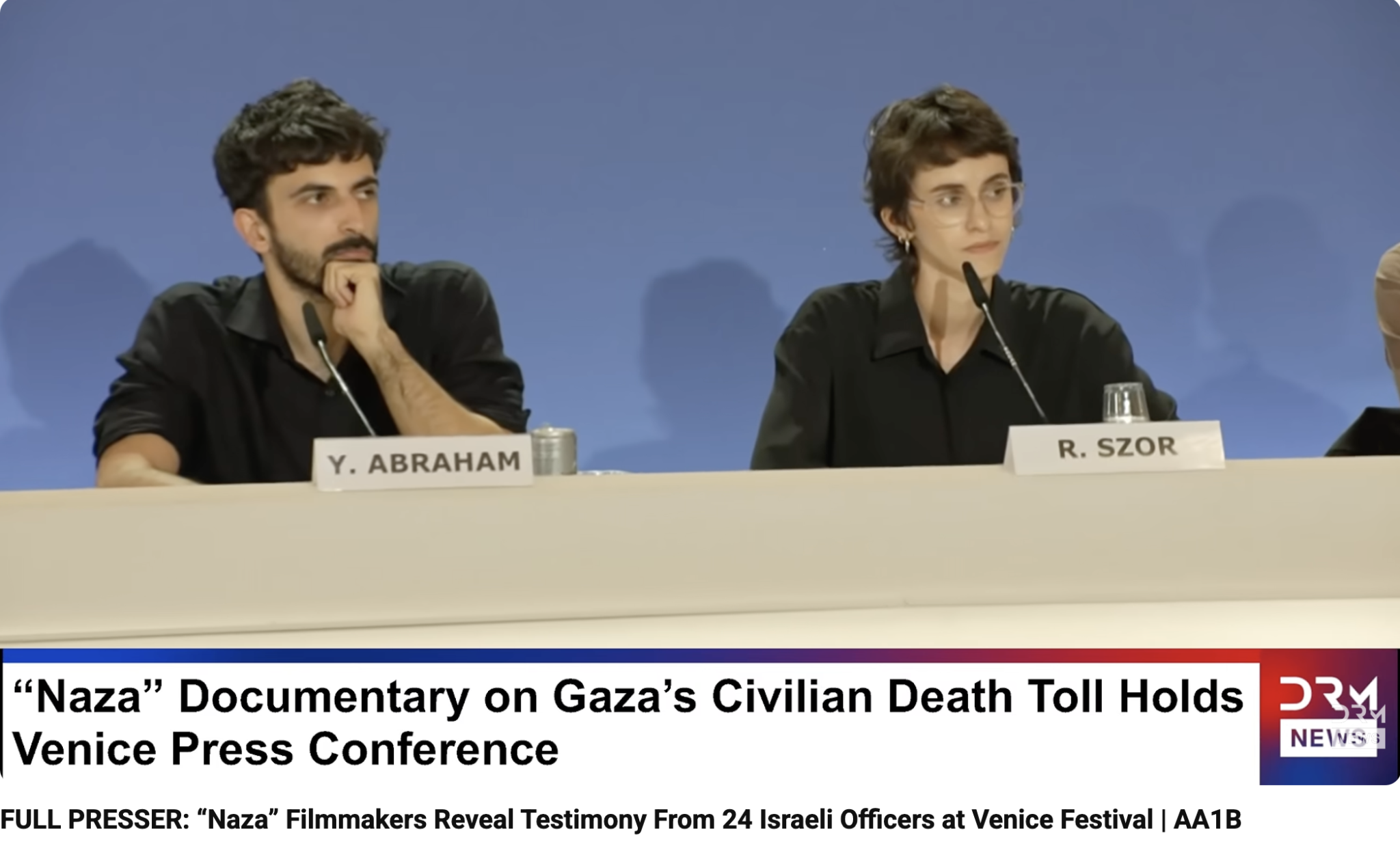
I watched the Venice press conference for “NAZA” in that spirit. Twenty-four Israeli intelligence officers and soldiers describe a “system of killing”: not that civilians died in a brutal urban war, but that their deaths became normalized inputs in the machinery. The allegation must not be waved away. I have not disproved it; I am writing about the room that declined to test it.
The witnesses are anonymous, faces and voices digitally altered. Asked how anyone could know the accounts were real:
“The strength of their testimony speaks for itself.”
No. Testimony never speaks for itself. It speaks through verification, corroboration, selection, editing. Who confirmed these men’s ranks, units, access to the systems they describe? “Trust us” cannot be the standard for an accusation of institutionalized mass killing.
I learned something about staged evidence in Hebron, on a narrow street where nets had been strung above the Palestinian residents’ heads to catch garbage thrown down by the Jewish families living above. The nets sagged with it. I asked a man why they did not clean them out and he said, “We do!”
The garbage was years old. Settlers throwing rubbish on their neighbors is real and it is disgusting, and I do not doubt it happened on that street. But a true story kept on display for visitors is doing something other than telling the truth, and I left less sure of everything I had been shown, including the parts that were true.
At Venice, the room did not turn toward method. It turned toward affirmation. A questioner began from the premise that “there’s still a genocide.” That is applause with a question mark. The panel moved from testimony to system, to crime, to genocide, never pausing between a reckless attack, a deliberate one, and the intent genocide requires.
Matti Friedman named this genre a decade ago: the moral striptease. “The two combatant sides in this strange universe,” he wrote, “aren’t Jews and Arabs, but Jews and their conscience.” Confession spoken in Hebrew among veterans in a bomb shelter is one thing; the same words “to a sated film-festival audience at Sundance or Cannes is something else.”
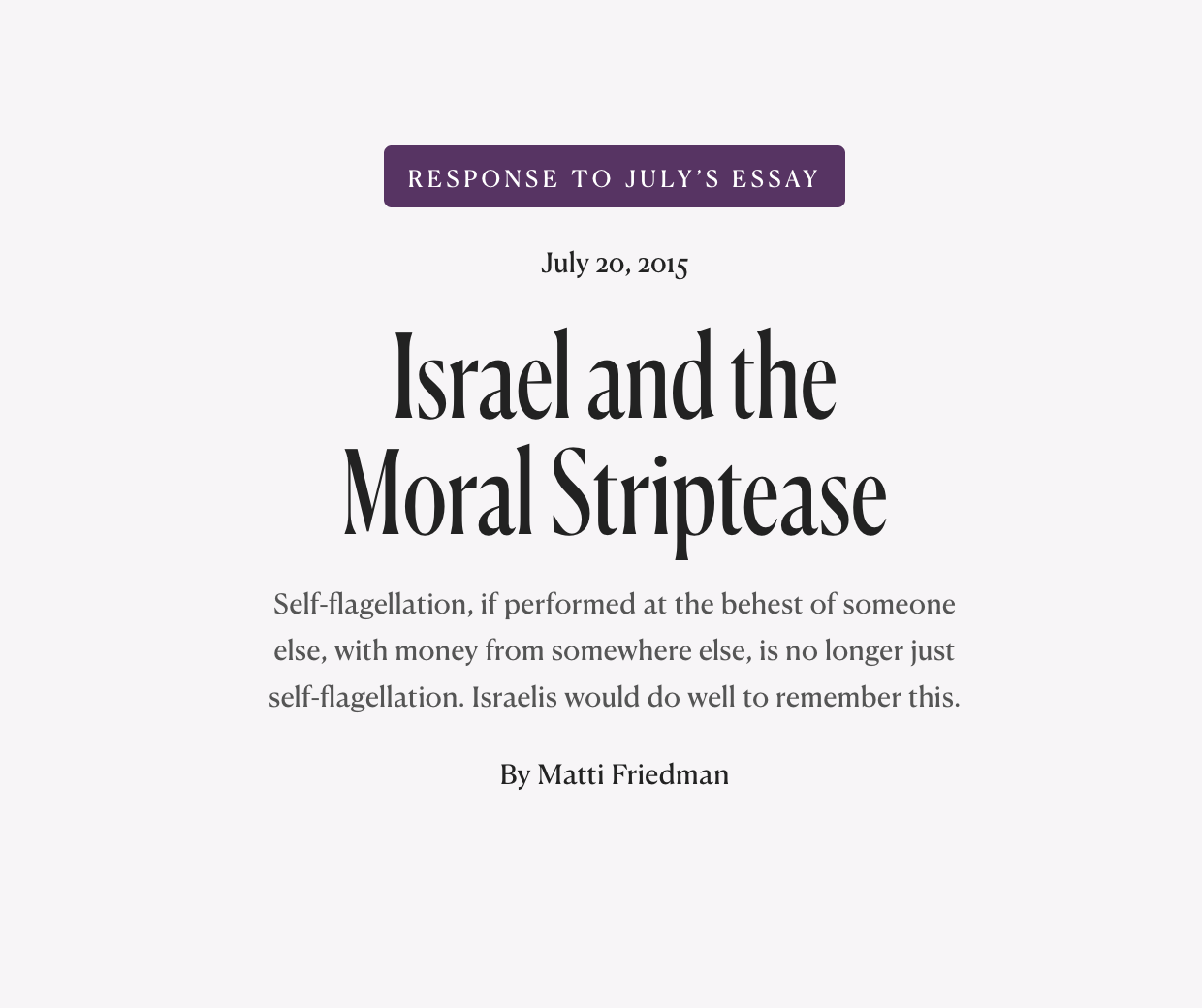 Venice is that room. And then the sentence I keep returning to: “Self-flagellation, if performed at the behest of someone else, with money from somewhere else, is no longer just self-flagellation.”
When Jews perform their conscience before the world, they cannot choose the audience. Some came to see a better Israel. Some came to hear a Jew say it, so that what they already believed about Jews could be said with a clean conscience.
Friedman does not ask Israelis to soften their self-criticism. He asks them to know what room they are standing in. None of this proves “NAZA” wrong. And Hamas’s crimes do not suspend Israel’s obligations, though a war fought from inside apartment blocks is not the same war, and whoever put the civilians there answers for that.
Where Israel is cast as the new Nazi Germany, the chain runs: government becomes society, society becomes Zionism, Zionism becomes Judaism, Jews abroad become accomplices.
And here is what I cannot ask a film festival.
From the river to the sea, Palestine will be free.
I have heard it chanted in a hundred videos and still do not know what I am being told. So I ask, without sarcasm: What do you picture the morning after? Seven million Jews with suitcases, going where? Or is the honest answer the one nobody says into a microphone, that there is no morning after, because they are not there anymore?
I have tried asking. I wrote to the historian Rashid Khalidi about the stated goal of eliminating the Jewish state; he replied that these were “old Israeli tropes that have no basis in reality.” I showed that to Yossi Klein Halevi, who asked one question back: Would Khalidi ever say he recognizes the legitimacy of a Jewish-majority state in any borders? Nobody has answered that one for me.
If it means one state where Jews and Palestinians live as equals, say so plainly. The vagueness is doing work, and a people hunted before is not paranoid for noticing it.
My Jerusalem landlord, Yigal, once yelled at me, “You know nothing!” I yelled back, “I know! And neither do you!” We agreed on the nothing. I would still like to be wrong about this. I have been wrong before.
I refuse antisemitism as a shield against evidence of Israeli wrongdoing. And I refuse Palestinian suffering as a weapon against Jewish existence.
The dead in Gaza deserve evidence, not mythology. Jews everywhere should not be defendants in a war they did not wage.
“NAZA” may be an important film. Important films deserve more than admiration.
It got applause. It deserved interrogation.