A Man of Masks and Mountains
One of the saddest moments in the Torah walks hand in hand with one of its most selfless. In this week’s parasha, after counting the Jewish People who will shortly possess the Land of Israel, Moshe is reminded that he will not. They will travel on without him:
God said to Moshe, “Go up to this Mountain of Avarim[1], and see the Land which I have given to the Children of Israel. And you shall see it, and (then) you shall be gathered to your people…” (Bamidbar 27:12–13)
This is followed by an unprecedented moment in the Torah; after forty years of God giving Moshe commands, Moshe makes one in return:
Moshe spoke to God, saying, “Let God, the God of the spirits of all flesh, appoint a man over the congregation: who will go out before them, and who will go in before them, and who will lead them out, and will bring them in; so that the congregation of God will not be as a flock that does not have a shepherd.” God said to Moshe, “Take Yehoshua the son of Nun, a man who has spirit in him, and lay your hand upon him…” … Moshe did as God commanded him: and he took Yehoshua… (Ibid 15–18, 22)
Moshe puts People over pride. He might not be allowed to be the leader, but he insists that the People will have a leader regardless. His dedicated student Yehoshua will succeed him. A lifetime of hard work and commitment has paid off for Yehoshua. His unceasing learning from, and shadowing of, Moshe, has made him his successor. A remarkable individual though he was, he was not Moshe. The Talmud makes a profound analogy:
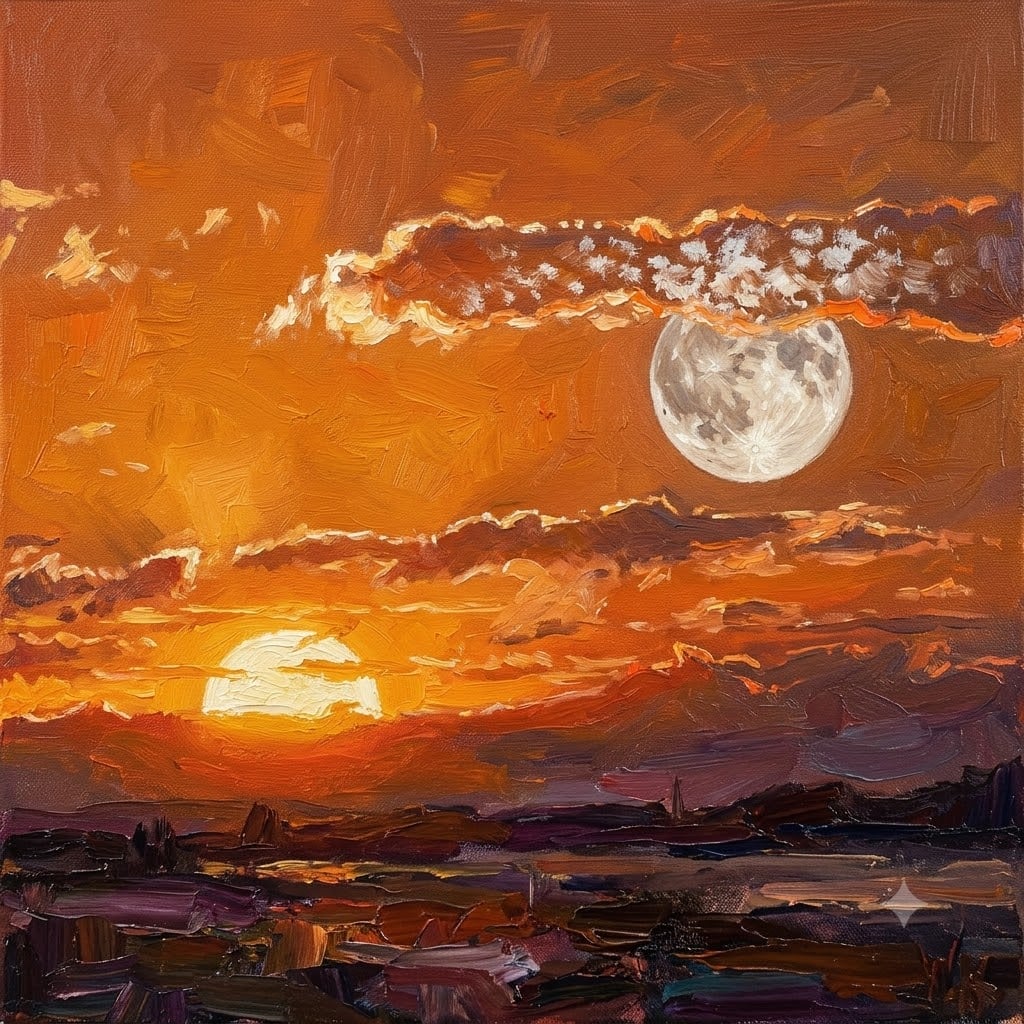
The face of Moshe was like the Sun, the face of Yehoshua was like the Moon. (Bava Batra 75a)
This is not just a statement about their relative greatness: Moshe’s radiance outshone that of Yehoshua’s, as the sun outshines the moon; it is an analogy to their roles: The sun is a source of light, the moon merely reflects the light of the sun. Moshe was the teacher, Yehoshua, his student.
Moshe publicly anoints Yehoshua in a moving ceremony[2]. With his successor chosen, Moshe will climb the mountain, and Yehoshua will lead them on into battle.
This has a familiar echo: There is another time in the Torah when a very similar arrangement takes place. It is in fact the first time that Yehoshua is introduced in the Torah:
Amalek came and battled Israel in Refidim. Moshe said to Yehoshua, “Select men for us and go battle with Amalek. Tomorrow I will stand on the top of the hill with the staff of God in my hand.” (Shemot 17:8–9)
Moshe climbed the hill and Yehoshua led the people to war. This is a repeated theme. Why? If we look at a third instance of this happening, we can see the symbolism at play.
The second story in the Torah which features Yehoshua involves Moshe climbing another mountain, this time Sinai:
God said to Moshe, “Go up the mountain to Me, and stay there…” Moshe and Yehoshua his attendant got up, and Moshe went up the Mountain of God. (Shemot 24:12–13)
Yehoshua accompanies Moshe to the mountain but only Moshe ascends. Moshe is on the mountain for forty days and nights. Tragedy strikes. The Jews build the Golden Calf. When Moshe hurries down the mountain, rushing to the camp to destroy the Golden Calf, he encounters someone at the mountain’s foot. Yehoshua was still there[3]. He had waited for his teacher all that time. Moshe was at the mountain’s summit, Yehoshua at its base.
In the aftermath of the Golden Calf, two noteworthy things happen. First, Moshe takes the Tent which had been designated as a place to meet God, from the centre of the camp to outside it. Anyone who sought God would have to leave the camp to get to it. Moshe was making a deliberate point. The tent of God has no place in a camp of Calf-worshippers. To encounter God, you must leave the camp. Second, Moshe’s face began to shine. The Torah describes that when he descended from the mountain, Moshe was unaware that his face shone, but the People now feared him. They gave him a mask. When Moshe spoke to them, he would wear it; when he spoke to God, he would remove it[4]. It was easier for Moshe to speak to God than it was for people to speak to him.
The analogy of the Sun and the Moon returns. The sun is blinding; you cannot look at it directly. The moon has a softer, easier light. A mask will always separate Moshe from his People.
This is why Moshe’s place is always at the top of the mountain. He is beyond the people. His greatness is blinding. The People cannot really see him; that is why they often do not appreciate him. Yehoshua waits at the foot of the mountain, between where Moshe is and where the people are. He dazzles less than his teacher, but he can be seen more easily.
Moshe’s greatest contribution was giving the Jewish People the Torah; Yehoshua’s greatest contribution was taking them into the Land of Israel. The sun’s light is a constant; the Torah is the one constant of Jewish history. Its light shines for all places and all times. The Jews’ presence in Israel is not a constant. Like the moon, it waxes and wanes. As history has bitterly taught us, Israel’s light only shines when we are appreciative of its blessings.
Moshe could be the miraculous leader who could take the Jews out of Egypt; he could never lead them into Israel. It was not his deficiency but theirs. A land which mixed holy and mundane, and where shortcomings and success would both be found, Moshe could never call home. He could look at Israel from the top of a mountain, but he would never be able to walk in its streets.
This explains so many of the differences between Moshe’s and Yehoshua’s lives, up to and including their deaths. The Tanach describes Yehoshua’s burial place with great detail:
And they buried him in the border of his property in Timnat-seraĥ, which is in Mount Efrayim, on the north side of the hill Ga῾ash. (Yehoshua 24:30)
Yehoshua is buried in a very specific place, in his land among his people. In contrast, Moshe’s precise burial place is unknown. The Torah[5] describes that he ascended and died on Mount Nevo, but that his grave was never located. He remains a constant with no final resting place, but forever on the mountain.
–
[1] Literally the Mountain of the Banks (of the Jordan)
[2] See Rashi Bamidbar 27:23
[3] Shemot 32:17
[4] Shemot 34:29-35
[5] Devarim 34:1-6