A voice from Morocco
A Marshall Plan for Breaking the Brotherhood’s Monopoly
Textbooks, Not Tanks: Israel’s Real Weapon.
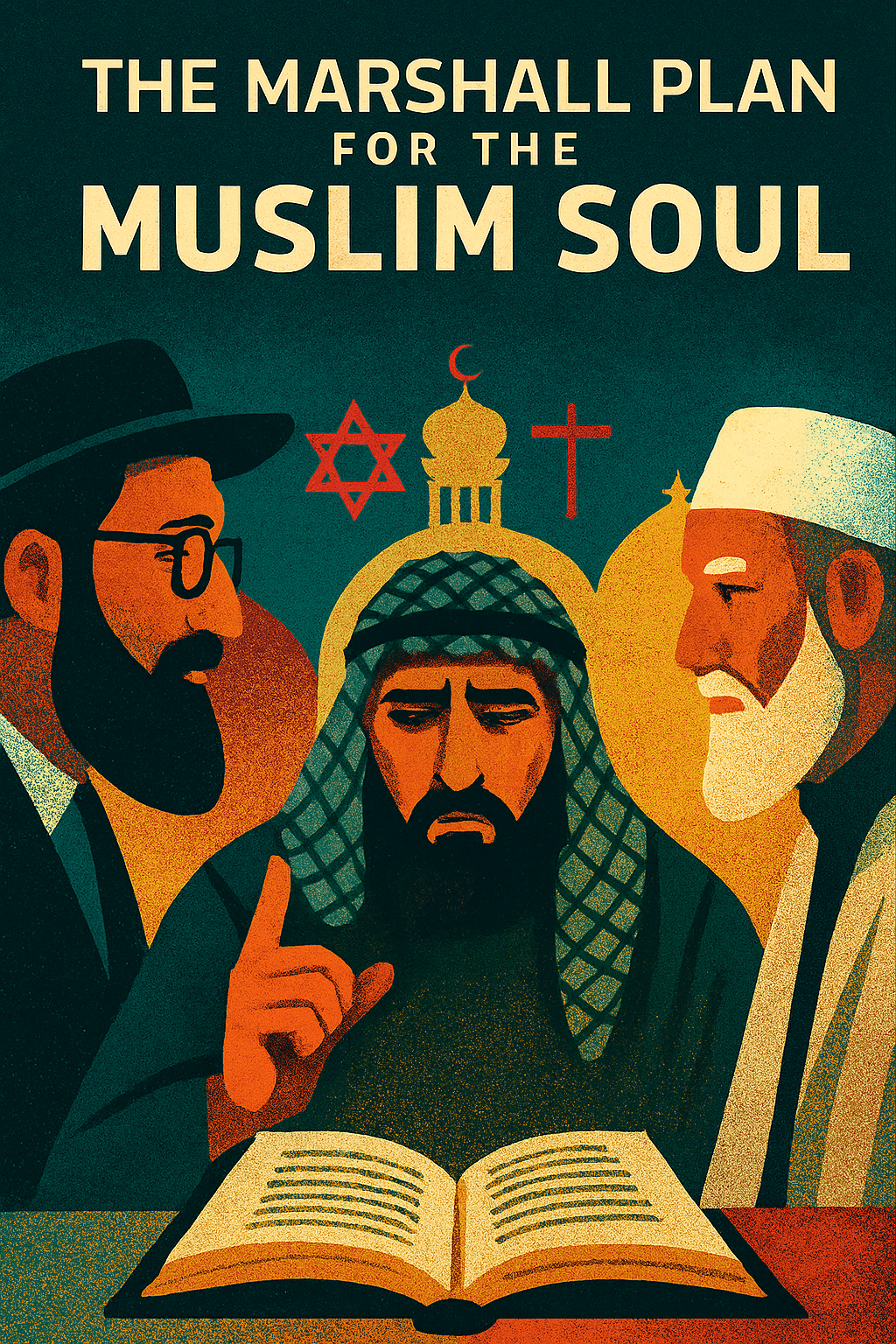
The trauma of October 7 has hardened Israeli psychology in ways that risk calcifying the future. But if Israel is to secure peace—not just security—it must look beyond retaliation and containment. It must look inward, and then outward, toward its neighbors. The Palestinians are not going anywhere. Their fate is sealed alongside Israel’s, and the only viable path forward is one of transformation—not of borders, but of belief.
Just as postwar Germany was rebuilt not only with concrete but with curriculum, Israel must now consider a Marshall Plan for the soul—a cultural and theological reconstruction of the ideological landscape that fuels perpetual conflict. This is not about coercion. It is about offering alternatives. And those alternatives already exist, buried beneath decades of Wahhabi dominance and Brotherhood propaganda.
The Forgotten Islam:
Islam is not monolithic. The Wahhabi-Muslim Brotherhood axis, turbocharged by petro-dollar influence, has suppressed centuries of pluralistic, philosophical, and mystical traditions. But they remain. Sufi thinkers like Ibn Arabi and Ibn Sab’in, philosophers like Ibn Tufail, Avicenna, and Averroes—these are not fringe figures. They are the architects of a rational, introspective Islam that once flourished in Andalusia and North Africa. Their doctrines challenge fatalism, glorify coexistence, and elevate reason over rage.
Why are these voices absent from the Palestinian theological discourse? Why are madrassas not teaching Ibn Tufail’s Hayy ibn Yaqzan, a tale of spiritual awakening through nature and reason? Why is Ibn Arabi’s vision of divine love not part of Friday sermons in Gaza?
Break the Taboo: Revisionist Islam Must Be Debated:
The ideas of revisionist scholars like Patricia Crone and John Wansbrough—long taboo in Arab intellectual circles—must be brought into the open. Their work interrogates the historical formation of Islam, its textual evolution, and its relationship with Jews and non-Muslims. These are not attacks. They are invitations to rethink, to reframe, to reimagine.
This school of thought, which flourished in Western universities from the 1970s onward, has since been brutally suppressed—not by scholarly rebuttal, but by a cascade of cash. Gulf monarchs like Hamad bin Khalifa Al Thani, his son Tamim, and Alwaleed bin Talal—alongside his father, Prince Talal bin Abdulaziz—poured millions into Western academic institutions, funding Wahhabi centers and buying silence. Even prominent Arab leftist intellectuals were not immune: Mohammed Abed al-Jabri, the celebrated Moroccan philosopher, dedicated several of his books to Prince Talal, who personally financed his medical care. Kuwaiti Islamist intellectuals joined the effort, shaping curricula and co-opting Arab leftist thinkers whose critical edge was dulled by patronage. The result: a chilling effect on theological inquiry, and a vacuum where debate once thrived.
Israel, paradoxically, stands to benefit most from reviving this intellectual reckoning. These scholars touch the very nerve of the theological hostility that has shaped Muslim-Jewish relations for centuries. Why let Qatar and its media arms monopolize religious discourse when Israeli minds—brilliant in tech, AI, and philosophy—can help shape a more honest, pluralistic conversation?
This is not about rewriting Islam. It is about recovering its diversity, its internal debates, its suppressed alternatives. And it is about breaking the silence that has allowed one narrow creed to dominate the Arab world for generations.
Israel Can’t Outspend Qatar—But It Can Outthink It:
Israel does not have the financial firepower to challenge Qatar, Saudi Arabia, and the broader Arab world in shaping mass religious narratives. But it doesn’t need to. It has Gaza. And Gaza, post-Hamas, is a crucible of ideological reformation. With strategic support from Washington—especially in curtailing Qatar’s Islamist zealotry—Israel can help foster a new theological ecosystem rooted in peace, pluralism, and historical depth.
This is not about domination. It is about disruption. A targeted, intellectual intervention in Gaza could ripple across the Arab world, offering alternatives to the Wahhabi-Brotherhood monopoly and restoring suppressed Islamic legacies to their rightful place.
A New Religious Compact:
Israel must convene a coalition—not of generals, but of sheikhs, rabbis, and scholars. A theological summit that reimagines the Abrahamic compact, rooted in mutual recognition and spiritual dignity. This is not naïve idealism. It is strategic realism. The ideological vacuum left by disillusionment with Hamas and the Brotherhood must be filled—not with silence, but with substance.
Peaceful Islamic sects, especially Sufi orders, offer a doctrinal counterweight to extremism. Their emphasis on inner jihad, divine beauty, and universal compassion aligns more closely with Jewish and Christian mystical traditions than with the militant creeds of the 20th century. This is fertile ground for a new discourse—one that stems from Islam itself, not imposed from outside.
The Psychological Wall:
The greatest barrier is not theological. It is psychological. Israelis must overcome the trauma-induced reflex to see all Palestinians as threats. This requires courage—not just from politicians, but from poets, educators, and spiritual leaders. The cruelty of October 7 must not become the blueprint for permanent estrangement. It must become the catalyst for a deeper reckoning.
Israel Must Lead—Not Just Defend:
Israel’s intellectual class—its AI pioneers, historians, and philosophers—must engage with this challenge. The future of coexistence depends not only on Iron Dome but on intellectual daring. Why outsource religious imagination to Qatar when Israel can do better? Why let the ideological terrain remain frozen when it can be reimagined?
This is not about converting Palestinians to Zionism. It is about offering them a theological and philosophical lifeline—one that affirms their identity while disarming its most destructive impulses. Israel cannot do this alone. But it can lead. And in doing so, it can redefine the very meaning of victory.
Not conquest. Not containment. But coexistence—rooted in a shared spiritual grammar that predates the oil bonanza and outlives the Brotherhood.
Related Topics
Related Posts