
A Mother’s Laughter
It is a story that we all know and love. Yet, on reflection, it seems a little too familiar.
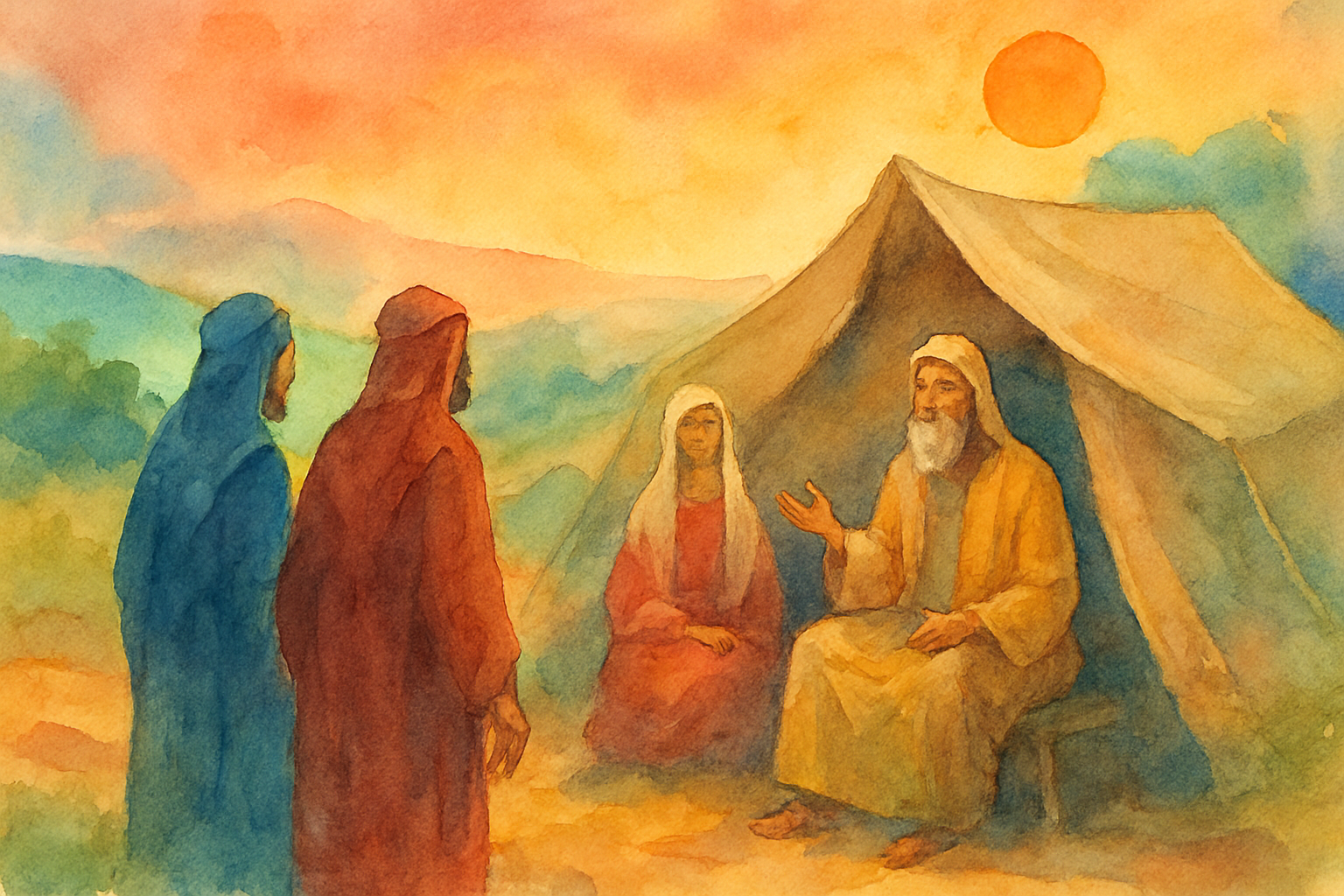
Avraham is sitting at the entrance of his tent. The sun beats down mercilessly on the plains of Mamre. Three people approach. Avraham, the exemplary host, will not let this opportunity pass. He runs towards them and invites them into his tent. Avraham and Sarah prepare a lavish meal. Sat and satiated under his tree, his guests give him some news:
They said to him, “Where is your wife Sarah?” And he said, “There, in the tent.” Then one said, “I will return to you next year, and your wife Sarah shall have a son!” Sarah was listening at the entrance of the tent, which was behind him. Now Avraham and Sarah were old, advanced in years; Sarah had stopped having periods like women. And Sarah laughed to herself, saying, “Now that I have aged, am I to have youthful flesh and my husband is elderly?!” Then God (י-ה-ו-ה) said to Avraham, “Why did Sarah laugh, saying, ‘Shall I really give birth for I have become old?’ Is anything too wondrous for God (י-ה-ו-ה)? I will return to you at the same season next year, and Sarah shall have a son.” Sarah lied, saying, “I did not laugh,” for she was frightened. And he said “No, You did laugh.” (Bereishit 18:9–15)
This story is remarkable in two ways: First, although it carries within it the heartwarming news that Avraham and Sarah will have a child of their own, yet there is nothing new in this news. Avraham, while receiving the command of the brit milah (Bereishit 17:1-27), had already been told that Sarah would bear him a child. Secondly, it comes to an awkward end: Sarah’s denial is rejected. She is told that she indeed laughed; nothing more is said. Yet, even the laughter at the end of this story seems to be a repetition of something we have heard before, only one chapter earlier:
And you shall no longer be called Avram, but your name shall be Avraham, for I make you the father of a multitude of nations… I will maintain My covenant between Me and you, and your offspring after you, as an everlasting covenant throughout their generations, to be God (א-ל-ו-ה-י-ם) to you and to your offspring after you… You shall circumcise the flesh of your foreskin… And God (א-ל-ו-ה-י-ם) said to Avraham, “As for your wife Sarai, you shall not call her Sarai, but her name shall be Sarah. I will bless her; indeed, I will give you a son through her… Avraham threw himself on his face and laughed, saying to himself, “Can a child be born to a man a hundred years old, or can Sarah, at ninety years old, give birth?!”… God (א-ל-ו-ה-י-ם) said, “Nevertheless, Sarah your wife shall bear you a son, and you shall name him Yitzhak; and I will maintain My covenant with him as an everlasting covenant for his offspring after him.” (Bereishit 17:2–19)
There is much overlap between these stories, and yet a few notable differences: First, in both stories, the couple is promised a child, but in the first, the initial revelation is made to Avraham alone. Second, in both stories, the person who receives the news laughs. Nevertheless, only Sarah’s laughter is criticized; Avraham’s is not. Third, in the earlier story, the role of Sarah is somewhat contorted: “I will give you a son through her” (v.16), “Sarah your wife shall bear you a son” (v.19), “whom Sarah shall bear to you at this season next year” (v.21). Sarah’s job in that chapter seems to be to present Avraham with a son and heir. Whereas, in this week’s parashah, she is the object of the news. The guests first ask where she is, before delivering the news. It is news for her. The child will be hers: “Sarah shall have a son” (v.10). Finally, and perhaps most profoundly, in this week’s parashah, the name used for God is י-ה-ו-ה, whereas in the earlier story, it is א-ל-ו-ה-י-ם. All of this begs the simple question: why two stories? What does the second one add that the first one lacked?
An answer can be found if we utilize an important principle: we must listen not only to what the Torah tells us, but also to how it tells it to us. Expanding that concept outward to life, tells us that we must notice not only what God gives us, but also how He gives it.
In the earlier story, God promises Avraham a child that will be the heir to his legacy. He is promised a son through whom the “ברית-covenant” that God made with Avraham will be continued. The entire theme and feel of the story is legacy: a continuation of God’s mission to man. Nonetheless, Sarah, obviously, would be overjoyed. This child would be hers; her lifelong dream would finally be fulfilled.
But for God, that was not enough. Sarah, a remarkable woman who had dedicated her life to kindness and spreading the word of God, deserved more. This quintessential Eshet Chayil (woman of valor), would not just have her prayers answered because it fitted with God’s continuity plan. She would be answered directly. What better place could there be for finally giving her the news of the arrival of the child she had longed for, for a lifetime, than in her tent, where she had always given to others? What better person to tell her the news than one of her thousands of guests?!
The earlier story is about the birth of Avraham’s heir; the second is about the birth of Sarah’s son. With this, we can understand not only the need for the second story but also the discrepancies between the stories. In the earlier story, Sarah’s role was to bear a successor to Avraham; in the later story, the son was for her. In the first story, Avraham’s laughter was appropriate for the moment. It is truly laughable for an one-hundred-year-old to have a child. It might well be laughable but it did not make a difference. If God’s plan is to make a person with a speech impediment His primary messenger, or give a child to a centenarian, so it will be. Laugh as much as you like. Yet, with Sarah, the laughter is out of place. Admittedly, some interpret this as a reproach to Sarah for insufficient faith in God, but perhaps an additional explanation can be suggested[1]: Sarah’s laughter is indeed out of place, but for a different reason: After ninety years of piety and prayer this news is deserved. It was a matter of merit, not of mirth.
This also explains the change in the name used to refer to God between the first story and the second. In the earlier story, the word א-ל-ו-ה-י-ם, “Elohim”, is used. This name is purely descriptive, depicting God as the unity of all powers. This name is often used when God is interacting with Man or the World in a universal, non-personal way[2]. When God is ensuring that Avraham will have descendants who will continue as God’s ambassadors to the world, this formal name of God is used. It is, for lack of a better term, His job description. In the second story, the word י-ה-ו-ה (the Tetragrammaton which we are not supposed to pronounce) is used. This is, so to speak, God’s personal name (this is why we cannot use it). It is the name used when He is interacting with Man from a personal perspective. Accordingly, in the second story, God’s blessing is coming to Sarah not because of some greater cosmic need to continue the Abrahamic mission. Rather, God is reaching out to her on a personal level, blessing her with her son.
This personal address to Sarah carries through, to the very moment that Yitzhak was born:
God (י-ה-ו-ה) remembered Sarah as promised, God (י-ה-ו-ה) did for Sarah what he had said.
Sarah conceived and bore a son to Abraham in his old age, at the set time of which God (א-ל-ו-ה-י-ם) had spoken. (Bereishit 21:1–2)
—
[1] See Targum Yonatan ben Uziel 18:15
וְכַּפְרַת שָׂרָה לְמֵימַר לָא תָּמִהִית אֲרוּם דְחִילַת וְאָמַר מַלְאָכָא לָא תְדַחֲלוּן אֲרוּם בְּקוּשְׁטָא גָחַכְתְּ
[2] See Kuzari 4:2-3