
"These fragments I have shored against my ruins"
A Name Remembered, a Death Disappeared: Gedeon Richter
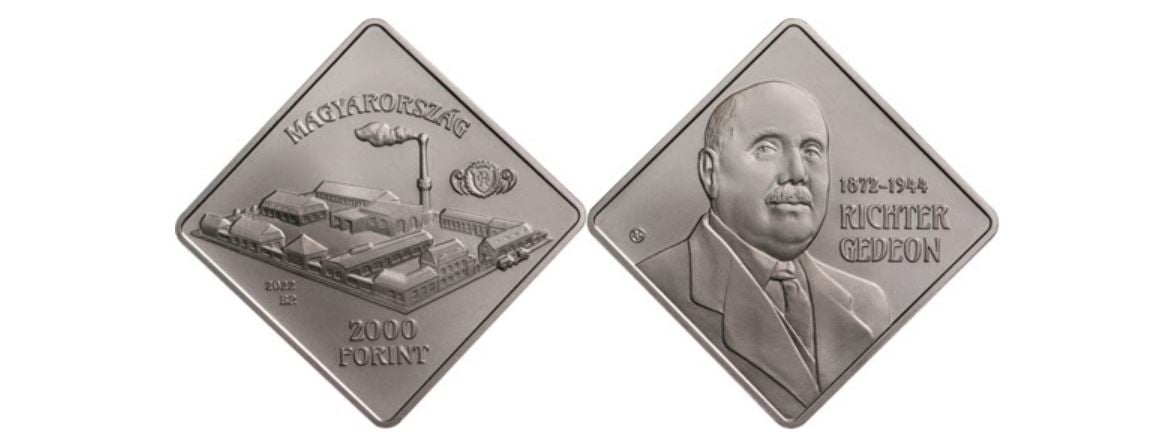
Commemorative coin issued by the Hungarian National Bank for the 150th anniversary of Gedeon Richter’s birth. (Publicly issued, reproduction permitted.)
Gedeon Richter’s name appears quietly, almost modestly, on medicine packets in pharmacies across the world. It is easy to take it for granted, to read it as a brand rather than as a life: a reassuring marker of pharmaceutical reliability, detached from biography. Yet behind the name was a Jewish orphan from rural Hungary who built an industry devoted to healing, and whose death, when it comes to be mentioned at all, is often reduced to a line of institutional understatement, as in the company’s own timeline: “1944: the founder’s death.”
That phrasing has always unsettled me.
On 30 December 1944, Richter was seventy-two years old. He was taken by Arrow Cross militiamen to the frozen bank of the Danube in Budapest, stripped naked in the dead of winter, bound, and shot into the river alongside his wife, Anna. His body was swallowed by the current, like those of thousands of others murdered there in those months — victims later evoked by the iron Shoes on the Danube memorial. We tend to think of those shoes as belonging to the nameless. Yet one of them belonged to a man whose name is still spoken daily, printed in small, familiar type on cardboard boxes.
Richter was born in 1872 in Ecséd, the son of Jewish parents whom he lost at an early age. He grew up an orphan in Gyöngyös, apprenticed as a pharmacist, and graduated with distinction from Budapest University in 1895. Like many ambitious young professionals of his generation, he travelled through Europe to learn from the most advanced laboratories of the time. In 1901 he purchased a small pharmacy on Üllői út; by 1907 he had founded Hungary’s first modern pharmaceutical factory in Kőbánya.
His trajectory became a national success story. Richter patented Kalmopyrin in 1912, a fever-reducing drug that became a household name, and later Hyperol disinfectant tablets, widely used during the First World War. By the time Europe entered the second, his company held dozens of patents and operated subsidiaries on five continents. He was not only an industrialist but a philanthropist, supplying medicines and insisting that production continue during the sieges and shortages of two wars.
None of this protected him.
Hungary’s Jewish Laws stripped Richter of his position as CEO in 1942, though he continued to direct the company illegally from his home. In July 1943, the papal nuncio Angelo Rotta visited the factory to convey Pope Pius XII’s thanks for Richter’s humanitarian efforts. The event later commemorated by a marble plaque that was subsequently smashed as an “undesirable clerical manifestation.” The sequence is telling: gratitude, followed by erasure.
After the German occupation of Hungary in March 1944, opportunities to escape did present themselves. The International Red Cross issued a safe-conduct letter for Switzerland; the head of the company’s Mexican subsidiary transferred a substantial sum to secure travel papers to Geneva. Richter refused to leave. He could not abandon his factory, or the country he believed he had served faithfully for decades. Raoul Wallenberg placed him and his wife in a so-called “protected house” in Budapest, but they were captured by Arrow Cross militiamen. The papers remained unused.
It is tempting, with hindsight, to read this refusal as tragic misjudgement. His assumption, though, was no folly; it was the assimilated Jew’s quiet compact with the world. It was a logic encouraged by the very societies that later disavowed it. Richter’s life had been built on the assumption — widely shared by assimilated Central European Jews — that usefulness, loyalty and contribution could amount to belonging. If he had cured fevers, disinfected wounds, sustained the nation through war, surely that would count for something. How often must a Jew prove his place before the very demand for proof becomes a trap? Richter’s fate exposes the lie at the heart of this bargain: that service confers safety, that usefulness will be repaid with protection.
The Shoes on the Danube memorial has become one of Budapest’s most visited sites, a powerful symbol of the 10,000 to 20,000 Jews murdered openly along the riverbank, sometimes wired together to save bullets. The anonymity of the shoes is part of their force. And yet Richter’s death unsettles that anonymity. His passing was not a gentle fading in old age, as corporate timelines might suggest, but a public humiliation and execution: a seventy-two-year-old man forced to undress in freezing temperatures before being shot into the river. His devotion to his country bought him neither safety nor recognition; only disappearance.
Today, Richter Gedeon Plc is a global pharmaceutical company, its official history a smooth chronology of innovation and growth. I do not doubt the sincerity of its pride in its founder. Still, I find myself wondering what it means to preserve a name while evacuating the manner of a death. When language becomes too careful, too hygienic, it does not merely soften violence; it obscures it. Today, the same impulse shapes many institutional narratives of the Holocaust, where death is archived but rarely described.
Richter’s medicines continue to circulate, alleviating pain, lowering fevers, extending lives. And yet the circumstances of his murder remain curiously easy to sidestep. Societies are adept at retaining what is useful — patents, pills, progress — while allowing the human cost to sink quietly out of sight.
Richter’s name still heals. His body lies somewhere in the Danube. Between the two stretches an unease that no timeline can resolve, only acknowledge.
Related Topics