
A Name That Came Back From Exile, on Elul
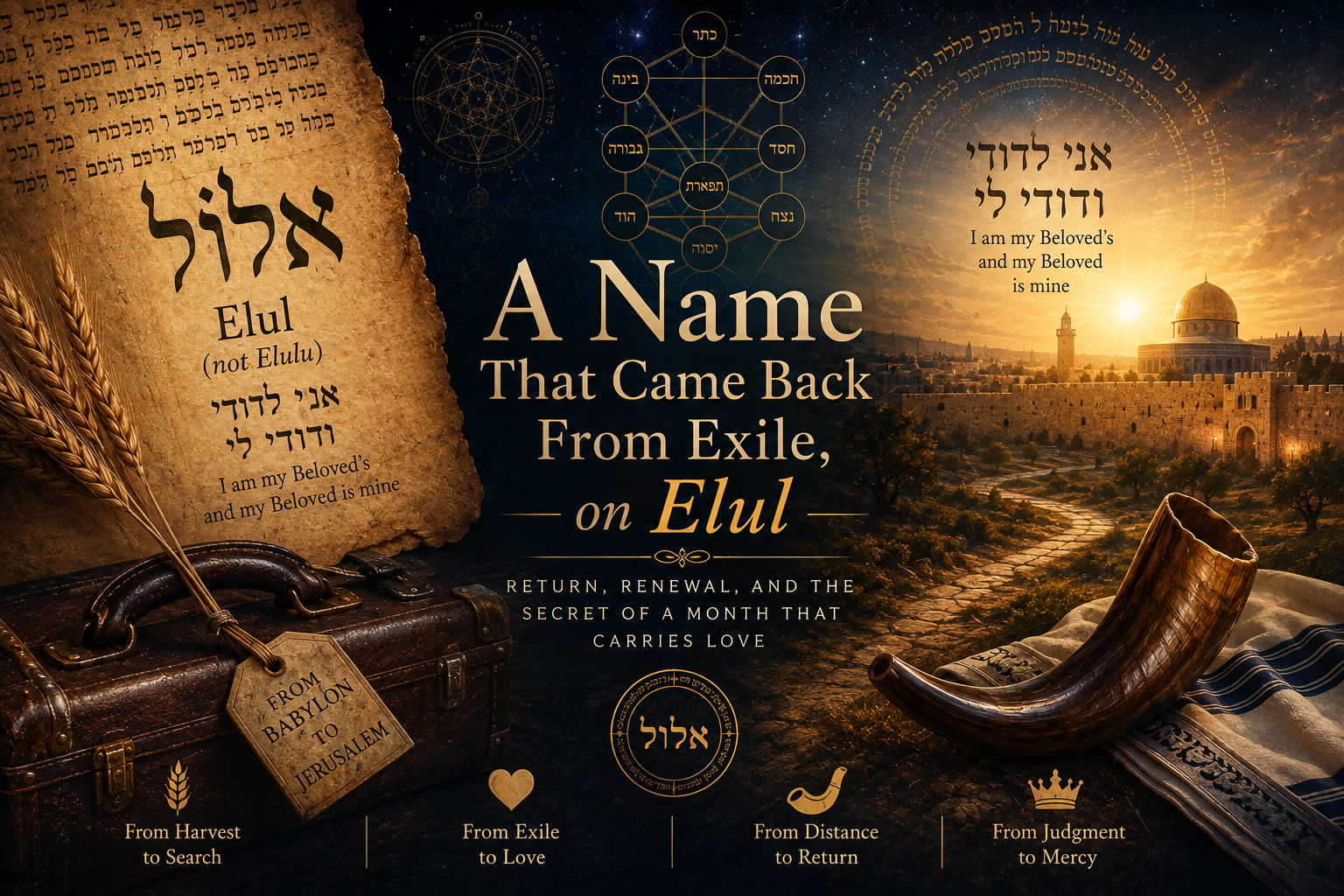
Most of the time, saying a month’s name, we don’t think about what it carries inside it, we just say it and move on. This year, saying Elul, I stopped. And stopping, I saw that the word itself, like us, had made a journey.
It isn’t Hebrew, this name. Its root sits in Babylon, elūlu, meaning harvest. In the Torah’s own pages, months carry no name at all, only a number, the first month, the sixth month, bare, silent. When the Israelites fell into exile, they carried a foreign land’s month names back with them, without noticing. Elul is one of them, a relic of exile, like something left in a suitcase and only found later. Even the place it first appears under this name in scripture says as much, in Nehemiah, written after the exile, while the walls of Jerusalem were being rebuilt.
But a word, once it falls into exile, doesn’t just stay there. In Aramaic, the same root began saying something else too, to search, to investigate. The verb used for the spies searching the land of Canaan comes from this same root. As though the word, stepping out of the harvest field, went looking for something too, searching for its own meaning.
Then the rabbis came. Centuries later, in the fourteenth century, they wanted to bring this foreign sound back home. They looked at the four letters, aleph lamed vav lamed, and saw a sentence there, Ani LeDodi VeDodi Li, I am my Beloved’s and my Beloved is mine. I don’t think this was chance, I think it was insistence. An insistence on taking a foreign sound and giving it a new birth inside love. The word had carried harvest, land, Babylon. They rewrote it to carry love, return, Hashem.
I stop here, because I notice that what happened to the word on its own is exactly what’s asked of us. Something went into exile, stayed foreign, and was later brought back and made holy again. Teshuvah means return. And this word, before it gave us its meaning, had to make an actual return itself, from Babylon to Jerusalem, from a field to a declaration of love.
Passing through a field, I don’t think, is a coincidence either. The Alter Rebbe, founder of Chabad, tells a parable in Likkutei Torah for Elul. Normally a king can only be approached in his palace, through protocol, with permission granted. But when a king is on his way back to his city, his people go out to greet him in the field outside the city walls, and in that moment anyone can approach him, and the king receives everyone with the same smile, making no distinctions. Elul, the teachers say, is that king in the field. On Rosh Hashanah the king returns to his palace, to the seat of judgment, but through Elul, he is in the field, and no one stands far from him. The word’s own history passed through a field too, in a way, out of a harvest’s soil, first through Aramaic’s open country, and then back into the rabbis’ garden, into its own palace.
There’s one more question, one almost no one asks. If the first letters of Ani LeDodi VeDodi Li spell Elul, what do the last letters spell. I looked, and found four yuds staring back. The value of four yuds is forty, exactly the number of days Elul carries until Rosh Hashanah. The word’s beginning speaks of a lack, a search. Its ending closes as though we’d never been apart, the same letter repeating four times.
None of these shifts in name hang in empty air. This month asks for the hand too. Psalm 27 is added to morning and evening prayer, the one that opens LeDavid, Hashem Ori VeYish’i, of David, Hashem is my light and my salvation. Mateh Ephraim, written by the Galician rabbi Ephraim Zalman Margolioth in the early nineteenth century, advises checking tefillin and mezuzot this month, so a small tear, a faded letter, doesn’t go unnoticed. Tzedakah increases. Where a bond has broken, forgiveness is asked. Loved ones’ graves are visited. Thinking isn’t enough, tradition insists on this, thinking about asking forgiveness isn’t an apology, thinking about generosity isn’t generosity.
The month right after Elul carries the same origin too, Tishrei, from Babylon’s tashritu, meaning beginning. So the end of a harvest and the name of a beginning stood side by side for the Babylonians as well. The turn we now attach to Rosh Hashanah carries, it seems, the rhythm of a much older field, one we’ve inherited without noticing.
Thinking about this, a study came to mind that has nothing to do with religion. In 2014, a group of researchers at Wharton published a study showing that calendar landmarks move people to act, something they called the fresh start effect. At the start of a new week, a new month, people held onto their goals more tightly. One of the researchers put it this way, these landmarks leave past failures to the “old you,” and hand the time ahead to the “new you.” Elul already knew this, thousands of years earlier. And the word itself carries that same divide, between an old identity and one reclaimed, inside its own body.
Now, every morning through Elul, knowing that a shofar is sounding somewhere, this is what I think. If even a word can go into exile and come back, maybe what we call return isn’t inventing something new at all. Maybe it’s only renaming what we already had, going over it again, and settling whatever debt is still owed.