A Naval Officer Invented the Middle East. We Still Live Inside His Map.
“If you don’t know where you’re going, you’ll end up someplace else.” — Yogi Berra
In September 1902, a retired American naval captain named Alfred Thayer Mahan published an essay in a London monthly about how Britain might keep Russia away from warm-water ports and protect the sea passage to India. Buried in it is one of the more consequential parentheses of the twentieth century. He wrote of “the Middle East, if I may adopt a term which I have not seen.”
He was not describing a culture, a history, or a people. He was describing a coaling problem. And the term he coined had no content of its own: it meant east of Britain, and between a Near East that was Ottoman and a Far East that was Chinese. Half a billion people now live inside a name that only parses if you are looking at a map from Whitehall.
Names invented for logistics do not stay in logistics. After 1918, the phrase absorbed the collapse of the Ottoman Empire, the discovery of oil, and the mandate system. After 1945 it acquired populations, flags, and eventually seats at the United Nations. Then it inflated. In 1957 John Foster Dulles used it to cover everything from Libya to Pakistan, plus Sudan and Ethiopia. By 2004 Washington had stretched it further still. A phrase invented to describe a shipping route had become the name of a civilization — and, more consequentially, the unit in which every subsequent plan for the region would be written.
Here is what that unit cost. Countries trade with their neighbors: 63 percent of European Union trade is internal. In the Middle East the figure is somewhere between 9 and 17 percent, the lowest of any major region on earth — and this in a place whose cities were trading with each other for three thousand years before anyone drew a border through them. The region did not arrive at that number naturally. It was engineered there, one frontier at a time, by a century that organized space around sovereignty instead of exchange.
Both of the great peace projects of the last thirty years accepted that unit without noticing. Oslo worked from the inside out: settle the hardest conflict first, and the region follows. The Abraham Accords worked from the outside in: build regional relationships first, and their accumulated weight eventually unlocks the hardest conflict. The inversion was real and it was brave. But the currency was identical. Both counted states. Both used treaties as the instrument. And both assumed that economics is what happens after politics succeeds.
Six years on from the Accords, that assumption has a scoreboard. RAND estimated normalization could produce more than five million jobs and a trillion dollars of activity within a decade. The Abraham Fund, meant to carry three billion American dollars and ten billion from the signatories, was never appropriated and has sat frozen since 2021 — behind the pandemic first, then behind the wars. Meanwhile the region’s own sovereign wealth funds manage something above four trillion dollars, of which roughly nine percent is invested inside the region. That last number is not a symptom of poverty or of war. It is a daily verdict, rendered by the people with the most money and the most local knowledge, that their own neighborhood is not investable.
The best account I know of how a region talks itself into that verdict is a Marx Brothers film. In Duck Soup, Rufus T. Firefly talks himself into a fury imagining that the ambassador of a neighboring state will refuse to shake his hand. He rehearses the insult. He works up the appropriate outrage. Then the ambassador walks in with his hand extended — and Firefly slaps him. Two countries go to war over a snub that never occurred.
I have sat in enough rooms to find this less funny than it used to be. A great deal of what the region calls strategy is Firefly’s rehearsal: elaborate preparation for an insult that has not yet been offered, conducted with such conviction that the insult eventually becomes unnecessary. And when someone points at the freight, the water, the electricity and the labor actually crossing these borders every week, the reply is the other great line of that film — Chico, caught red-handed, asking whether you’re going to believe him or your own eyes.
So look at what the eyes see. Israeli and international technology investment in Ramallah generates over ten percent of West Bank GDP. Israel and Jordan have a fifteen-billion-dollar gas contract, and a water-for-electricity swap in which Jordanian solar crosses one way and Israeli desalinated water the other. Qualified industrial zones with Egypt and Jordan move hundreds of millions of dollars in exports a year. Even through the worst of the past three years, Israel’s finance ministry restructured more than half a billion dollars of Palestinian electricity debt to enable grid reform. None of this required a comprehensive settlement. All of it happened while the official map insisted it could not.
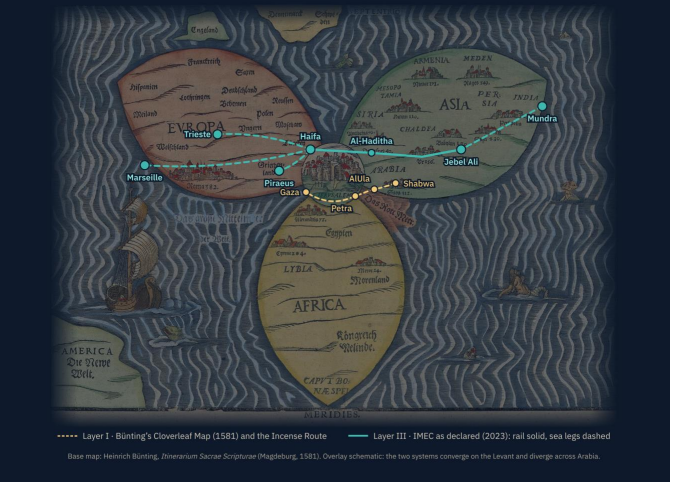
And then, in September 2023, the India–Middle East–Europe Economic Corridor (IMEC) was announced at the G20 — roughly a month before 7 October. It is tempting to read the timing as the plan’s obituary. I read it as the plan’s argument. IMEC is the first regional framework in a century that does not count states. It counts nodes: ports, rail heads, border posts, data pipes, grid interconnections, each a separately financeable asset with its own sponsor and its own timetable. Drawn on a map it looks like a line between two harbors. Built, it is roughly a hundred and twenty investable projects. A line collects a toll. A network creates an economy.
That modularity is the whole point, because it lowers the price of the next increment of cooperation from a comprehensive peace to a single financeable link. The corridor also, not incidentally, retraces the Incense Route, the Via Maris and the King’s Highway almost exactly — because the geography that made those routes efficient has not moved.
I want to be careful here, because there is a real objection. Corridor talk can become a way of not discussing this ongoing war, sovereignty, occupation, October 7, and any version of this argument that promises infrastructure will dissolve those questions deserves the contempt it gets. It won’t. Rail does not adjudicate Jerusalem, end terrorism, and pogroms. What corridors do is different and more modest: they build things expensive enough that destroying them becomes irrational, and they let cooperation begin at the segments where it is possible instead of waiting at the segment where it is not. Nobody has to want failure for failure to be the equilibrium — they only need more people invested in the problem than in the solution. The corridor changes that arithmetic.
The Middle East, as a category, remains perfectly useful for one job: measuring the damage a century of thinking in that category produced. It is useless for designing what comes after. That requires different units — nodes, corridors, city-regions — and a different sequence, in which economic interdependence is not the reward for peace but the material peace is built from.
Berra’s line is usually told as a joke. It isn’t one. We have spent a hundred and twenty years navigating by a name a naval officer invented for a coaling problem, and we have ended up someplace else.
_______________________________________________________________
Glenn Yago is Senior Director of the Milken Innovation Center at the Van Leer Jerusalem Institute and founder of the Financial Innovations Lab at the Milken Institute. He teaches at Hebrew Universiy of Jerusalem and the University of California-Berkeley. This article is based on his presentation at the Van Leer Institute Research Conference on Israel in the Middle East from a Comparative Perspective, October 26, 2026 and recently published policy brief: Back to the Future: The return of the Corridor and the Eastern Mediterranean as a Transcontinental Growth Hub.