
A New Middle East Architecture: Trump, MBS, and the Road to Normalization
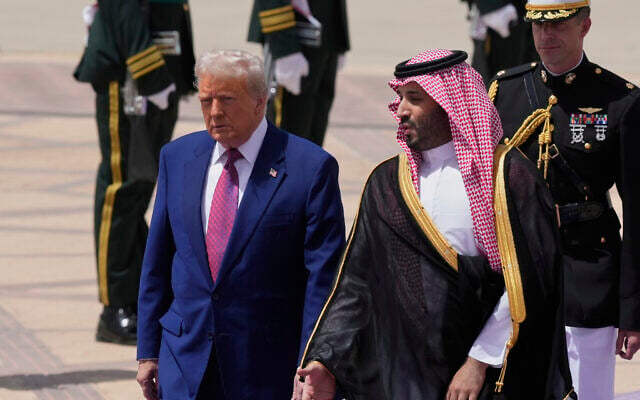
Right now, the Middle East is undergoing a transformation at a pace not witnessed in many years. President Donald Trump’s assertion that Saudi Arabia is on the verge of joining the Abraham Accords—potentially “very shortly”—cuts through the surrounding speculation and signals a dramatic turning point. If this bold move comes to fruition, it would be nothing short of historic.
Speaking aboard Air Force One, Trump radiated confidence: he suggested Riyadh is prepared to formalize a relationship with Israel that has, for years, existed unofficially, with quiet but consistent collaboration beneath the surface. Trump is preparing to welcome Crown Prince Mohammed bin Salman to the White House, where the two are expected to sign significant economic and defense agreements—a step that could fundamentally reshape the region’s diplomatic landscape and alter the balance of alliances for years to come.
“The Abraham Accords will be a part we’re going to be discussing,” Trump said Friday. “I hope that Saudi Arabia will be going into the Abraham Accords fairly shortly.”
Trump didn’t mince words: “The Abraham Accords will be a part we’re going to be discussing,” he told reporters. “I hope that Saudi Arabia will be going into the Abraham Accords fairly shortly.” As Air Force One climbed into the sky en route to Florida, he added, “We’re more than meeting. We’re honoring Saudi Arabia, the Crown Prince.” This language suggests more than just a standard diplomatic summit; it’s a signal of intent to forge a deeper partnership and set a new regional precedent.
“We’re more than meeting,” Trump said as he flew to Florida for the weekend. “We’re honoring Saudi Arabia, the Crown Prince.”
The possibility of Saudi Arabia joining the Accords comes at a time when the United States is reasserting its influence in the region with unmistakable force. After US-Israeli strikes in June dealt a decisive blow to Iran’s nuclear ambitions—Trump even went so far as to claim they had “put Iran out of business”—the strategic calculations in the Gulf shifted rapidly. Gulf states are increasingly viewing cooperation with Washington and Jerusalem not as a risky bet, but as a rational and forward-thinking strategy. For Trump, this summit is far more than a photo opportunity. He regards Saudi Arabia as the linchpin of a new Middle Eastern order—one that he is determined to cement before old patterns can reassert themselves.
The defense dimension throws this realignment into stark relief. Trump has been forthright about Saudi Arabia’s interest in acquiring F-35 stealth fighters—a move that would deepen US-Saudi military ties and send a clear signal that Washington is committed to helping its partners maintain a technological edge over Iran. “They wanna buy a lot of jets,” Trump remarked, leaving no room for ambiguity. Should Saudi Arabia both join the Accords and obtain these advanced weapons, it would solidify its position as a stabilizing force in the Middle East and further intertwine its security interests with those of the United States and Israel.
This is not merely the perspective from Washington’s corridors of power. Faisal J. Abbas, a well-known Saudi commentator, underscores that the US-Saudi relationship has endured regardless of ideological shifts, wars, or changes in leadership. The fundamental rationale behind the partnership remains intact. Whether opposing communism during the Cold War or collaborating to expel Saddam Hussein from Kuwait, Riyadh and Washington have consistently found common ground in moments of strategic necessity.
He writes: President Trump, known for his “art of the deal,” is not one to let bureaucracy stifle progress. His administration’s openness to fair competition means American firms can engage without being hamstrung by red tape. This is good news for both sides — and for global investors watching closely.
Saudi Arabia’s role surpasses that of a financial backer for the West; it serves as a geopolitical anchor. As the custodian of Islam’s holiest sites, the largest economy in the Arab world, and a dominant player in global energy markets, Saudi Arabia is irreplaceable in its influence and stature.
Saudi diplomacy is also evolving. The Kingdom has pushed for a two-state solution in Palestine, condemned atrocities in Gaza and facilitated negotiations in Sudan, Ukraine and Syria. Its humanitarian aid and development contributions are generous and consistent. Riyadh is no longer just a regional actor — it is a global mediator.
The US needs a partner that commands respect in the region. Saudi Arabia fits that role. Whether it is lifting sanctions or brokering peace, American policymakers know that Riyadh’s guarantees carry weight. The emergence of a new Syria — after decades of turmoil — is testament to that influence.
This visit is not ceremonial. It is consequential. If Israel is ready to commit to a serious path toward Palestinian statehood, it could join what the crown prince calls “the new Europe” — a region of integration, cooperation and shared prosperity. The stakes are high. The opportunity is rare. And the moment is now.
Faisal J. Abbas suggests that if progress is made on this front, the crown prince envisions a Middle East that could emulate Europe’s integration and prosperity—breaking out of the cycle of conflict that has long defined the region. Such a vision would mark a dramatic departure from the past, offering the promise of a new era defined by cooperation and shared growth rather than rivalry and unrest.
Trump in recent weeks has predicted that once Saudi Arabia signs on to the accords, “everybody” in the Arab world “goes in.” He has asserted that the Saudis will join, given that the Gaza ceasefire is holding.
“We have a lot of people joining now the Abraham Accords, and hopefully we’re going to get Saudi Arabia very soon,” Trump said in a speech to business leaders this month where Princess Reema Bandar Al Saud, Saudi Arabia’s ambassador to Washington, was a special guest.
However, Israel’s government is not budging when it comes to the idea of a Palestinian state. Foreign Minister Gideon Sa’ar spelled it out: Israel won’t agree to what he calls a “Palestinian terror state” right in the middle of its own territory. He warned that putting such a state so close to Israeli cities would be dangerous and hand the Palestinians a strong strategic position.
Defense Minister Israel Katz took the same line. He said, flat-out, that Israel’s policy is simple—a Palestinian state just isn’t happening. Speaking about Gaza, he laid out the government’s security goals: the area has to be fully demilitarized. That means all the tunnels go, Hamas gets disarmed, and this happens either by the Israeli military or, maybe down the road, by some international force. Katz also made it clear that Israeli troops will stay put on Mount Hermon and in the Syrian security zone, especially after the Assad regime’s fall.
National Security Minister Itamar Ben-Gvir, was not shy either. He said he wouldn’t stick around in any government that allowed Palestinian statehood “in any form.” He even took to social media, pushing the prime minister to say, once and for all, that a Palestinian state is off the table. Ben-Gvir went further, saying there’s no real historical or factual basis for a Palestinian people—he described them as scattered migrants instead of a nation. For him, the only way forward for Gaza is encouraging voluntary emigration, not what he calls handing out “a reward state for terror.”
Still, there’s real hope here. If the F-35 sale, the nuclear deal, and the bigger push for normalization actually happen, what is on the table now is a rare and fleeting opportunity. For perhaps the first time in decades, Washington, Riyadh, and Jerusalem all have tangible, overlapping interests that encourage them to work together just as the old regional order is unraveling. Trump’s certainty may well be warranted—if Saudi Arabia does join the Accords, it won’t be a mere gesture for international audiences. It would represent a fundamental reconfiguration of the Middle East’s balance of power, born not from idealistic sentiment but from a pragmatic recognition that entrenched rivalries no longer serve anyone’s interests.
The region now stands at a crossroads, with the possibility for genuine, lasting peace closer than it has been in a generation. Whether this potential is realized will depend on the willingness of the region’s leaders to move beyond the past and seize the historic moment before them—choosing cooperation and innovation over division and stagnation. The world is watching to see if, this time, the leaders of the Middle East are prepared to grasp the opportunity and transform their shared future.