
The Strategy Is to Provoke Iran’s Implosion
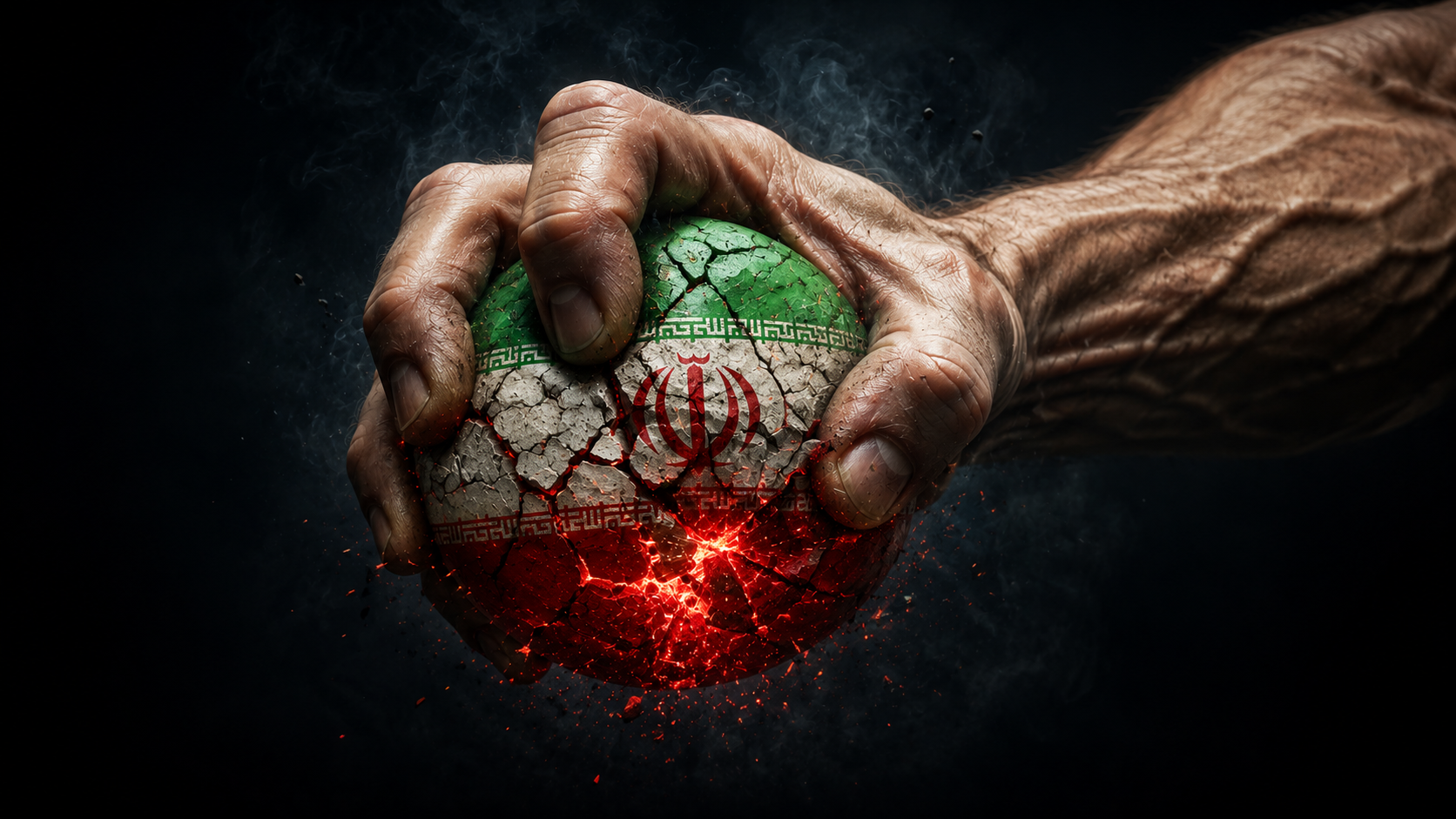
Implosion: the violent collapse of a body inward upon itself, occurring when external pressure exceeds the pressure within. The opposite of an explosion, which bursts outward.
On June 4, 2026, President Trump told reporters that the United States could seize Iran’s enriched uranium whenever it wished, and then said there was no reason to, because the material was “entombed.”
Days earlier he had stated that Washington “will get” that uranium and that a deal might come by the weekend, even as Tehran denied any progress. The statements do not reconcile, and the tone throughout has been unhurried, read by some as detachment from a war that has not ended.
The calm is better understood as method. The strategy behind it does not require bombing Iran into submission. It requires letting the country collapse from within, under a blockade that drains the economy while the cost to the United States stays low and, in the case of oil, turns to profit.
The aim is implosion rather than explosion, and the pressure is meant to be calibrated, economic first, then social, then political, and military only if the rest fails. Whether it works rests on two assumptions that neither Washington nor anyone else can fully verify.
The bet on implosion
The strategy applies economic pressure until one of two outcomes occurs. Either the regime capitulates, surrenders its enriched uranium, and reopens the Strait of Hormuz, which remains unlikely, or it commits a miscalculation grave enough to justify a wider response.
As long as Iran refuses to yield, the United States need do nothing but hold the blockade in place, and the implosion advances on its own. The burden of action rests on Tehran, while Washington waits at a cost it can sustain.
The aim is to drive that implosion as deep as it will go, through the economy, through society, and into the foundations of the state, until the regime is too weak to do anything but yield. It could yield in one of two ways, by handing its uranium to the United States, or by diluting its 440 kilograms of 60 percent stockpile down to reactor-grade levels in full view of the IAEA, the United States, Israel, and the rest of the world.
And if Tehran chose war instead, the implosion would still have done its work, because a regime cracked to its foundations is far easier to reduce to rubble when it lashes out than one confronted at full strength.
Trump has framed the present phase in those terms, saying that a ground operation to recover the uranium would come later and that Iranian defenses must be degraded first. The pressure is therefore both an end and a preparation, which makes it useful on either road.
Ambiguity is part of the method. The President alternates between predicting a deal and warning of force, and the effect is to hold Tehran in a suspense that keeps the rial from finding a floor while revealing nothing firm about American intentions. The same calculated optimism moves the oil market, since prices ease when his statements suggest progress.
By the standards of war the approach is inexpensive, requiring no occupation, no ground casualties, and no reconstruction, and it has produced revenue. With Iranian and Gulf supply disrupted, the United States exported crude at record levels in April, reaching 6.4 million barrels a day, and the President has said openly that higher oil prices benefit the country.
The siege on Hormuz
The pressure operates through a single American blockade. Iran began by closing the Strait of Hormuz on a selective basis, moving the shipping lanes closer to its coast, charging tolls, and allowing through the vessels that served its interests, chiefly its own oil bound for China. For a time the move even paid.
With Brent above 103 dollars, Iran earned roughly nine billion dollars over the forty days before April 13, when the United States Navy began preventing ships that had docked at Iranian ports from leaving through the strait. The second jaw of the vise closed on Iran’s own ports.
What moves through Hormuz is not only oil leaving the country. More than ninety percent of Iran’s trade passes through it, including the bulk food Iran cannot grow for itself. Grain, rice, cooking oil, animal feed, soybeans, and corn arrive at the deep-water terminals of Bandar Abbas and Bandar Imam Khomeini, alongside the machinery and manufactured goods that come mainly from China.
The blockade therefore tightens at both ends, cutting the revenue that flows out and the staples that flow in, and by May Iran’s storage for exports was approaching the point at which it would have to cut production of its only major source of foreign currency.
The four faces of the collapse
The economic damage is measurable. The International Monetary Fund projects a contraction of 6.1 percent for 2026 and inflation near 69 percent, with point-to-point readings reaching 73.5 percent by late April and food inflation above 100 percent.
The rial trades on the street between 1.6 and 1.7 million to the dollar, and the government has issued the largest banknote in its history, worth about seven dollars.
The social effect follows. The World Food Programme reports that the central problem has shifted from supply to the collapse of purchasing power, with a minimum wage near 149 dollars a month against a basic food basket that costs 22 dollars for less than a week.
Households have descended a protein ladder, abandoning red meat, then poultry, then eggs, and the evidence indicates that real food consumption per capita has been falling even as prices climb. More than a million jobs have been lost since the war began.
The political layer may decide the outcome. High inflation already produced mass protests in December and January and the resignation of the central bank governor.
As hunger spreads, that discontent could return in a stronger form, and sustained unrest would weaken the regime from within in a way no airstrike could. The military layer is the unstable one.
On June 2, Iran struck United States bases in Kuwait and Bahrain and a vessel near the strait, killing an Indian national and injuring more than sixty at Kuwait’s airport, which Tehran framed as retaliation for an American strike on a tanker bound for an Iranian port. A blockade is itself an act of sustained force, and the hand that maintains it is being burned as it squeezes.
The uranium and the gamble
The strategy rests on two assumptions, and both lie in shadow. The first is that the regime is rational, that it will yield before it destroys itself. The choice of a siege over a direct strike is itself evidence that Washington and Jerusalem believe this, since a government judged to be suicidal would be disarmed rather than squeezed.
Iran has tolerated harsh sanctions for decades, which argues for endurance, while a minority view points to an apocalyptic strand in its leadership that pressure could render less predictable.
The second assumption concerns the bomb, and the location of the material matters.
The IAEA assesses that much of Iran’s 440.9 kilograms of 60 percent uranium sits in the tunnels of the Isfahan complex, where it was moved before the 2025 strikes, which means the enrichment halls at Natanz and Fordow were likely empty when the bombs fell rather than holding the material in their wreckage. The strikes sealed the Isfahan tunnels beneath the ground, yet the stockpile appears intact, and satellite imagery shows Iran excavating to recover it.
Trump’s claim that the stockpile is entombed sits against his own intelligence, which holds that Iran can reach it. Converting that material to weapons grade would take weeks if functioning centrifuge cascades survive, while a deliverable weapon would take months or longer, and every estimate is conditional.
Much of Natanz was destroyed, yet Fordow, buried deep, may retain its centrifuges, and Iran terminated IAEA access on February 28, removing the cameras and seals that would reveal whether covert enrichment continues. Israeli and American intelligence has penetrated the program before, yet even capable services have been wrong, as Iraq showed. The clock is read in the dark.
The coordinated trigger
The economic campaign coexists with a military option held in reserve. The United States and Israel struck Iran’s nuclear sites together in 2025 and again in February, and the forces that would resume the war appear to remain in position across the region.
Israel maintains the Begin Doctrine, applied at Osirak in 1981 and in Syria in 2007, of destroying an enemy’s nuclear capability before it matures, and would act alone if it judged the threat existential. The clearest evidence of coordination is Israeli restraint, since Israel has both the capability and the motive to strike and has held to the ceasefire while the blockade does its work.
Trump has confirmed that he weighed a ground raid to seize the uranium at the start of the war and chose not to launch it, citing the risk to American forces, which shows the present restraint to be a choice rather than an inability.
Conclusion
The strategy is to compress Iran until it yields or errs, at a cost the United States can bear and Iran cannot, and to do so with enough precision that the implosion does not become an explosion. The data show the compression working, in the currency, in the inflation, and in the emptying table, while the burns on the hand that squeezes, Kuwait among them, show how fine the margin is. From here the roads fork.
Renewed and stronger protests could hollow out the regime, and a government that feels itself dying may lash out at the Gulf states or at Israel, an incentive that grows with time, since resuming the war after a week of blockade is not the same proposition as resuming it after months of compounding ruin.
The opposite is also possible, since an Iran weakened from within would be an easier target for a decisive blow or for an operation to seize the uranium at Isfahan. The same time that softens Iran, however, also lets it work to recover that stockpile and runs the nuclear clock.
What remains unknown is the reach of all this, whether the grip holds longer than a resilient adversary can endure, and whether the economy breaks before the nuclear bomb arrives. And even if the regime does implode, what would rise in its place cannot be known. Those answers lie in shadows no analyst can reach, and they will tell, more clearly than any statement, whether the strategy ends in the implosion it was built to produce or in the explosion it was meant to prevent.