Author of historical and contemporary novels
Featured Post
A pocket guide to defiance
Hidden in the pages of a World War II air-raid manual lies a mystery -- and a daring testimony about brutality and betrayal on the shores of the Holy Land
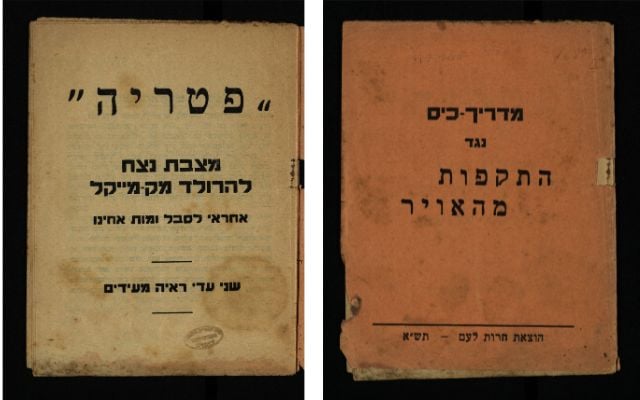
A Pocket Guide Against Air-Raid Attacks -- cover and title page (National Library of Israel - Public Domain)
This small, plain-covered book with the title A Pocket Guide Against Air-Raid Attacks was published in the Hebrew year of 5701, between 1940 and 1941. On the surface, it’s unremarkable. This was the middle of World War II, and recent events had made such a guide necessary.
The skies over the Land of Israel were no longer safe. In the summer of 1940, residents of Haifa heard air raid sirens for the first time. A sound that would become familiar to generations of Israelis in the decades that followed. As it sadly does to this day.
Italy, under Mussolini and allied with Nazi Germany, had entered the war in June 1940. Within weeks, Italian bombers began targeting British-controlled Mandatory Palestine.
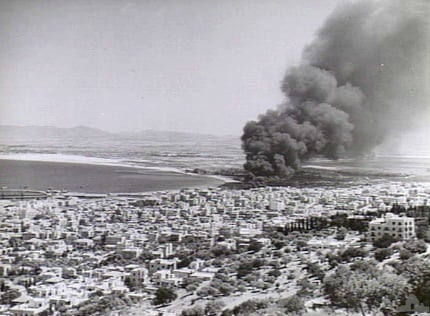
On 15 July 1940, five Italian bombers struck installations in Haifa, setting fire to three oil storage tanks and damaging one of the city’s power stations. One Arab civilian was killed.
Ten Italian bombers returned on 24 July, dropping 50 bombs on eastern Haifa and its oil infrastructure, starting huge fires and blocking the refinery’s production for almost a month. Twenty-eight Arabs, 15 Jewish civilians and a British police officer were killed.
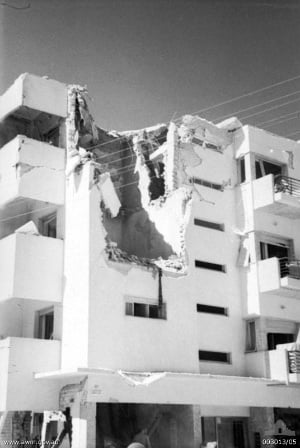
Between August and early September, four further raids on Haifa caused little damage and no casualties. Then, on 9 September, six bombers flying from Rhodes intended to strike Haifa once more – but British fighter aircraft turned them back. The bombers redirected towards Tel Aviv, aiming for the port, but instead struck residential areas. One hundred and seventeen Jewish civilians were killed, along with seven Arab civilians and one Australian soldier. One Italian bomber was shot down.
Within this context, a civilian air raid guide would have made perfect sense. But on closer inspection, this book is not what it first appears to be.
One clue is in the publisher’s name printed at the bottom of the cover: Cherut L’Am – Freedom for the People. No evidence exists of a legitimate publishing house by that name in 1940 or 1941. Almost certainly, it was fictitious. A name chosen deliberately as a statement of defiance.
A deliberate deception
Open the book and the title page tells a completely different story.
Patria
An eternal monument to Harold McMichael
Responsible for the suffering and death of our brothers
Two eyewitnesses testify
This was not an air raid guide. The title was a deliberate ruse, designed to evade British censorship and protect those responsible for its publication.
I discovered this book at the National Library of Israel while researching my latest novel, Another Shore. The novel is based on the true story of the SS Atlantic, carrying 1,800 Jewish refugees who arrived in Haifa Bay in November 1940 after a three-month journey fleeing Nazi-occupied Europe, hoping to find safety in Eretz Israel. Instead of permission to disembark, the British announced they were to be transferred to the SS Patria for temporary quarantine before being deported to Mauritius. Was it really quarantine – or was this deception? And then, the following morning, tragedy struck.
The paramilitary Haganah group, which opposed the deportation, planted a bomb intended to disable the ship and prevent it from leaving Haifa. However, the bomb blew the frame off one side of the ship, and it sank in about 15 minutes, killing 267 people and injuring 172. The British allowed the survivors to remain in the country.
The Patria disaster and the subsequent events at the Atlit Detention Camp are two of the pivotal moments in the novel. And here, in this disguised little book, were the voices of two people who witnessed both.
Harold McMichael was at the time the British High Commissioner for Mandatory Palestine. The word “monument” was not chosen to honor him. It was chosen to hold him accountable.
Their testimony relates what took place on the Patria, and later at the Atlit Detention Camp. The betrayal. The brutality. Visited upon Jewish refugees who had fled persecution and the horrors of the Shoah, seeking safety in their ancestral homeland.
This little book was largely forgotten. Between its plain covers, it holds an extraordinary secret – voices that could not be silenced.
Alongside many other testimonies, diaries, and oral accounts, their words helped shape characters in my novel. These two anonymous witnesses recorded what they had seen at great personal risk. They bore witness so that their story would not be forgotten.
In an age when the history of this period is increasingly contested and distorted, that feels more important than ever.
Their names are lost. Their words are not.
Related Topics
Related Posts