Jewish values, leadership, and honest conversation
Featured Post
A rabbi and a shofar walk into a church…
After October 7, an unlikely friendship across a theological divide became a living lesson in what it means to show up for one another
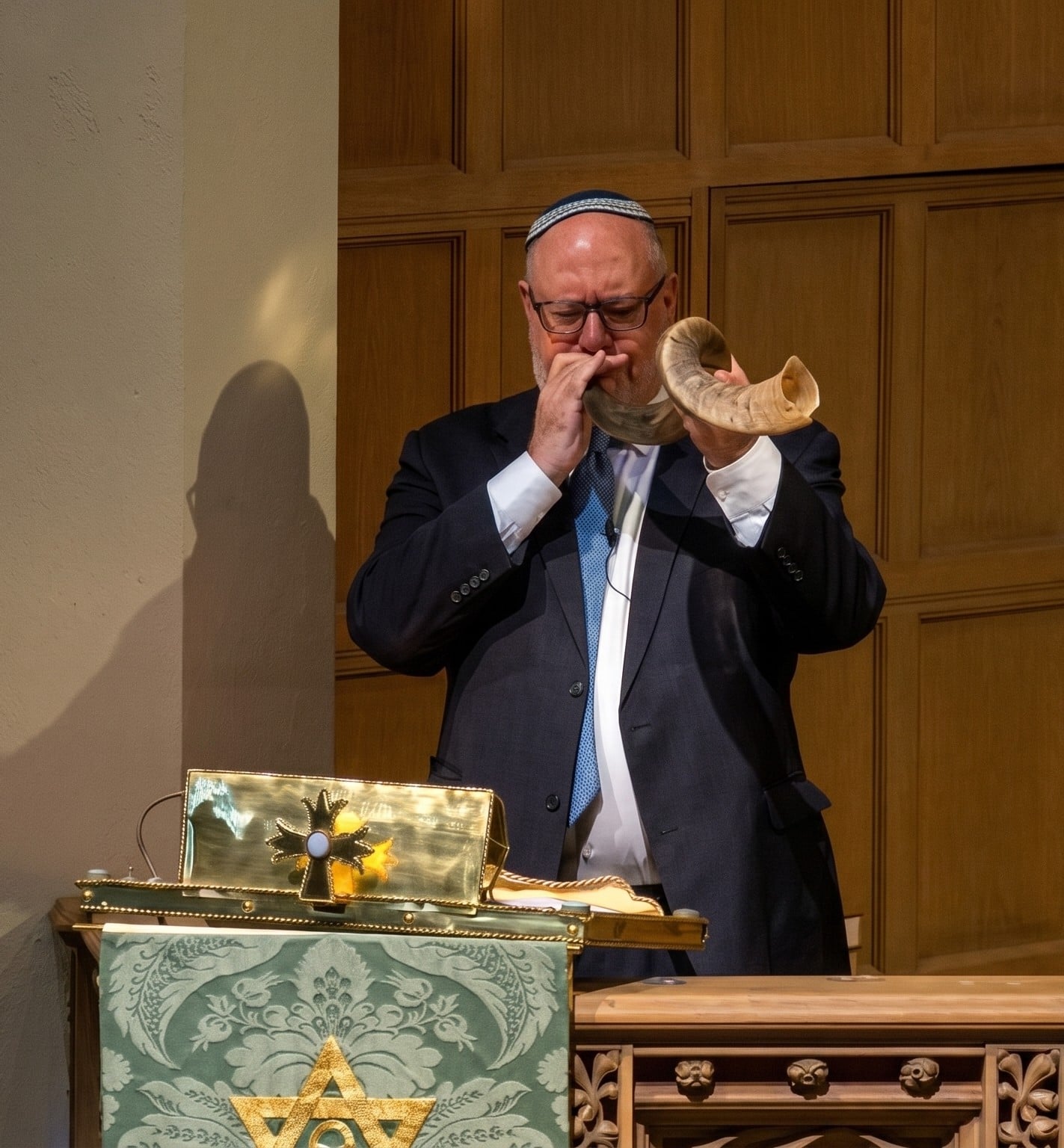
The Author Sounding the Shofar at Timothy Eaton Memorial Church August, 2026
In the raw, disoriented days following the Hamas massacre of October 7th, something happened at Timothy Eaton Memorial Church on St. Clair Avenue that members of my congregation, Beth Tzedec, still talk about.
The Rev. Jason Byassee called me.
Not to express condolences through proper channels. Not to issue a statement. Jason called me — my friend Jason, the theologian and pastor who leads one of Toronto’s most storied Protestant congregations — and said: We need to be together. Bring your people. Come to our space. Let’s not let your community stand alone in this.
And so, we came. Hundreds of Beth Tzedec and Holy Blossom Temple members filed into that magnificent Gothic sanctuary and sat, together with the Timothy Eaton community, in the kind of silence that only shared grief makes possible. We prayed. We wept. We bore witness to one another in a way that no interfaith panel or joint programming initiative could manufacture. It had to be earned. And Jason and his community gave it to us freely.
I have been a rabbi for 30 years. I have attended many interfaith events. What happened that October evening was not an interfaith event. It was an act of love.
Which is why, when Jason invited me to preach at Timothy Eaton this August 16th, I did not hesitate. Rabbis don’t typically preach in churches. The crossing of that threshold carries weight — theological, historical, personal. You don’t do it casually.
But there is nothing casual about what Jason and I have built. And there is nothing casual about this particular moment in the Jewish calendar.
August 16th falls five weeks before Rosh Hashanah, which begins this year at sundown on September 11th. We will be deep in the Hebrew month of Elul — the 30 days of spiritual preparation preceding the High Holy Days. Every morning in Elul, Jews hear the shofar, the ancient ram’s horn, as an alarm clock for the soul. Wake up. The gates are open. It is time to ask the hard questions.
The text we read that morning is Genesis 22 — the Akedah, the Binding of Isaac. A text we share, though we read it differently. For Christians, the ram caught in the thicket points forward — toward Golgotha, toward a different kind of sacrifice on a different mountain. For Jews, the story ends here, on this mountain, with this ram, whose horn will become the shofar. There is no prefigurement. There is only Abraham, and Isaac, and three days of silence between them, and the angel’s voice breaking through at the last possible moment.
There is also a Midrash — a rabbinic legend — that our Bible doesn’t show us. It teaches that Abraham did not stop. That the knife fell. That Isaac died on that mountain. And the angels of heaven, watching, began to weep — and their tears fell and landed on Isaac’s closed eyes. It was those tears that brought him back.
I find in that midrash something true about what happened at Timothy Eaton that moment post-October 7. Sometimes we cannot find our way back ourselves. Sometimes it is the tears of others — friends, neighbors, a community that shows up when it doesn’t have to that opens our eyes again.
At a point during the service, I did something I believe was a first for that 111-year-old sanctuary.
I sounded the shofar.
That raw, unmediated, ancient cry — no melody, no nuance, just the sound of a human soul stripped of its performances — filled those Gothic arches for what I suspect is the first time in the building’s history. And then I asked the congregation to turn to the person next to them and share what they felt.
Because the shofar is not a museum piece. It is a summons. It says the same thing in a church in Toronto in 2026 that it said on a mountain in Moriah three thousand years ago: Look up. Something is being provided. Are you paying attention?
I am often asked what interfaith work is actually for. The real answer — the one I have been living since October 7 — is that it is for the moment when the phone rings and someone says: We need to be together.
Jason called me that week because we had built something real. Not a partnership. A friendship. The kind that holds across theological difference and shows up in the dark.
On August 16th, I stood on his pulpit carrying a shofar and the memory of what his community gave my community when we needed it most. And I closed with words I will say again five weeks from now to some five thousand of my own people:
L’shanah tovah tikateivu.
May you be inscribed for a good year. May you look up from whatever mountain you are climbing and find what has been provided. May the gates, while they are open, be wide enough for you to walk through.
Related Topics
Related Posts