
Russian-American-Israeli Palestinian. Palestine is Israel.
A Return to the Golden Fields: The Ziophobic Utopia
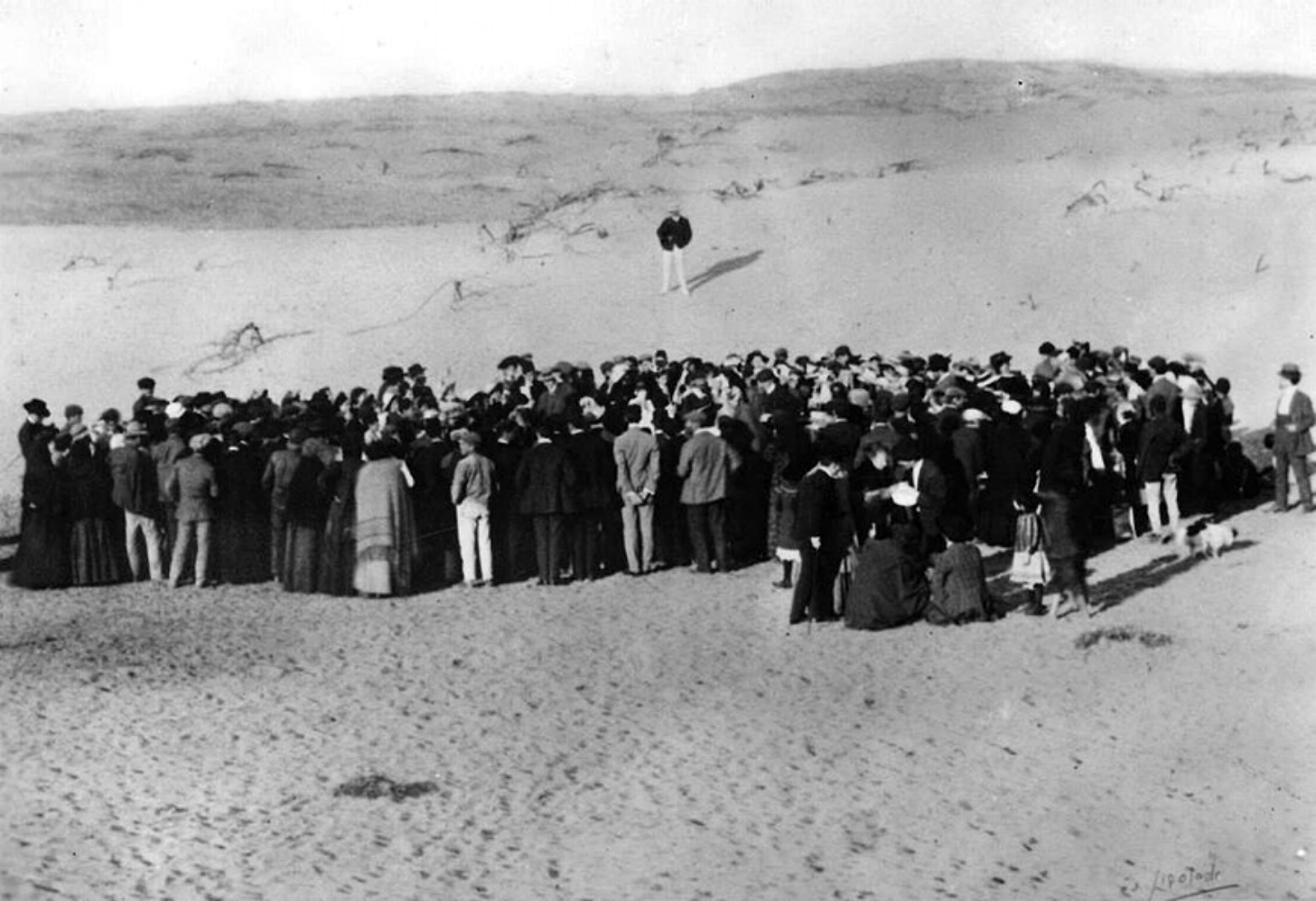
Tel Aviv was founded in 1909 on land purchased from Bedouins, north of the existing city of Jaffa. This photograph shows the auction of the first lots. Public domain. Source: Wikimedia Commons.
How Resentment and Envy Paint a Perfect Future—If Reality Will Just Step Aside
In the prevailing fantasy of the Ziophobe imagination, a vision takes shape so vivid, so perfectly ordered, that one might mistake it for a scene from a celestial tapestry. In this vision, history folds back on itself like a well-creased map, and the inhabitants of a once-and-future land step neatly into pre-1948 homes, orchards, gardens, farms, and villages they left “just yesterday”—never mind the intervening decades, skyscrapers, shopping malls, and tech parks.
And once it has all happened, war, borders, and security will vanish. Wealth will flow endlessly, beachfront properties in Tel Aviv and Old Town-view properties in Jerusalem will be available to all. Because that’s how history, property law, and human nature work—in the Ziophobic imagination.
The Premise: A Perfectly Reversible World
According to UNRWA’s registry, nearly six million people worldwide hold the unique status of “Palestine refugees,” a designation inherited indefinitely and decoupled from actual displacement. Add to this the roughly two million Arab citizens of Israel—who, in the fantasy, are generously “allowed” to stay after Israel’s demise—and the future state arrives pre-loaded with eight million Arab residents on Day One.
And the story goes like this: millions of these long-dispersed returnees, many never having set foot in the land but carrying the coordinates of a village in their grandparents’ memory, will arrive to find it waiting. Tel Aviv’s glass towers? They’ll melt into orange groves. Jerusalem’s hillside apartments? Reclaimed by the rightful “heirs” with all the grace of a ceremonial handover. Legal, logistical, and social complexities vanish in this dreamscape like fog before the morning sun.
It is an alluring picture—because it requires no confrontation with the stubborn nature of reality. Borders dissolve without resistance, property changes hands without dispute, and history itself politely steps aside.
Scenario One: The Divine Ledgers
An all-seeing Land Allocation Authority (perhaps blessed with prophetic insight) produces the Master Ledger of Original Ownership. Each plot, from the prime beachfronts of Tel Aviv to the alleyways of Jaffa, is assigned to a returning family exactly as it was—never mind that the farmhouse is now an underground parking garage. Owners of “squatted” homes receive a dignified knock at the door, followed by an untroubled demand: hand over the keys and prepare to relocate to your ancestral home in Europe — the place you supposedly came from.
In some tellings, Israel’s cities and infrastructure have been either quietly abandoned, partially destroyed, or neutron-bombed—sometimes leaving buildings standing but emptied of inhabitants without international complaint. The surviving real estate is then redistributed according to ancestral claim, as if in a serene post-apocalyptic estate sale.
Where multiple families—often descended from the same great-grandfather—claim the same plot, olive grove, or humble courtyard, they will co-own it in perpetuity, rotating possession on a yearly, monthly, or even daily basis in an act of symbolic reconciliation. The inconvenience of deciding who plants, harvests, or pays the electricity bill is left to the imagination.
Outcome: An impeccably fair transition where everyone ends up exactly where they are “meant to be,” as if life were a cosmic game of musical chairs with no losers.
Scenario Two: The Great Egalitarian Swap
In this version, there are no ledgers—only a grand vision of perfectly equal distribution. Tel Aviv penthouses, Haifa sea-view apartments, and Negev villas are shuffled and reallocated like a deck of cards. High-demand properties are “rotated” every few years so no one feels left out. Shopping malls become communal housing complexes with panoramic rooftop gardens. Cities transform into utopian settlements where no corner is more desirable than any other—because desirability itself has been abolished.
Outcome: A society without envy—because envy, in this model, has been legislated out of existence.
Scenario Three: The Historical Reenactment
Here, the guiding principle is historical restoration: villages are rebuilt exactly as they were “before,” complete with goat pens, fig trees, and hand-dug channels—never mind that light rail tracks now cut through the site. New residents forsake ruined apartment towers for mud-brick homes lovingly reconstructed in the same spots to match faded photographs. All this unfolds on land that must somehow accommodate millions, including the returning “refugees.” Life resumes as if the twentieth century—and much of the twenty-first—had never happened.
Outcome: A living museum, where heritage is not merely preserved but reinstalled wholesale, and modernity politely relocates elsewhere—though fitting everyone into the old villages requires a miraculous reconfiguration of space.
Why This Remains Fantasy
The common thread in all three scenarios is not just their logistics—though those are fantastical enough—but their assumption that property rights exist independently of sovereignty. In reality, ownership is not timeless: it exists only within the legal framework of a functioning state. Courts, registries, and enforcement mechanisms—not sentiment—make property rights real. Ownership confers not only rights but also obligations: maintaining the property, complying with zoning laws, paying taxes, and abiding by other civic duties.
The romantic notion that a farmhouse abandoned in 1948 remains “yours” forever—regardless of political, legal, and demographic transformations since, and even if Jews legally purchased it decades earlier—exists in no functioning legal order on earth. A long-gone 1940s farm in Jaffa is no more a legal claim in 2025 than a plot now buried under an interstate in New York belongs to the great-grandchild of someone who once lived there.
Moreover, these utopias rely on a near-theological belief in perfect compliance: millions of people accepting without dispute where they’ve been placed. No courts, no police, no conflicts—just a serene restoration, as if human nature itself had undergone a miraculous rewrite.
The Philosophy Behind the Dream
These visions tell us less about the land itself than about the deep human longing to rewind history to an imagined moment of purity. This appropriated nostalgia is not purely spontaneous—it is deliberately cultivated from early childhood in kindergartens and schools, and reinforced by institutions such as UNRWA. It is fueled by the ache of perceived dispossession, as well as by resentment and envy. The problem is not that such dreams are emotionally incomprehensible—it’s that they exist entirely apart from the world in which law, politics, and society actually function.
The irony is that, in painting these visions so vividly, their proponents unintentionally reveal the impossibility of their own cause. The utopia collapses the moment you ask the most basic of earthly questions: Who gets the apartment with the view?
Thus, the golden fields remain eternally green, the houses perpetually await their “true” owners, and the roads lie clear of traffic for the imagined homecoming procession. The dream is beautiful, as all utopias are—and impossible for the same reason: it presumes a world in which history can be selectively unwound, law suspended, and reality commanded to yield to fantasy.
In this imagined order, Ottoman paperwork experiences a miraculous resurrection: every deed from absentee landlords is instantly revalidated—except the ones proving Jews legally purchased the land, which are dismissed as “colonial fabrications” and struck from the record.
And in that imagined world, the gates never close, the fig trees are always in bloom, and no one ever asks where the deeds are filed.
Related Topics
Related Posts