Writing as P. Mordechai on Faith and Israel
A Returned Hostage and the Fire of Faith in Tel Aviv
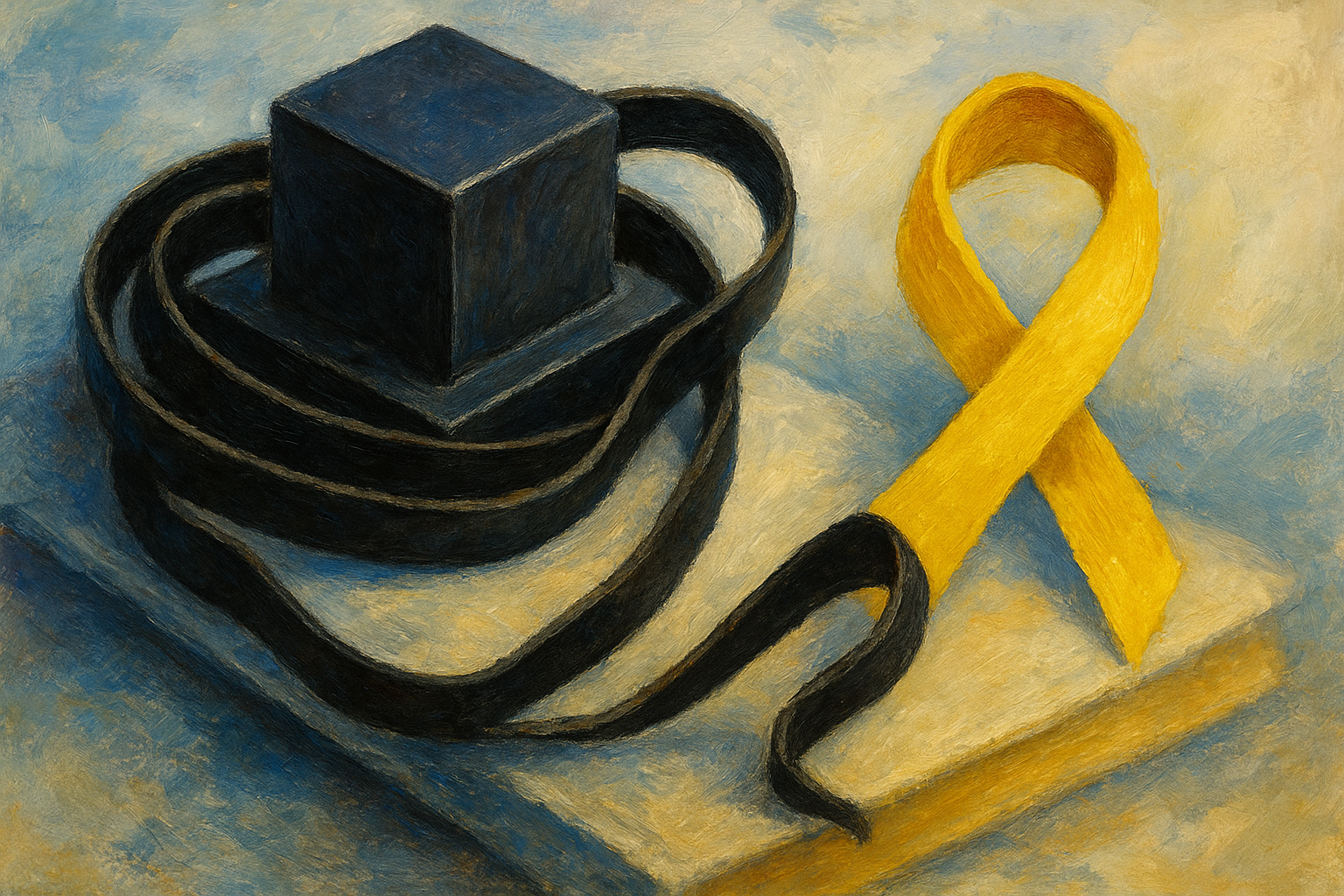
Symbolic digital artwork depicting tefillin and a yellow ribbon, representing faith and hope for the hostages. (Generated with AI)
On a Friday morning beside the fountain at Hostages Square, Tel Aviv, the air felt charged with quiet expectations. Families of captives, soldiers on leave, and passersby from nearby cafés gathered before a low wooden platform where a thin young man stood holding a microphone. His voice was raspy, his stance unsteady, but his words carried across the square.
Bar Kupershtein had been free for exactly eighteen days. Kidnapped from the Nova music festival on October 7, 2023, he spent 738 days in Hamas captivity before being released on October 13, 2025. The sunlight caught the yellow ribbons tied to nearby barricades as he spoke.
“My dream while in captivity was to put on tefillin,” he said, pausing as the crowd grew silent. “And we’ll do it for the release of all our brothers still there.”
The gathering that followed was both spontaneous and organized. Chabad of Central Tel Aviv, which coordinated the event, counted over 1,200 attendees. Volunteers had arrived at dawn to set up folding tables in neat rows, laying out tefillin, Tehillim pamphlets, and Shabbat-candle kits.
The participants reflected the mosaic of Israeli society. Young soldiers on 24-hour leave stood beside secular men who had not worn tefillin since their bar mitzvahs. Hostage families stood quietly near the center, some clutching photos. Tourists stopped at the edge of the square to watch. For many, this was not a demonstration but a prayer in motion.
Bar’s mother, Julie Kupershtein, moved among the tables with practiced care. For nearly two years she had kept a small “Bar Tefillin” stand here every Friday, inviting strangers to lay tefillin in her son’s merit. On this day, she guided others through the seven loops of the shel yad and the single loop on the middle finger, her eyes never leaving her son.
Bar closed his eyes and recited the Shema. Even the traffic on Ibn Gabirol Street seemed to soften. Then his father, Tal Kupershtein, who uses a wheelchair, was helped onto the platform by two volunteers. For the first time in public, he donned tefillin and placed both hands on his son’s head, whispering the words of the Priestly Blessing.
Before long every tefillin set had been used. Volunteers recorded names for the next week’s distribution. Someone began to sing Acheinu Kol Beit Yisrael, the traditional prayer for unity and deliverance. Within moments, hundreds of voices joined in unison.
When the song ended, people began tying fresh yellow ribbons to the barricades. Others lit early Shabbat candles on the folding tables, their flames flickering in the Mediterranean breeze. There were no speeches, no slogans, no politics. There was only an unspoken understanding that something sacred had happened.
This was the largest tefillin event at Hostages Square since the weekly stand began in early 2024, and the first ever led by a returned hostage. For many, it marked not only an act of remembrance but also of spiritual renewal.
Kupershtein’s words, simple and unwavering, had become reality. The dream he held through 738 days of darkness now unfolded under open sky. In a square defined by loss, his act became a statement of presence that even in captivity, the soul of a people does not yield.
For many Israelis, the moment captured something they had struggled to articulate since the war began: a fragile but undeniable rebirth of spirit. After months of tension, protests, and uncertainty, the sight of young and old wrapping tefillin together, some for the first time in decades, felt like a quiet form of national healing.
The tefillin straps, coiling around arms and fingers, seemed to carry their own language a binding of pain into prayer, captivity into covenant.
The fire of faith that morning did not roar; it flickered quietly in hundreds of hearts. And for a moment, in the city that rarely pauses, Tel Aviv stood still.
What had begun as a vow whispered underground ended as a public declaration of faith and the fire that refused to die, rekindled in the heart of Tel Aviv.
Related Topics
Related Posts