
CFO | Empower Society for Good I Author
A Rosh Hashanah Letter to His Majesty’s Government
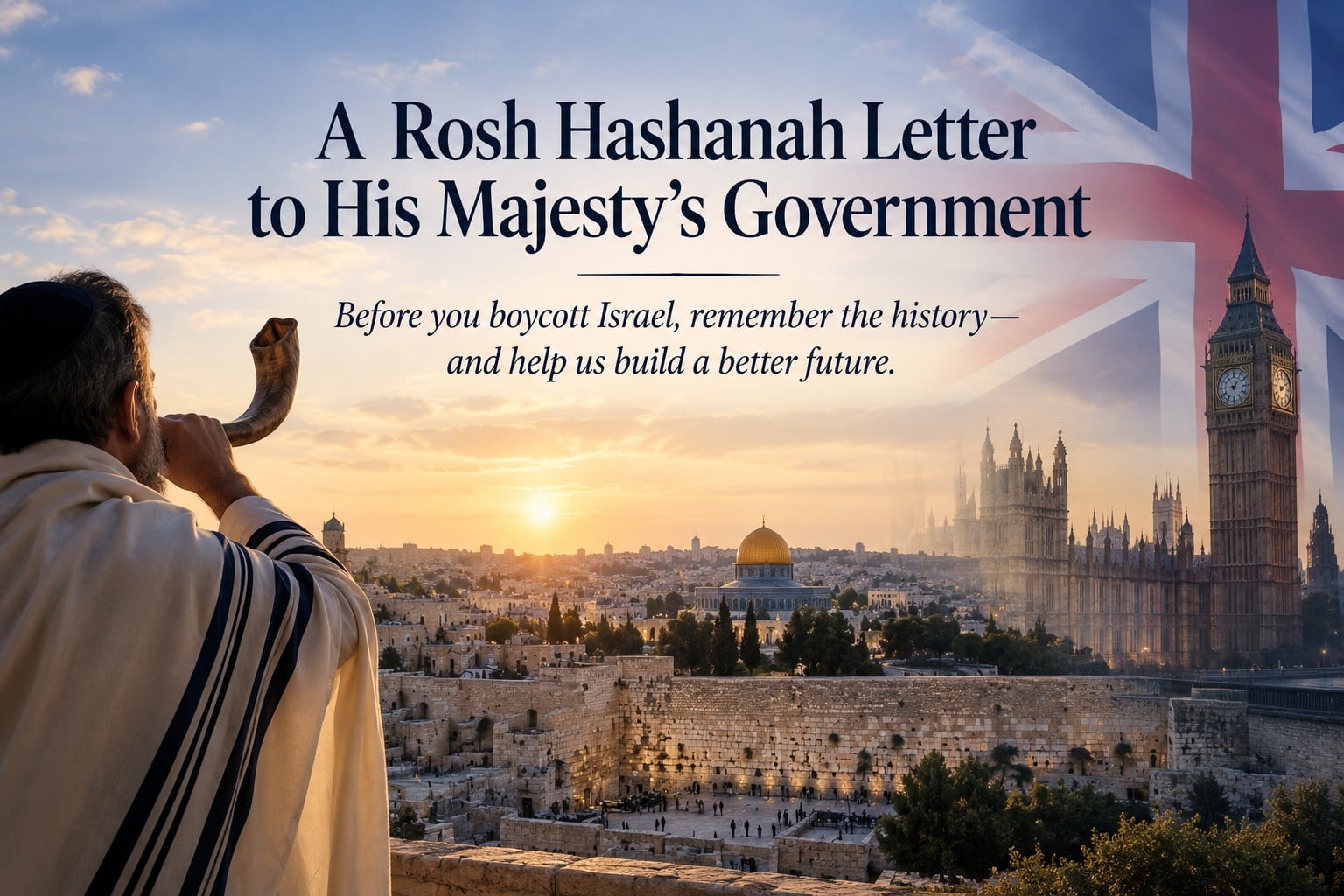
Before you boycott Israel, remember the history—and help us build a better future
Over the past few days, Britain has moved from criticism of Israel towards economic action.
Foreign Secretary Ed Miliband has announced an import ban on goods from Israeli settlements and a new sanctions regime that will go further, targeting companies and individuals involved in construction, infrastructure, financing and real estate connected to settlement expansion. Britain says this is necessary to preserve the possibility of a Palestinian state.
I confess, I struggle to understand the logic.
Britain wants to advance peace by introducing a boycott. It wants to help Palestinians through measures that may also cost Palestinians jobs and livelihoods. It wants to preserve a political architecture born out of Oslo without seriously confronting what happened to the assumptions underlying Oslo. And it is prepared to reach into the Israeli economy—including potentially its financial system—to prevent one population from creating “facts on the ground,” while treating construction by the other population very differently.
What troubles me most is how much history—and how much recent experience—seems to have disappeared from this policy.
A contiguous Palestinian state is presented as the destination that must be preserved. E1 therefore becomes a threat. Jewish construction becomes an obstacle to peace. Economic restrictions become a legitimate way of preventing Israel from changing the map.
But before His Majesty’s Government uses economic power to preserve that political architecture, perhaps it should ask whether the assumptions behind it still withstand history and reality.
A few weeks ago, I was driving up Highway 1 towards Jerusalem, past Ma’ale Adumim and E1.
I had been reading the familiar warnings about Jewish construction creating irreversible “facts on the ground.” Yet across the hills I saw large new Palestinian apartment blocks and expanding Arab communities.
They simply looked like another suburb.
This landscape is still routinely described using Areas A, B and C. But these divisions were created by the Oslo process as an interim arrangement, not permanent borders. Area A came under Palestinian civil and security control, Area B under Palestinian civil administration with different security arrangements, while Area C remained under Israeli civil and security control pending a negotiated settlement.
And the purpose of that process was supposed to be peace.
At Oslo’s heart was an extraordinary bargain: mutual recognition between Israel and the PLO and a process intended to lead towards peaceful coexistence.
That destination was never reached.
Yet three decades later, Britain and Europe often seem to treat Oslo’s anticipated outcome as though it had already been agreed.
European governments support Palestinian planning and development, including in parts of Area C. I have no objection to Palestinians building homes, businesses and better lives where that development forms part of peaceful coexistence.
But construction is not politically neutral when it is intended to establish territorial claims or prevent compromise.
And that principle must apply equally.
If Jewish construction is a political “fact on the ground,” Palestinian construction across the same contested landscape cannot automatically be treated as something entirely different.
Both populations are growing. Both are building. Neither is leaving.
Perhaps we should drive the roads before drawing the borders.
There is also Britain’s own history.
As Rosh Hashanah approaches, Jews throughout the world will once again hear the shofar—a call to remembrance, awakening and teshuvah. We are asked to examine ourselves: Where have we failed? What have we learned? What should we do differently?
Perhaps nations should occasionally ask themselves the same questions.
Less than a century ago, under British Mandatory rule, Jews were forbidden to blow the shofar at the Western Wall. Young Jews defied that prohibition, risking arrest and imprisonment.
As I prepare to hear that same shofar this Rosh Hashanah in sovereign Jerusalem, I find myself asking:
Why then—and why today?
Britain issued the Balfour Declaration and administered a Mandate that recognized the Jewish people’s historical connection to this land. Yet Britain later restricted Jewish immigration with the 1939 White Paper as the gates of Europe were closing around European Jewry. After the Holocaust, British forces intercepted Jewish refugees trying to reach Palestine and interned many in Cyprus.
I do not recount this history to hold today’s British government responsible for every decision of its predecessors.
I recount it because history should produce humility.
Britain has drawn maps here before. Britain has determined where Jews could settle before. Britain has attempted to manage competing national aspirations before.
The consequences have lasted generations.
And then there is our history.
Oslo was supposed to produce peace. Instead, Israelis experienced terrorism, suicide bombings and the Second Intifada.
In 2005, Israel removed every Jewish community from Gaza and withdrew its permanent military presence from inside the territory. Hamas eventually seized control, built a terrorist army and carried out the massacre of Oct. 7.
And the fundamental question of recognition remains unresolved.
Peace requires more than Palestinians accepting Israel as a temporary political reality. It requires acceptance that Jewish sovereignty is permanent.
Yet we still hear “from the river to the sea.” Hamas states its rejectionism explicitly, while a powerful current within Palestinian nationalism continues to imagine liberation not as a Palestinian state alongside Israel but as the end of Jewish sovereignty.
If that is the underlying conflict, stopping construction in E1 does not solve it. It merely changes the line from which it continues.
None of this means Palestinians do not deserve dignity, prosperity and meaningful political agency. They need to earn it by actions towards peace and coexistence.
Palestinian society and its leadership have responsibilities: to build accountable institutions, uphold the rule of law, reject terrorism and protect innocent Israelis from terror.
Israel also has responsibilities: responsible sovereignty, the rule of law and protection of innocent Palestinians from violence.
But Oct. 7 must mean something. History must mean something. Reality must mean something,
If Britain wants to preserve a Palestinian state, it must ask: Who governs it? Who controls its weapons? Who disarms Hamas? What prevents Iranian weapons from entering? And will that state recognize the permanence of Jewish sovereignty?
These are not excuses for avoiding peace. They are lessons purchased at an unbearable price.
And now Britain’s measures raise another question.
Our lives are more intertwined than we realise.
Palestinians work on Israeli construction sites, in factories and in businesses, including in Judea and Samaria. Israeli employers depend on Palestinian workers, while Palestinian families depend upon those incomes.
The roads, infrastructure, banks, supply chains and livelihoods of the two populations do not divide themselves neatly along the lines drawn on diplomatic maps.
Britain now says it will target not only settlement products but those providing financing and other services connected to settlement expansion.
But Israeli banks do not operate as separate “Israel” and “settlement” banking systems. The same banks that finance homes and businesses in Tel Aviv and Haifa provide mortgages and financial services to Israelis living in Ma’ale Adumim and elsewhere in Judea and Samaria.
So where does this principle end?
Does a bank become implicated because it finances a home in Ma’ale Adumim? What about the insurer? The construction supplier? The Palestinian worker who helped build it?
And who ultimately gets hurt?
Not only Israelis.
Palestinian workers, businesses and families may pay a price too.
There is something deeply shortsighted about a policy intended to advance Palestinian interests that may damage the very economic relationships from which Palestinians themselves benefit.
Which is why Britain’s instinct towards boycott disappoints me.
Instead of boycotting, help us build.
Help build Palestinian businesses and accountable institutions. Encourage Palestinian entrepreneurship alongside Israeli technology and Gulf investment. Invest in infrastructure and economic opportunity.
Demand that Palestinian leaders confront terrorism and accept permanent Jewish sovereignty. Demand that Israel uphold the rule of law and protect Palestinians from Jewish violence.
Imagine Britain saying:
We will invest in those who build together.
Peace must have a dividend.
And this brings me back to something I have been thinking about increasingly: what does it mean to build a Good Society?
For Israel, the question after Oct. 7 cannot simply be how we survive. It must also be what kind of country we are trying to build.
A Good Society requires security, but also responsibility, dignity, opportunity and the rule of law. That challenge applies to us. It applies to Palestinians. And it should inform the policies of those who seek to influence our future.
Perhaps the challenge is not simply how to separate Israelis and Palestinians.
Perhaps it is how two peoples whose lives are already far more intertwined than we realise can build a peaceful future together.
Rosh Hashanah teaches that teshuvah does not mean forgetting the past. It means learning from it sufficiently to choose differently.
Britain cannot change its history here.
Neither can we.
But we can decide what we do with that history.
Nearly a century ago, British authorities tried to prevent Jews from sounding the shofar at the Western Wall. They failed.
This Rosh Hashanah, the shofar will once again sound in Jerusalem, capital of a sovereign Jewish state.
So my request to His Majesty’s Government is simple:
Before you boycott, remember.
And then help us find a better way.
Don’t boycott the future. Help us build it.
Related Topics
Related Posts