

NAnews - Nikk.Agency Israel News
A Russian MP for a Ukrainian City Moscow Never Captured. Why Israel Should Care
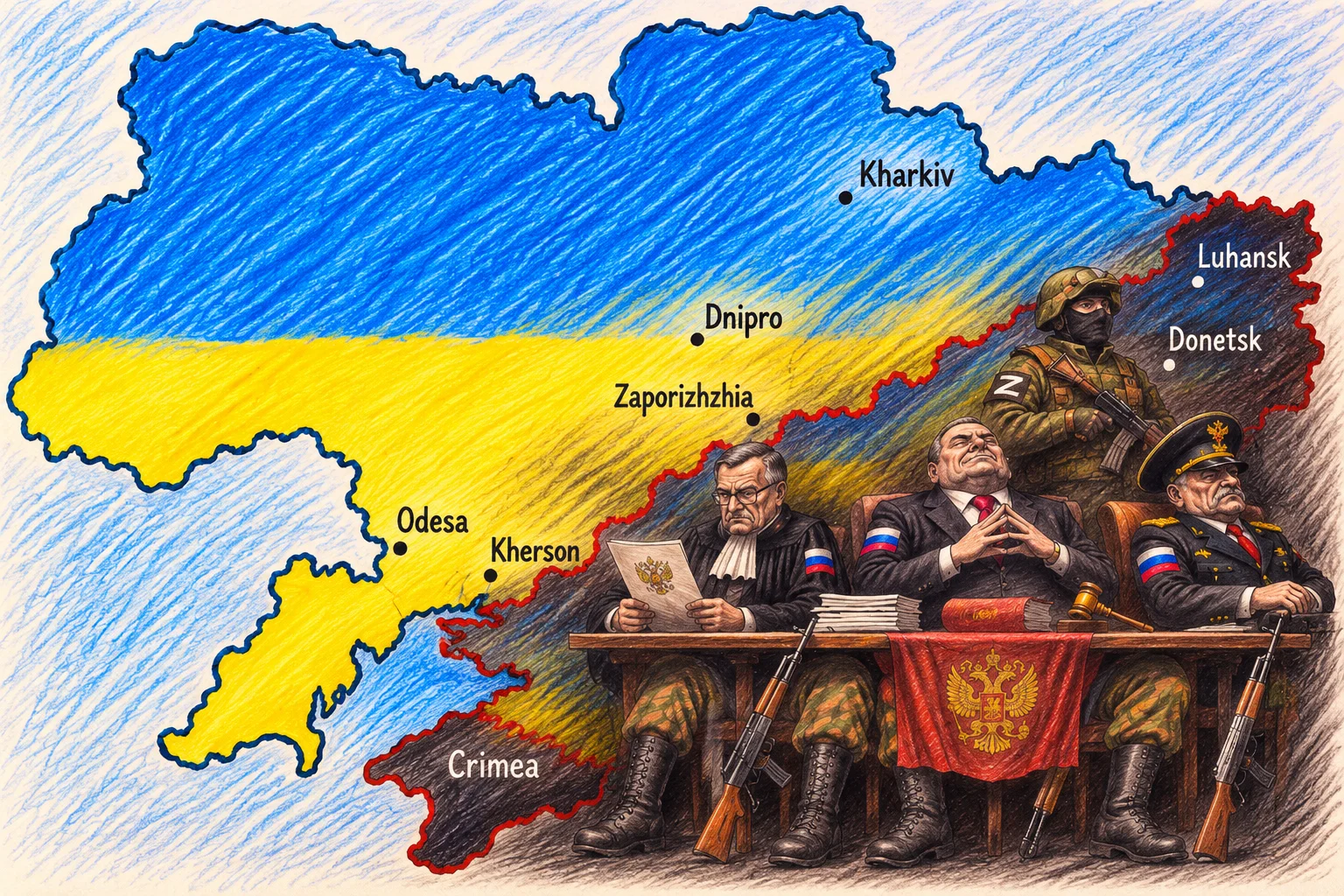
The image was created using AI. A Russian MP for a Ukrainian City Moscow Never Captured. Why Israel Should Care
Russia has turned Ukrainian territory into parliamentary constituencies, including cities it does not control. Behind the ballot papers lies a larger question about power, legality, and the Russian state Israel must deal with.
There is something almost absurd about the idea of electing a member of parliament to represent a city your government has never captured.
Imagine the paperwork. The constituency has a number. The electoral commission has a seal. A political party nominates its candidate. The votes are counted, the result is announced, and a man takes his seat in parliament.
Everything looks perfectly administrative.
There is only one problem: the city is in another country, and the government issuing the parliamentary mandate does not control it.
This is not a hypothetical scenario.
In September 2026, Russia held elections to its State Duma using a system of constituencies that included Ukrainian territory under Russian occupation. But Moscow went further. Among the places incorporated into its electoral map were Kramatorsk and Sloviansk, two cities in the Donetsk region that remained under Ukrainian control.
The Russian Central Election Commission declared Sergei Makarov, a candidate from Vladimir Putin’s United Russia party, the winner of the Horlivka constituency, designated District No. 15. According to Russia’s official figures, he received 251,186 votes, or 62.38 percent.
That figure does not mean the residents of Kramatorsk and Sloviansk voted for him. It is an official Russian electoral result, not an independently verified expression of the political preferences of those two cities.
But it means something else.
Russia has created a parliamentary constituency that claims to represent Ukrainian cities beyond its actual authority.
For an Israeli reader, the important question is not simply whether this violates international law. It is how a state uses ordinary institutions to transform an extraordinary act — the seizure of another country’s territory — into something that begins to resemble normal government.
And there is another reason to pay attention.
This is the same Russian political system making decisions about military cooperation with Iran.
When a military occupation acquires a parliamentary address
On May 23, 2025, Putin signed Russian Federal Law No. 107-FZ, approving the map of single-member constituencies for State Duma elections.
Eleven of those constituencies were assigned to internationally recognized Ukrainian territory: three in Donetsk, two in Luhansk, one each in Zaporizhzhia and Kherson, three in Crimea, and one in Sevastopol.
Seven cover the four Ukrainian regions Russia claimed to annex in 2022. The remaining four concern Crimea and Sevastopol, occupied and purportedly annexed in 2014.
This distinction matters because Russia does not actually control all the territory it claims.
The electoral map is therefore more than a reflection of military occupation. It is a representation of Moscow’s territorial ambitions.
Consider what happens when such a map becomes part of everyday state administration.
Political parties establish organizations. Electoral commissions receive instructions. Candidates campaign, or are presented as having campaigned. Official results are published. Parliamentary mandates are awarded.
The entire machinery begins to operate as though the central political question — to which country the territory belongs — has already been resolved.
That is the real significance of the September 18–20, 2026 elections.
A military occupation is being supplemented by an administrative structure intended to outlast the immediate battlefield situation.
For the Russian public, the repetition of these procedures can make occupied territory appear indistinguishable from any other Russian region. For foreign audiences, Moscow can produce documents, elected representatives and visiting observers, all suggesting that its control has acquired a certain institutional legitimacy.
It is a familiar political temptation: make a disputed reality look routine long enough, and eventually people may stop asking how that reality came into being.
Yet repetition does not create sovereignty. A government cannot acquire another country’s territory merely by incorporating it into its electoral legislation.
The detailed Russian electoral arrangements, including the inclusion of Kramatorsk and Sloviansk, were examined in a Hebrew-language NAnews investigation into Moscow’s use of elections to consolidate occupation.
The central issue is not the existence of a ballot box. It is the authority claimed by the government placing that ballot box there.
The people behind the electoral statistics
There is another problem with treating voting figures from occupied Ukraine as an expression of popular consent.
What does consent mean when ordinary life has become dependent on the occupying authorities?
On March 20, 2024, the United Nations Human Rights Office published a report covering Russian-occupied Ukrainian territory from February 24, 2022, through December 31, 2023.
Based on more than 2,300 interviews with victims and witnesses, the report documented arbitrary detention, torture, suppression of peaceful protests, restrictions on independent information and the imposition of Russian administrative institutions.
It also described pressure on residents to acquire Russian passports.
Without those documents, people faced obstacles to employment, healthcare and social benefits.
It is worth considering what that means for an ordinary family.
A person needs medical treatment. A parent needs to continue working. An elderly resident depends on a pension or other assistance. Someone must obtain documents to navigate an administrative system they did not choose.
If accepting a Russian passport makes those things possible, does it prove that the person supports annexation?
Of course, the document itself cannot answer that question.
A passport acquired under pressure may represent adaptation, necessity or a means of avoiding confrontation with the authorities. It cannot automatically be interpreted as a political endorsement.
The same caution applies to elections.
A person may participate because they fear unwanted attention, hope to avoid difficulties or believe participation is necessary to preserve access to essential services.
Others may genuinely support Russia. The existence of coercion does not establish that every resident holds the same political views.
But that is precisely why official participation figures cannot substitute for evidence of a free political choice.
Article 25 of the International Covenant on Civil and Political Rights establishes the right to genuine periodic elections, conducted by secret ballot and guaranteeing the free expression of voters’ will.
The UN Human Rights Committee has explained that these guarantees depend on freedoms extending well beyond polling stations: political discussion, expression, association, access to information and protection from coercion.
This raises a much more revealing question than the number of ballots counted.
Could a resident of an occupied Ukrainian city openly campaign for the return of Ukrainian authority?
Could that person establish a political organization advocating such a position, distribute campaign materials and seek public office without fear of arrest or retaliation?
The UN’s documented findings help explain why these questions matter.
A polling station may exist in a political environment where the freedom necessary to make voting meaningful is severely restricted.
The March 2024 UN report does not constitute direct observation of Russia’s September 2026 elections. It documents conditions during an earlier period. Allegations concerning the 2026 vote require their own evidence.
Nevertheless, those findings reveal the danger of treating an administrative act under occupation as proof of voluntary allegiance.
A Russian law cannot erase Ukrainian sovereignty
International law had already addressed Russia’s territorial claims long before the 2026 parliamentary elections.
On October 12, 2022, the United Nations General Assembly adopted Resolution ES-11/4, condemning Russia’s attempted annexation of the Donetsk, Luhansk, Zaporizhzhia and Kherson regions.
The resolution received 143 votes in favor.
Israel was among them.
The text reaffirmed Ukraine’s sovereignty and territorial integrity and rejected the legal validity of Russia’s attempted territorial changes.
This was not a minor procedural vote. It established a clear diplomatic record of Israel’s position on the annexation.
International humanitarian law also distinguishes between exercising factual control over territory and acquiring sovereignty over it.
Article 43 of the 1907 Hague Regulations requires an occupying power to restore and ensure public order and civil life while respecting the laws in force in the occupied territory unless absolutely prevented from doing so.
Article 45 prohibits compelling inhabitants to swear allegiance to the hostile occupying power.
Article 47 of the Fourth Geneva Convention protects people living under occupation from losing their Convention rights because the occupying authorities alter local institutions or declare annexation.
These provisions address different legal questions, but together they illustrate a fundamental principle.
Occupation creates obligations. It does not automatically create ownership.
An electoral commission cannot rewrite internationally recognized borders. A parliamentary mandate cannot erase the protections afforded to civilians under occupation.
And even if residents participate in an election organized by the occupying power, that participation does not transform the territorial seizure into a democratic mandate.
For Israel, this is not an abstract question about a distant legal controversy.
Israel voted for the UN resolution rejecting the attempted annexation. The subsequent Russian parliamentary procedures do not alter the territorial status on which that vote was based.
There is an important distinction between acknowledging that someone holds a seat in the Russian parliament and accepting that Russia has the sovereign right to represent Ukrainian territory.
One is a factual description of Moscow’s political system.
The other is a question of international recognition.
They should not be confused.
Elections without independent political competition
The conditions inside occupied Ukraine cannot be separated from the political environment inside Russia itself.
In her 2025 reporting, Mariana Katzarova, the UN Special Rapporteur on the situation of human rights in the Russian Federation, described the use of laws concerning “foreign agents,” “undesirable organizations,” the alleged “discrediting” of the armed forces and supposedly false information about the military to suppress dissent.
Independent journalists, anti-war activists and government critics have faced prosecution and other forms of repression.
This matters because an election is not merely an exercise in counting votes.
A meaningful electoral contest requires the possibility of arguing publicly against the policies of those in power.
What does an official election result tell us about public support for a war if organized opposition to that war faces criminal consequences?
The question is especially relevant to Russia’s occupied Ukrainian territories, where restrictions associated with Russian domestic politics intersect with the conditions imposed by military occupation.
The European Union also raised concerns about political competition during the 2026 parliamentary campaign, including the exclusion of the federal list of the opposition Yabloko party, which had maintained an anti-war position.
Against that background, the familiar presentation of electoral figures as proof of public approval becomes difficult to sustain without independent scrutiny.
A government cannot simply present the number of votes it announces and expect that figure to settle questions about political freedom.
When international observers become part of the story
On August 6, 2026, the OSCE Office for Democratic Institutions and Human Rights and the OSCE Parliamentary Assembly announced that Russia had not invited their observers to monitor the forthcoming State Duma elections.
The organizations noted that this continued a pattern of restrictions on independent international election observation.
They also condemned the organization of voting in Russia-occupied Ukrainian territory and reaffirmed that such electoral results have no legal force under international law.
The OSCE’s election-observation work is not simply a matter of sending distinguished visitors to polling stations.
A credible mission examines the legal framework, access for candidates, political freedoms, media conditions, election administration, complaints procedures and the counting process.
The freedom to observe is inseparable from the freedom to report uncomfortable findings.
At the same time, Russia was developing alternative international networks of electoral experts.
In an interview published on November 12, 2026, Areg Agasaryan, a member of Russia’s Public Chamber, described the creation of the International Association for Political and Electoral Expertise.
According to his account, the initiative grew from efforts by invited international experts following Russia’s 2024 presidential election. He said Russian Foreign Minister Sergei Lavrov had subsequently approved the idea of developing alternative international observation structures.
Agasaryan stated that the association’s founding conference took place in Moscow in April 2026 with support from Russia’s Central Election Commission, Public Chamber and Foreign Ministry.
He said the organization had attracted more than 80 members from 50 countries and that its representatives had already participated in observing the State Duma elections.
These are statements by a participant in the project, not independent proof of the association’s impartiality or lack of it.
The institutional connections nonetheless make the question of independence particularly important.
Who pays for the observers’ travel?
Who determines which polling stations they can visit?
Can they interview voters and candidates without supervision?
Are they free to document violations and publish findings that contradict the position of the government hosting them?
Foreign nationality alone does not answer those questions.
Nor does the presence of international visitors settle the legal status of occupied territory.
An observer may see a functioning polling station, neatly organized documents and a completed electoral protocol. That does not establish whether voters were free to oppose the occupying authority.
And it certainly does not transform a Ukrainian city into a Russian one.
There are three distinct concepts here: the presence of foreign guests, independent professional election observation and international legal recognition.
Merging them creates precisely the impression of legitimacy that a state seeking to normalize territorial annexation may wish to cultivate.
Sanctions reveal the practical consequences
The September elections did not pass without an international response.
On September 21, the European Union declared that it would not recognize either the organization of Russian elections in occupied Ukrainian territory or their results.
Five days later, Ukrainian President Volodymyr Zelenskyy enacted sanctions against 44 people whom Ukrainian authorities linked to organizing or facilitating the unlawful voting.
Those named included Irina Kuksenkova, characterized by Ukrainian authorities as involved in Russian propaganda, and former Ukrainian lawmaker Iurii Onishchuk, who cooperated with occupation authorities after the capture of Melitopol.
On October 12, the Council of the European Union imposed sanctions on 77 individuals connected to the elections.
The list included 74 candidates who had run in occupied Ukrainian territory and three members of Russia’s Central Election Commission.
The restrictions included asset freezes, travel bans and prohibitions on making funds available to those designated.
Not all 74 sanctioned candidates had necessarily won parliamentary seats. The EU action concerned participation in and organization of the electoral process.
This distinction is important.
Moscow presented the campaign as an ordinary parliamentary election. European institutions treated participation in the same exercise on occupied territory as conduct contributing to the maintenance and attempted legitimization of Russia’s occupation.
One side produced mandates.
The other produced sanctions lists.
The contrast demonstrates that internal administrative procedures and international acceptance are entirely different things.
Why should Israelis care about the political structure of Russia?
For Israelis, the argument can easily seem remote.
Ukraine is far away. Kramatorsk and Sloviansk are not familiar names to many people in Tel Aviv, Haifa or Jerusalem. The legal distinction between occupation and sovereignty may appear to belong to a European diplomatic debate.
But the Russian state making these territorial claims is also a military partner of Iran.
And that brings the subject much closer to Israel.
On February 23, 2024, the United States Treasury described Russia’s production of Iranian-designed unmanned aerial vehicles at the Alabuga facility in Tatarstan.
The American sanctions documentation identified the industrial, financial and procurement networks involved in the cooperation.
This was not merely the transfer of a few completed drones.
It involved production capabilities, components, financing and the development of a supply chain supporting Russia’s war against Ukraine.
Iranian-designed Shahed drones, extensively used in Ukraine, are part of a family of weapons whose development and use are of direct interest to Israeli air-defense planners.
Then, on March 27, 2026, Associated Press reported, citing American and European officials, that Russia was allegedly sending upgraded drones to Iran.
The report suggested that some of the improvements reflected experience accumulated during the war in Ukraine.
The Kremlin denied the reports. The number of drones, the precise contents of any shipment and the actual consequences remained uncertain.
Those qualifications matter. A reported transfer should not be presented as a fully documented shipment with established operational results.
Still, the broader military-industrial relationship between Moscow and Tehran is documented.
The Caspian Sea has also attracted attention as a logistical route between the two countries. A recent NAnews examination of Russia’s assistance to Iran and the Caspian connection explores the intelligence, technological and military dimensions of that relationship, while recognizing the constraints Russia faces because of its war in Ukraine.
What does any of this have to do with Russian parliamentary elections in occupied Ukraine?
Not what an oversimplified argument might suggest.
There is no established causal relationship between the creation of a constituency in Donetsk and a particular shipment of drones to Iran.
The relevance lies in the political system through which Russian decisions are made.
When independent journalism is restricted, anti-war activists are prosecuted, opposition structures face exclusion and parliamentary politics operates under severe constraints, society has fewer opportunities to scrutinize military decisions and demand accountability.
That does not prove any specific weapons transfer occurred because of the absence of democratic oversight.
It does, however, help explain why the structure of Russian political power matters when assessing the durability and transparency of Moscow’s foreign and military policies.
For Israeli security analysis, the question is not only what Russia says about Iran.
It is who in Russia can challenge the decisions behind those statements.
The Russian information problem reaches Israel itself
There is another connection that deserves attention.
On November 1, 2026, Israel’s Institute for National Security Studies published research examining foreign interference in Israeli social-media discourse.
Among the activities discussed was the Russian influence operation known as Doppelgänger.
Drawing on findings by Alethea and ClearSky, the researchers described an operation involving fabricated Hebrew-language articles, websites impersonating familiar news outlets and social-media accounts presenting themselves as Israeli users.
The material included narratives questioning the reliability of the relationship between Israel and the United States.
The study did not establish that the campaign changed Israeli election results. It also noted the limited immediate reach of much of the identified activity and did not find evidence that the different foreign networks operating in Israel were coordinated with one another.
Those limitations are important.
There is no demonstrated basis for claiming that Russia’s electoral arrangements in occupied Ukraine, its military cooperation with Iran and Doppelgänger formed a single operational plan.
But they raise a legitimate common question: how does the Russian state, and how do networks linked to it, exercise influence beyond Russia’s internationally recognized borders?
In Ukraine, the issue concerns territory, public institutions and claims of political authority.
In Israel, the concerns include military technology, relations with Iran and attempts to influence the information environment.
The methods differ. So do the available evidence and consequences.
What connects the discussion is the need to examine the institutions behind the actions rather than accept official presentation at face value.
The danger of making the abnormal appear ordinary
I keep returning to those two Ukrainian cities.
Kramatorsk and Sloviansk.
Places whose residents have lived with the threat of Russian military attacks, yet whose names now appear in Russian parliamentary geography as if Moscow had already settled their political future.
A constituency number can seem insignificant beside the destruction of a city or the suffering of families under occupation.
But it serves a different purpose.
It gives a territorial claim a bureaucratic identity.
There is a committee responsible for it, a party organization, an official result and a deputy with a parliamentary mandate.
Over time, these apparently ordinary details can create the impression that the original act of territorial seizure belongs to the past, while the institutions established afterward are simply the normal machinery of government.
That is why election observation matters.
That is why the rights of people living under occupation matter.
That is why the distinction between a Russian passport and genuine political consent matters.
And that is why the legal status of Ukrainian territory cannot be determined by the electoral commission of the state occupying it.
For Israeli journalists, analysts and diplomats, a practical responsibility follows: examine who organizes such elections, who is invited to validate them, what observers can genuinely investigate, and which territorial claims are being smuggled into the language of ordinary parliamentary representation.
Israel already took a position on the attempted annexation when it supported the UN resolution in October 2022.
The September 2026 elections did not change the legal foundations of that position.
They demonstrated another way in which Russia is attempting to consolidate its territorial claims through the everyday mechanisms of state power.
And because that same state is involved in military cooperation with Iran, Israelis have an additional reason to understand how its institutions function, how dissent is restricted and how official narratives are constructed.
A parliamentary election can produce a member of parliament.
It cannot, simply by taking place, produce sovereignty over somebody else’s city.
Nor can a ballot cast under occupation erase the rights of the people who live there.
A government may be able to add a Ukrainian city to its electoral map.
It cannot turn that city into Russian territory by counting votes.
Related Topics
Related Posts