My grandmother’s courage — and mine
The siren was unmistakable – a cacophony of alerts from an iPad, several phones, and a rising wail outside the window. My three granddaughters, not yet two, four, and six, all knew the drill. Armed with bamba, markers and coloring pages, we made our way to the mamad, the safe room, their little bodies marching ahead of me.
They take safety protocols seriously and urged each other to hurry up. They also knew that once I did my quick check of the news, I’d indulge them and let them watch Cocomelon and Arthur on my phone and so they were incentivized to get the process started.
I watched their sweet seriousness and wondered what they will remember from this time. Do they see my frayed nerves or only the endless piles of smiley pancakes that I produce for them? How will they describe me, their grandmother, to their children, or grandchildren?
And then, I thought of my own grandmother.
Growing up, it was as if there were two versions of her. One was the woman I knew: European, stocky and in later years, confused. She would sit by the dining room window staring out at the quiet street, occasionally humming a Yiddish lullaby. I’d sidle up beside her, nestling in her soft arms, studying her translucent, feathery skin and the brown age spots on her hands. Together, we’d settle into our familiar well-worn conversations.
She would show me the “Canadian Mizrachi Women Mother in Israel” brooch on the collar of her floral, silky dress and tell me how she raised money for Israel when it was barely a state. Often, she would name for me the streets of her hometown, Ciechanow, Poland: Yosselevitche, Plutzke, Guberne, Vayavushka, Varshafska. I never understood why this was crucial information to impart to me, but I would repeat it back to her nonetheless, like a sorcerer’s apprentice repeating an ancient incantation.
Another set of our conversation rituals centered on languages. She would open: “Shifaleh, how many lengwigiz do you spik?”
“One and a half,” I’d reply. “English, and Hebrew, sort of.”
And then, without fail she count out on her five thick fingers, “Ven I vas your ayge I knew five, five! Yiddish, Polish, English, Hebrew, Russian.”
Our conversations were so practiced that even after my grandmother stopped speaking any language at all, she would nod along in recognition as I recited these lists back to her in a Montreal nursing home, where she sat with a bib tied loosely around her neck.
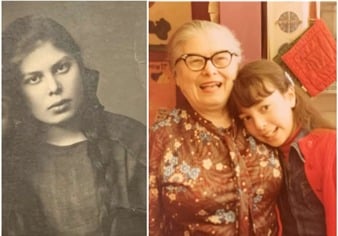
But alongside that physically present grandmother existed a parallel woman whose stories filled my childhood imagination and shaped my sense of who I wanted to be. That other woman posed for a photo in a Ciechanów photography studio in 1920 and her picture stared down at me from the fireplace mantle in my childhood home.
She had thick dark braids to her waist and large bittersweet chocolate eyes. She was a farbrende Zionist and studied Hebrew in the evenings with friends to prepare herself for life in the Land of Israel. Her father owned a shenk, an inn, and she helped him manage the business and serve the customers. When she was 14, I was told, she grabbed the wrist of a drunken Cossack and protected her father from having his beard shorn. She was the de facto head of the family, the one who navigated the process of immigration to Canada for her parents and younger sister.
I may not have seen evidence of my grandmother’s grit with my own eyes, but I drank up the stories about her childhood. When I was young, I solemnly told myself that I too would have burned with that same fire if I lived in Ciechanów, that I too would protect my family bravely, without fear. When relatives said that my father inherited my grandmother’s steely reserves and that he passed them on to me, I felt as though I had been handed a tiny pebble of superpower to hold in my pocket.
A few months ago, I visited Ciechanów, Poland for the first time.
When I landed in Warsaw, the extreme cold spell was newsworthy even for Poland, and the icy wind felt like mini knives nicking my cheeks. My Polish guide Zbigniew – who quickly offered that I call him Ziggy – drove us in his cozy overheated van.
The highway was mostly empty. The scene outside was all white. Every so often a random farmhouse or half-collapsed wooden shed appeared in the distance, but try as I might, I could not find a line between the white sky and the endless moonscape of snowfall.
When I visit Poland with groups, people often remark that they were half expecting to enter a black and white world to match their family’s old photos and the grim history. They are surprised to encounter a modern, colorful country. And yet on that drive to Ciechanow, the only color I could find were the green highway signs. Without them, it felt as though we were not just traveling north, but slipping backward in time, into the monochrome world of my grandmother’s albums.
As we pulled off the highway and got closer to the Ciechanów city center, I became giddy as I recognized the street names. I gripped the van door handle and called out “Yes! This street IS Plotz! Next goes Guberne!” Ziggy tried to share my excitement, but if I was the child who had just seen a life-size Mickey Mouse upon entering Disneyworld, he was the accompanying adult.
Ziggy parked the van next to Ciechanow’s center square, not far from a sushi restaurant and across from the site where my great-grandfather’s shenk once stood. In my grandmother’s day, the street was named for Berek Joselewicz, a Jewish-Polish military commander and hero. That was the Yosselevitche street that my grandmother had me memorize decades earlier when we sat by the window in my childhood home. Today, the street has been renamed for a Polish cavalry regiment from the Napoleonic Wars. The Jews are gone from Ciechanow, and with them much of that memory.
Still, I was proud to see that my grandmother’s home was right on the corner of the main drag. I had always imagined her world as hardscrabble and impoverished – an amalgam of “Fiddler on the Roof” and Chagall’s dreamy shtetl paintings. Seeing the inn’s prime location, I reconsidered and felt my genetic stock rise slightly. Standing in Ciechanow my teenage grandmother suddenly felt real, and for the first time I wondered whether she was as fearless as I had always believed. Maybe she was scared, but acted anyway? Maybe she had no choice?
The sidewalk next to the site of the former inn was slick with ice and I slid in my clunky Costco snow boots. If I slipped and died, I thought wryly, I wouldn’t be the first in my family line to meet my end here. I steadied myself and took out my grandmother’s Mizrachi Women pin which I had brought along and took a picture of it on the snowy sidewalk corner where her house once stood.
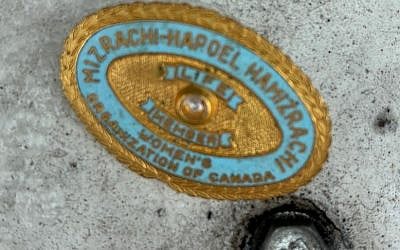
For a moment, everything blurred – the young woman in the Ciechanow photograph, the grandmother by the window, me as a little girl and me as a grandmother today. Time collapsed as past and present folded into each other.
Before leaving Ciechanów, we paid a visit to the site of the former Jewish cemetery, now a local park. The headstones were scattered around the town decades ago, though local efforts have begun to recover and return them. I trudged through the thigh-high pristine snowbanks and stood in the center of the field where a memorial stands. In my pocket, alongside my grandmother’s Mizrachi pin, I carried a small stone from my backyard in Israel.
Jewish tradition holds that one places a stone on a grave when visiting. One explanation is that the Hebrew word for stone, אבן ehven, is an acronym for both father/son/grandson and mother/daughter/granddaughter. Thus, it is said, by placing a stone on a grave, we emphasize the continuity of life and family in a place of death.
I balanced my garden’s rock on the icy memorial and tried to remember the traditional mourning psalms that one says at a grave. I couldn’t get past the first few phrases and was too cold to try to look them up on my phone. Instead, I closed my eyes and listened to the whistle of the wind. My nose started to run and reflexively I thought of the way my father would pull a handkerchief to his nose when we went sledding. It seemed apt. Standing in the resting place of my father’s ancestors I was able to hear him cheer me down the hill “Go, go, go!”
Anyone passing by might have assumed I was overcome with grief – a solitary figure in a long-destroyed cemetery. But in fact, standing there, I felt something else entirely. I felt steadied.
In Ciechanów, I was part of something larger than just myself. My roots lay beneath the snow, in that patch of earth. The street names I had memorized were not fragments of a legend — but real places. My grandmother was not only a character in stories, but a person who had lived, and who had loved me.
Standing there, I felt buoyed by that ehven. It reminded me that I have a past to lean on.
And now months later, sitting in the mamad with my granddaughters, I feel that ehven again. I feel a future that can support me, too.