‘Marginal’ Plunder

Lithuania’s Genocide Centre published the plunder, defended the plunderer and kept the word.
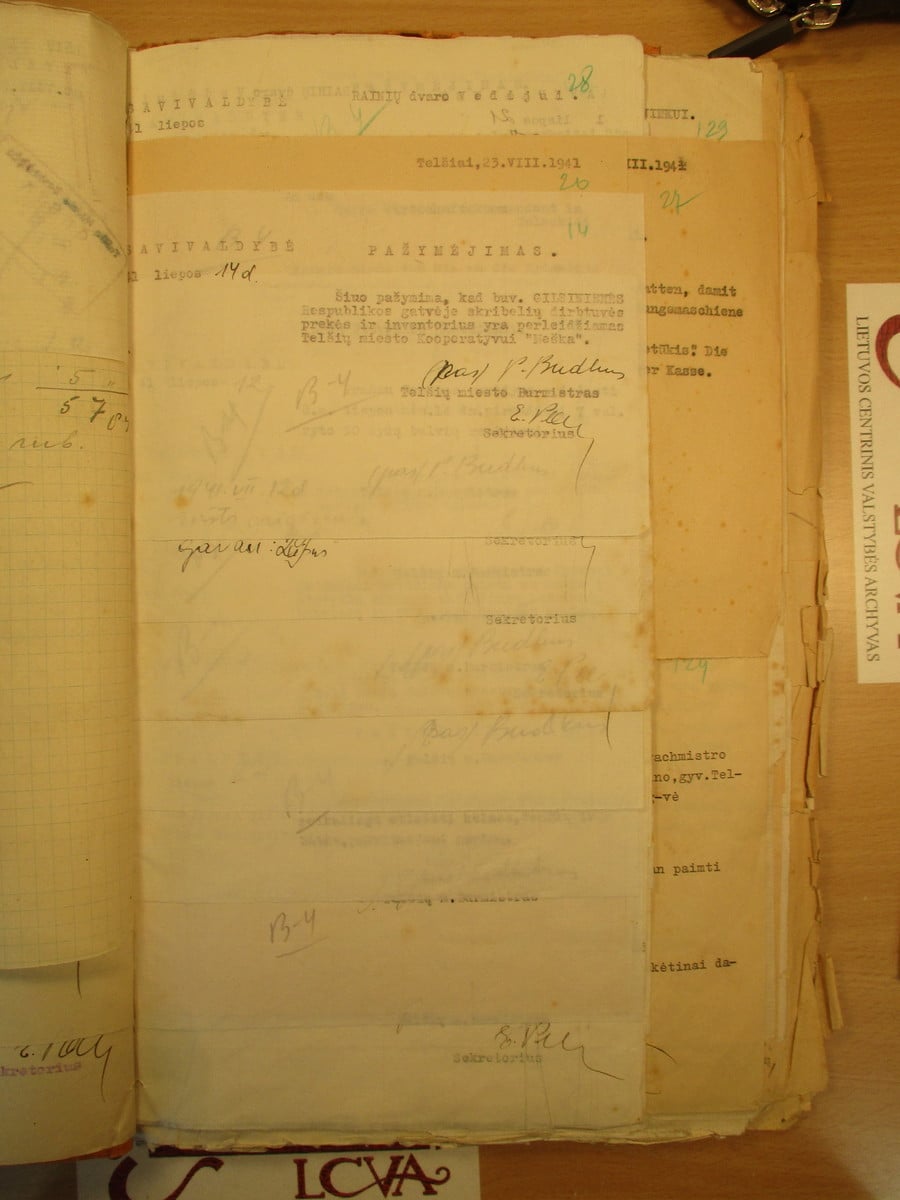
On July 7, 1941, a Lithuanian cart driver asked the mayor of Telšiai for Leibovičius’s carriage. He offered to pay in installments. His reason: Jews would no longer be in that business. As one man was being driven from his livelihood, another applied to city hall to take it.
Lithuania’s state-funded Genocide and Resistance Research Centre later published a description of Lithuanian participation as “supporting cast and thus essentially marginal.” On November 3, 2026, it refused to correct or annotate the passage. The application and the refusal belong together. What, precisely, is marginal about administering the dispossession of your neighbors?
The carriage had an owner
The cart driver’s application names Leibovičius, his former address and the carriage number. The applicant already had a horse and harness. He wanted to carry passengers to the railway and buses. If someone else had already received the carriage, he asked permission to find another.
His explanation: “aišku, kad jau žydeliai tuo verslu nebesivers.” In working translation: “it is clear that the Jews will no longer engage in this business.” Žydeliai is a derogatory diminutive.
He knew whose carriage he wanted. He counted on the owner’s exclusion to make it available.
This article follows ‘Marginal’ Murders, ‘Marginal’ Rapes and ‘Marginal’ Infanticide. This time the paperwork follows the possessions, many taken while their owners were still alive.
They called the theft just
The Lithuanian Activist Front claimed the plunder as a right. Its proclamation, reproduced in Rukšėnas’s 2017 study, page 8, promised Jewish property to Lithuanians, the most active fighters first. It called the transfer teisingu būdu—just.
On July 2, 1941, the Telšiai county chief declared that communists and Jews had fled and left property without care. He ordered it collected, allocated and stored. The Jewish owners had not vanished. They were alive in confinement, and needed municipal permission to recover necessities from their own homes. A July 5 certificate let a man and his wife take essential bedding, underwear and clothing into the camp, subject to inspection.
Three days later, police sergeant Augustinas Srėbalius applied for a sewing machine, sofa and two bedside cabinets from Jewish property in a warehouse, on installments. Prosecutor Antanelis had already received authorization for a dining table, six chairs and a radio.
The municipality appointed an official to supervise the property, transferred a hat workshop’s merchandise and equipment to the Talka cooperative, and authorized the removal of remaining Jewish property from Rainiai to Telšiai. When freelancers carried goods out of town, the mayor’s July 12 instruction sent police to check permits and return the goods to the municipal warehouse.
In mid-July, the Telšiai county chief called such taking an appropriation of svetimo turto—someone else’s property—and ordered the goods handed to the municipality. Officials knew whose property it was. They delivered it to themselves.
A child thrown out of a carriage
In her Telšiai testimony, Malke Gilis described students arriving with partisans to demand belongings. They took baby carriages, throwing the Jewish children onto the ground. After families surrendered their money and valuables, they had nothing left to buy food.
Khane Golemba’s testimony describes peasants around Nevarėnai receiving papers that let them confiscate Jewish cows, horses and farm equipment. Neighbors led the animals away, promising to return them after the war. At Viešvėnai, a woman obtained permission to take Golemba’s brother’s goat. His children pulled the rope from her hands. She struck them and took the animal.
At Ponary on November 21, 1941, Kazimierz Sakowicz recorded a Lithuanian rifleman selling women’s clothes beside the road. When the coats ran out, he told a man shopping for his wife that he would choose a Jewish woman exactly her size. The diary entry records the offer; Exactly Her Size follows it.
For the people robbed, possessions bought time. In Notes from the Valley of Slaughter, pages 58–59, Dr. Aharon Pick described four men in partisan armbands taking three of his new suits, his son’s only new suit, and other clothes and shoes. Sold, he wrote, those things could have kept him alive for more than six months.
Six months of survival went into somebody else’s wardrobe.
Noreika signed the distribution rules
Jonas Noreika’s August 6 order put Jewish property “left without care” under local control, with inventories and valuations. His August 16 supplement required the owner’s signature on the inventory.
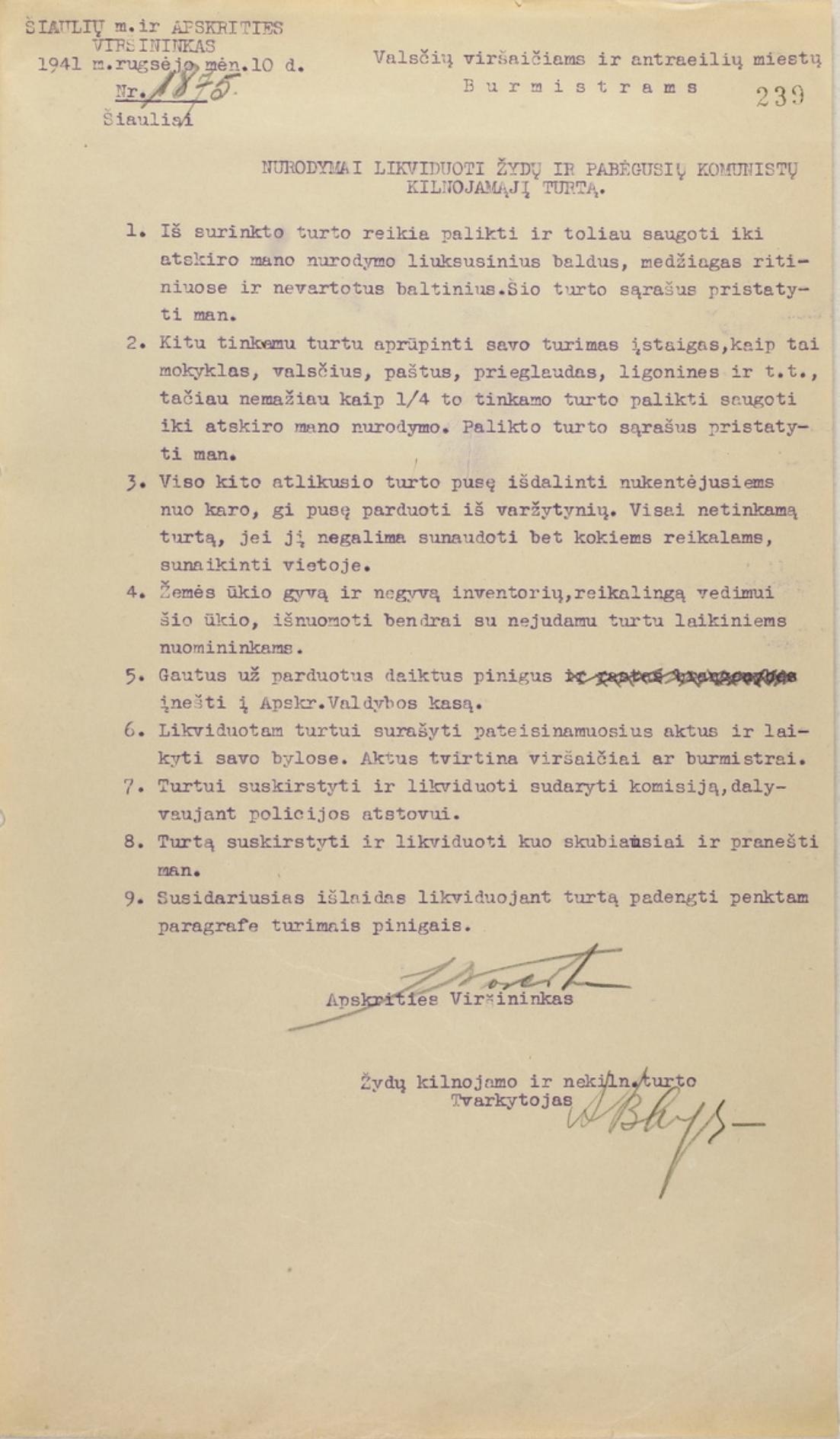
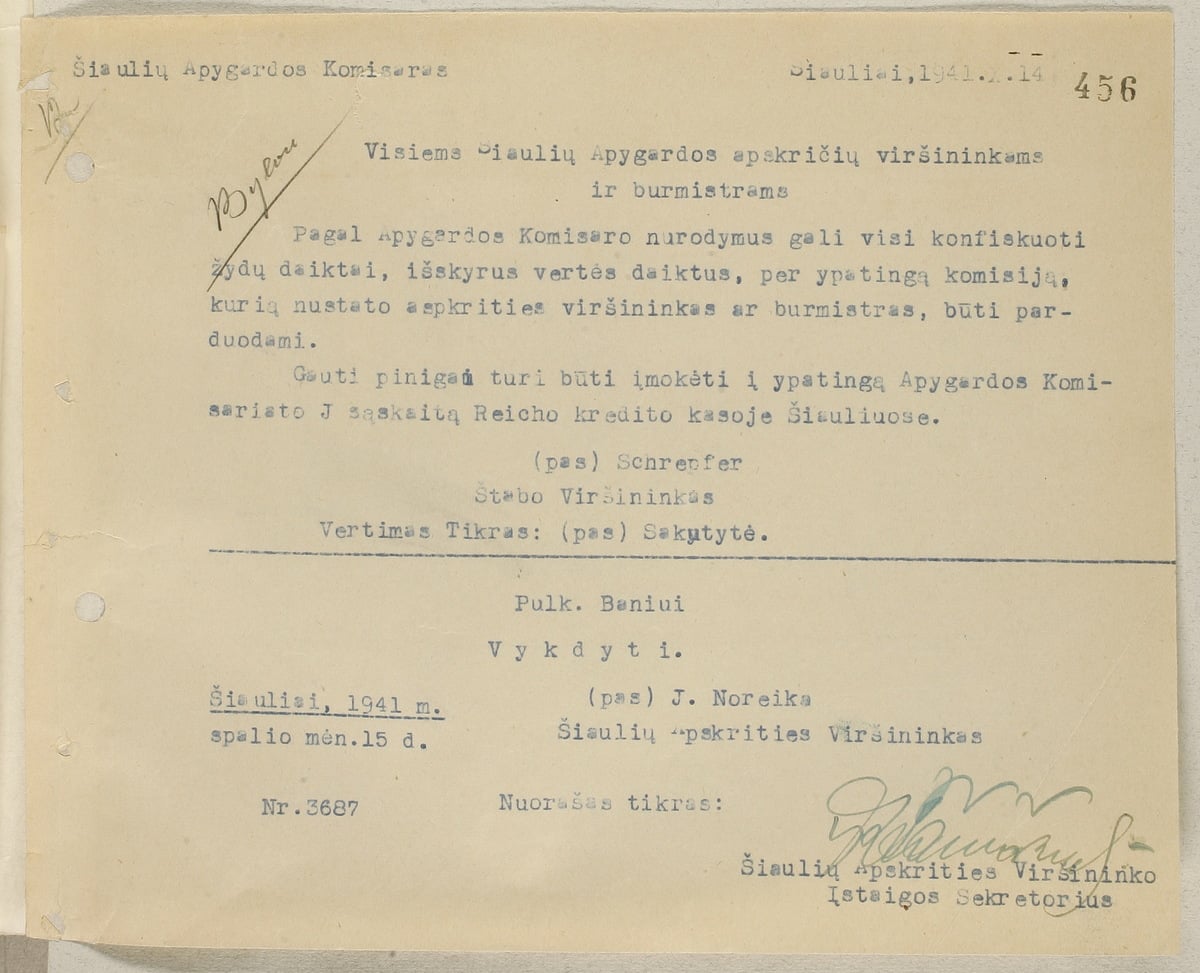
His September 10, 1941 instructions set out how to liquidate Jewish movable property. Luxury furniture, cloth and unused linen were to be reserved. Other goods would equip schools, hospitals and other institutions, with a quarter held back. Half the remainder was to go to war victims, half to auction. Commissions with police members were to run it. Proceeds were to go to the county treasury, and the costs of liquidation were to come out of them. The victims were to pay for their own dispossession.
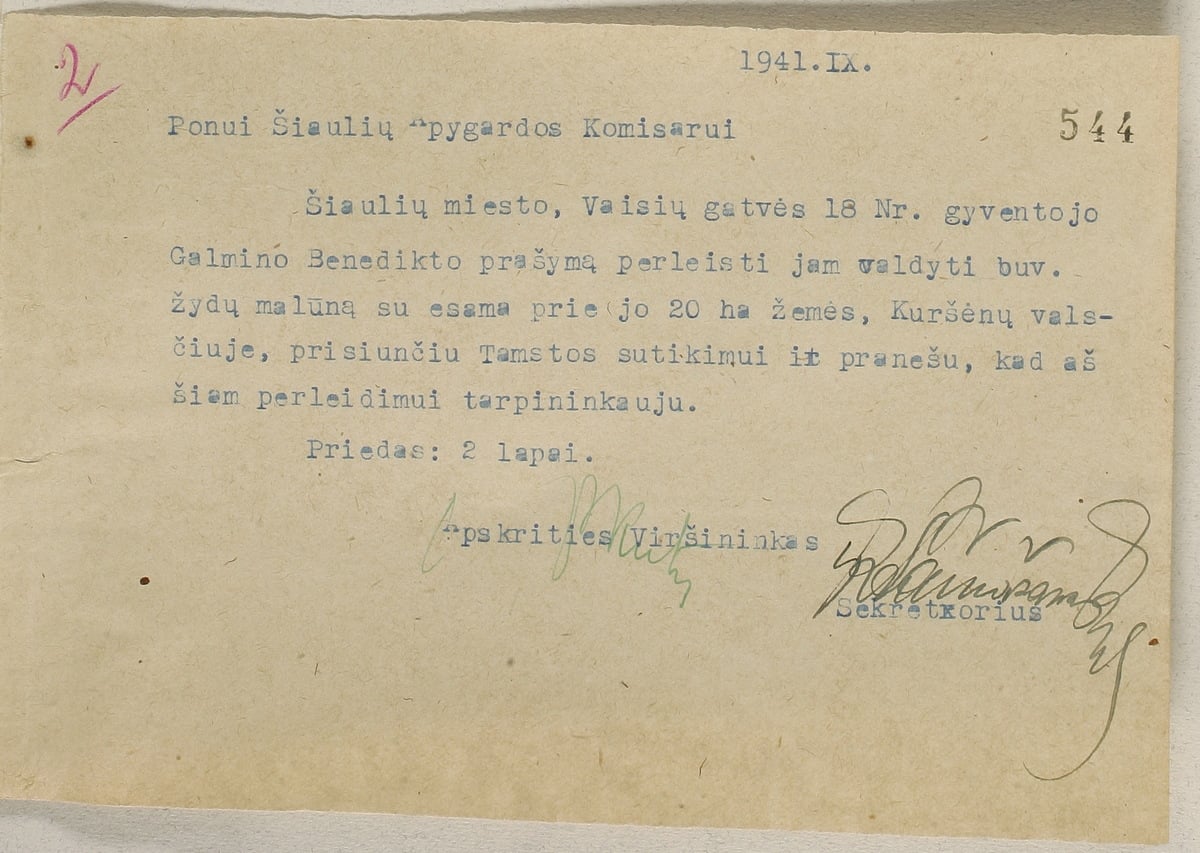
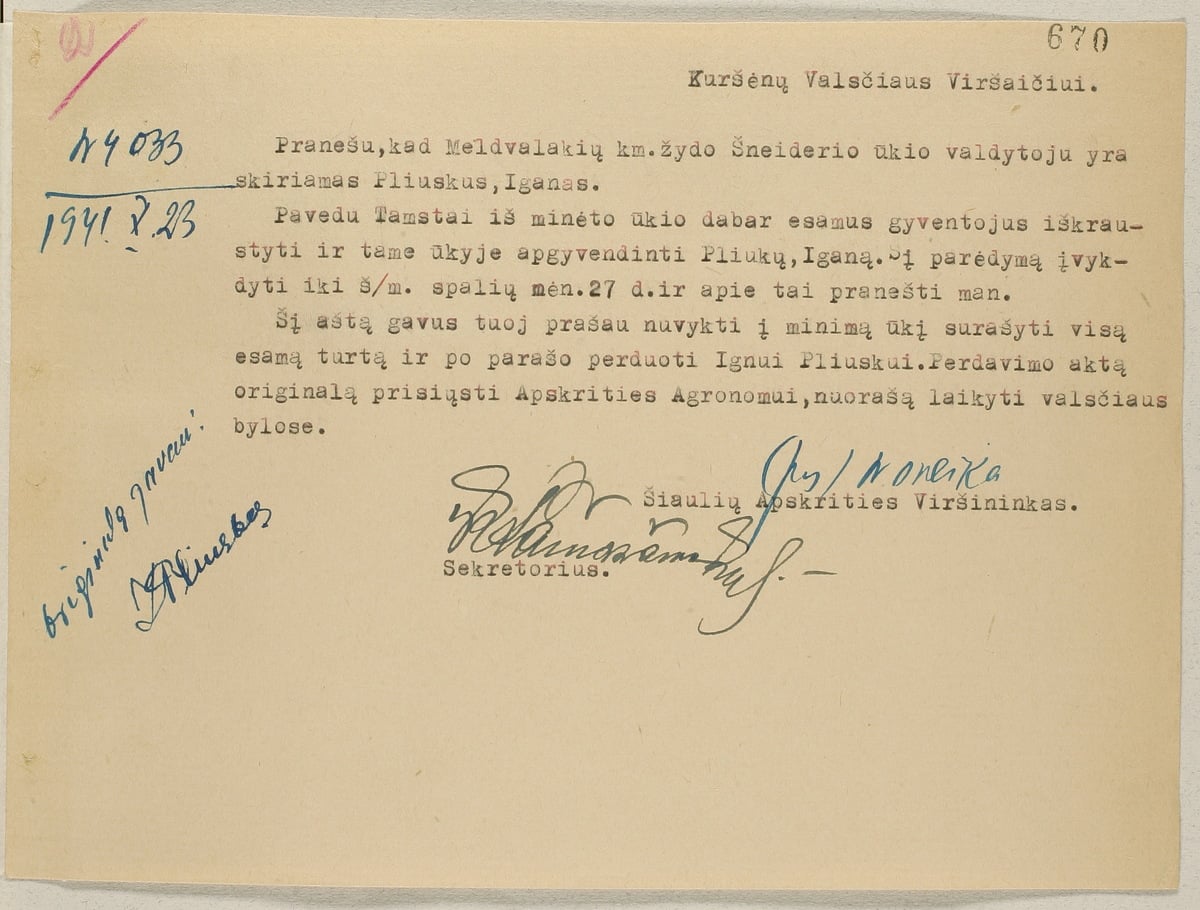
He also handled individual properties. He forwarded Galminas’s request to operate a Jewish mill and twenty hectares to the German commissar, as intermediary. He appointed Pliuskus to manage Šneideris’s farm, ordering the occupants removed and the property inventoried and handed over.
Then his own household took its share. His signed declaration of March 30, 1942 lists nine lots acquired from the Šiauliai municipal warehouse, among them two beds with mattresses, a desk, a bookcase and two bedside cabinets: Spintelės prie lovų. The objects match the buyers’ register entry reproduced in Silvia Foti’s The Nazi’s Granddaughter, page 235, which identifies the goods as Jewish property. The reverse values them at 460 Reichsmarks, payable in installments to the city’s finance department. Above his signature he wrote: “Daugiau jokio turto nesu įgijęs”—“I have acquired no other property.” An installment plan documents a transaction. It cannot supply the owners’ consent.
On October 9, 1941, in document No. 3282, Noreika asked the Papilė elder to give a primary-school teacher, Gužauskaitė, Jewish furniture and clothing without payment, because her family had lost a political prisoner to the Bolsheviks. His August 22 order had sent Papilė’s Jews to Žagarė. The allocation came seven days after the October 2 massacre there. Members of my own family lived in Papilė and were murdered in the Holocaust. The county chief could be generous because the property belonged to somebody else.
German authority is explicit in the commissariat sales instruction he forwarded for execution. It does not erase his signature or the local officials who carried out the distributions.
The Orliansky family had a home
In The Family Erased, Johnathan Orlianski, Rachel Hirshovitz Orliansky’s great-grandson, identifies the family home as Vaižganto 9 in Plungė: a shop downstairs, living quarters upstairs, and a chess table. Rachel was murdered at Kaušėnai, one of seven members of the July 1941 household who were killed. He states that Noreika and his family moved into the house that July.
I later bought the chess table from Noreika’s daughter and placed it on loan with the Šeduva Jewish Memorial Fund. The signed 2021 agreement, in both languages, identifies the table as Orliansky property later appropriated by Noreika. The family and the table are the subject of The Table of Truth, the September 2021 program with Shulamit Rabinovich, Faina Kukliansky, Silvia Foti, Dudu Fisher and me.
Against this record, the Centre now stands trial on six counts. Its authorship adds no evidentiary weight: I cite its statements as assertions, tested against the primary records on which the facts rest.
Count 1: It admitted the acts and erased the responsibility
The Centre’s October 2015 memorandum, page 5, filed Noreika’s September 10 liquidation order under Jewish “isolation,” then concluded he took no part in mass extermination. The order distributed the victims’ belongings and sent the money to the treasury. Calling it isolation leaves the theft unnamed. The memorandum records his property order, then invokes his civil office to deny participation in mass killing.
In his 2016 study, pages 51 and 53, the Centre’s historian Rukšėnas placed expropriation within the Holocaust and stated that Noreika himself handled the takeover and disposal of Jewish property. His page 59 conclusion opens: “Tyrimas iš esmės nepatvirtina … kad J. Noreika … buvo susijęs su Holokaustu”—the research essentially does not confirm that Noreika was connected with the Holocaust in the periods under examination. The same conclusion then acknowledges his role in expropriation and confinement, stages of the Holocaust. He denies the connection and describes it on one page.
His 2017 study, page 31, calls the Nazi-directed Jewish property reform an integral part of the Holocaust. The Centre’s own journal refutes any claim that dispossession stood outside the genocide.
Count 2: It recorded his loss and omitted his gain
The 2015 memorandum’s final page records that the Soviet sentence confiscated all of Noreika’s property. It says nothing of the furniture he acquired from the Šiauliai warehouse.
The Centre’s published examination failed to account for that acquisition. It must state what acquisition records it sought and what it examined.
Count 3: It answered occupancy with ownership
In paragraph 34 of its October 1, 2018 court response, the Centre rejected the house account partly because Foti had not been born. Her informant was her aunt Aldona, ten years old at the time (The Nazi’s Granddaughter, page 306). Foti’s birth date does not dispose of another person’s memory.
The Centre then cited Noreika’s absence from a 1942 list of Vaižganto Street homeowners. The account concerns occupation in July 1941. Ownership and occupancy are different facts, and the Centre’s own chronology moves Noreika to Šiauliai by August 1941. A later ownership list proves nothing about who lived in the house earlier. The Centre deliberately answered the wrong question, about the wrong year. It is a familiar move: it certified a German judgment it had not read and rebutted a witness by quoting a different book. Each time the answer looks like evidence and decides nothing.
Count 4: Its historians documented the plunder; its publications excused it
Arūnas Bubnys, the Centre historian who later compiled its 2020 volume, wrote a provincial study issued by the International Commission. Its page 18 describes “contributions” demanded from Jews within 24 hours under threat of shooting. Page 8 records Butrimonys police chief L. Kaspariūnas-Kasperskis leaving with seized property in fourteen or fifteen large carriages. Page 32 describes eight commissions at Veliuona, auctions on September 18, 19, 20 and 22, 1941, and about 200,000 rubles in proceeds. Page 34 records police at Zapyškis taking a bookcase and clock, the municipality a cupboard, desk and six chairs, and a German inquiry into valuables and money taken by Lithuanian officials involved in the extermination.
Rukšėnas’s 2017 study documents property confiscated from more than 445 Jewish owners and communities in sixteen Kaunas County districts in August and early September 1941, including 620 residential houses and fifteen synagogues. Part went to 254 residents and five institutions. That is one county.
Yet page 38 of the Centre’s 2020 volume has Furmonavičius pronounce the Lithuanian Provisional Government “clearly exempt from this charge”—the charge of collaboration with the Nazis in the Holocaust. On page 40, he infers an essentially marginal Lithuanian role from SS command structures. The officials still allocated the goods. The police chief still left with the carriages. German command does not make their acts disappear.
Count 5: It knew the property record and kept “marginal”
In paragraph 44 of its 2018 court response, the Centre admitted: “it is clear Noreika performed specific actions relating to the ordering of Jewish property.” It then assigned principal responsibility to German commissar Hans Gewecke. Paragraph 27 had already called Gewecke’s orders on ghettoization and “the seizure of their property” “mandatory” for district heads, Noreika included.
The Centre knew the acts. Its answer was the superior’s command. It made that defense in court in 2018, published Furmonavičius’s command-structure inference in 2020, and kept the word in 2026. In decision No. 55R-1130 of November 3, 2026, answering my request registered September 21 as 7R-1167, it declined to correct or annotate the passage, calling it the contributor’s scholarly interpretation. The signature is that of Arūnas Bubnys, acting Director General, who compiled the volume and wrote the provincial plunder study. Bubnys signed after a documented challenge, with the property record in his own study. Keeping the word was a conscious decision, taken under state authority. In my assessment, it is Holocaust distortion.
Count 6: It presented the property taker as a rescuer
In December 2019, the Centre presented Noreika as the organizer of a Jewish rescue network. The state had awarded him the Cross of Vytis in 1997. A school in Šukioniai bore his name.
The furniture declaration belongs beside those honors, with the distribution orders and the free allocation he requested for the teacher. An institution that presents a man as righteous must answer for the Jewish property he administered and took.
Verdict: the Centre’s own record convicts it
The IHRA working definition of Holocaust denial and distortion identifies intentional efforts to excuse or minimize Nazi collaborators and allies as distortion. Its broader guidance adds blurring responsibility for Holocaust crimes and honoring people complicit in them.
On these six counts, my editorial verdict is that the Centre’s defense of “marginal” is Holocaust minimization and distortion under IHRA’s standard. Its own publications and court filing identify the acts its command-structure argument diminishes. Its 2019 rescuer memorandum, the 1997 Cross of Vytis and the school’s former name fit the honoring pattern IHRA describes. IHRA has not adjudicated this passage.
Calling a proposition an interpretation does not exempt it from a standard written against minimization. The Centre chose to publish it. After a documented challenge, it chose to keep it. Public funding gives that choice the weight of the state.
My murdered relatives belonged to a Jewish civilization rooted in Lithuania. Nazi Germany and the Lithuanian officials, policemen and partisans who joined its crimes destroyed the communities that carried it. Homes were occupied, shops reassigned and belongings carried off because the owners had been stripped of the power to refuse. I inherited the absence of people who should have been my family. Now a state-funded institution tells me the local role was essentially marginal.
I will not accept that word as an account of my family’s destruction. A child thrown from a carriage is no less violated because the taker had a German superior. A county chief’s signature is no less consequential because Nazi Germany directed the genocide. The documents name the thieves and the officials who administered the theft. They took from people their own authorities had made helpless. “Marginal” demeans the victims and shelters the takers.
The Seimas must scrutinize this publication and the signed refusal against IHRA’s distortion standards. The Centre must retract or substantively correct the marginality formulation. Institutions that received Jewish property must obtain and produce the allocation records and name the owners it was taken from. Lithuania’s IHRA delegation must explain how defending this wording squares with the standards its alliance publishes.
Bubnys’s signature stands beneath the refusal. He and the Centre answer for keeping this word. The applications and orders name the people who took Jewish property, and the victims’ names survive beside them.
Which murdered Jew, which raped woman, which child, which stolen bed was marginal?
Credible corrections and additional primary records are welcome at ggochin@gmail.com.