A Swedish leftie is Painting Every Oct. 7 Victim
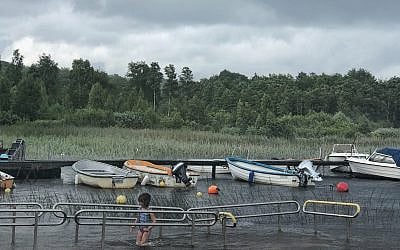
Autumn has a crisp grip on Sweden. I’m at home, in triple wool socks, bickering with the kids about their respective playdates and whom between me and my husband they expect to do the driving for them. I live in the calm southern Swedish countryside and my kids go to a school in a tiny village a few kilometers away. The school is gorgeous, it’s the middle of an apple orchard, five minutes from the beach, and every like minded, progressive, climate change aware parent around here puts their kids there. I love it, but it also means we have to drive the kids a lot. That and cleaning the house is a source of constant tension in our lives. It’s a cocoon, I realize, the lack of conflict in our lives. A privilege granted to very few people in the world. And it’s from this place I pick up the phone, that mid morning of October 7th 2023.
It’s my sister. She’s calling from a hotel room in Tel Aviv. She’s quite the globe trotter, my sister. She lives in Paris but goes to Miami, LA, Israel and Morocco all the time and when I see her name on the screen, the little Greta Thunberg in me has time to think that she does do a lot of flying, that sister of mine.
“How are you?” I ask.
She says something I don’t understand, and I look at my husband because he does actually read the news every day. He explains what’s happened, or what the world knows so far.
“We’re on the balcony watching the rockets”, she says. ”They’re shooting down every one. Sometimes we run to the hotel’s bomb shelter.”
They’d been in Ashkelon the day before, she says, and the rockets reached Ashkelon, so they’re grateful to be in Tel Aviv. That is scary, I think and my big-sister instinct kicks in full force. I want to know where she is and what can I do. I want to know how do I get her home. She’s in the middle of a war, it seems, logically, she can’t be there now. And so I open Google Maps to find her hotel.
Israel looks so small, it hits me. Is this the tiny strip of land everyone keeps fighting over?
I should explain who I was before that day. As every parent in my kids’ school, I too am a progressive. I’ve always voted for the Green Party, in fact, for a few years I was an active member. And as a Awedish progressive I’ve absorbed the standard story: Israel is the aggressor, Palestinians are to be pitied. So before I really understand what is happening on October 7th, my first instinct, shameful, but worth admitting because it shows how deep that conditioning runs, is that maybe this will finally force a solution. That thought only lasts a few minutes though.
Then my sister tells me she’s pregnant. I’m about to become an aunt for the first time and the father of that child is Jewish.
Over the following hours, the picture becomes clearer, and my sympathies shift. My mother, in Malmö (the same town where Eurovision contestant Eden Golan had to disguise herself to move around), tells me people are celebrating in the streets, waving Palestinian flags. I don’t want to believe her. They don’t understand, I explain to her, they’re just protesting the occupation, not celebrating.
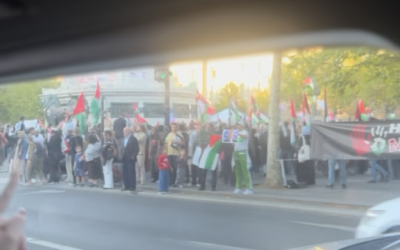
In the days after, I try to work out how to get my sister home. Every flight is cancelled. The Swedish Foreign Ministry quietly suggests she rent a car and drive out, through countries I couldn’t even picture a safe route through. Swedish TV interviews her about being stuck in Israel, but she doesn’t want to say her name, afraid of the online crowd. Maybe rightly so. I do watch people online I’d long agreed with be outraged that political leaders stood with Israelis on the day of the massacre. I push back, gently, saying we should stand on the side of the victims today, but reassure them that my sympathies for Israel may be temporary. I’m nevertheless called a “disgusting Zionist.”
Deep inside, I know from the start it’s not temporary. I’m not going back. I can’t unlearn that Israel had withdrawn from Gaza in 2005, for example. And, as sometimes happens to people when their worldview is shattered, I become obsessed. I read books, listen to history podcasts, chase footnotes and citations. All while watching the same people who’d shaped my old views spread claims about Israel that had no basis at all.
And in the middle of all of this is my sister, pregnant with a soon to be little Jewish boy while Jews everywhere are expected to answer for a war they had no part in starting. That’s when my support for the Jewish people, not just for Israel as a state, begins to take shape.
I wish I could say it doesn’t matter, but it costs me. I see my social feed filled with opinions I can no longer share and there’s something wrong with me. I can’t shut up. I have to point out logical fallacies and factual errors and people that I love and who once loved me begin to see me differently. Some agree to disagree. Others don’t. I lose close friends. An old friend from college and an ex boyfriend, both people I hold dear and who don’t know eachother take turns scolding me. “It’s my damn duty to tell you when you’re out of line”, one of them proclaims. I see parents from school unfriending me, party invitations show up to everyone but us and some don’t even say hello anymore.
Yet, I can’t keep my mouth shut. I feel like the people around me look at me like they would a flat earther, no matter how sound and fact based my arguments are. And even if it hurts, the truth is more important. The most important, actually.
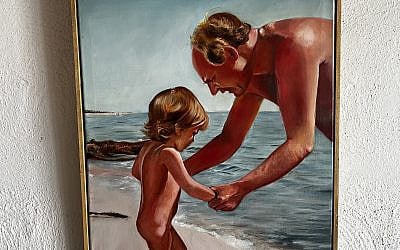 Through all of it, I keep doing what I do. I paint. I create family scenes out of oil on canvas, trying to spread love and warmth in a cold world, I don’t yet know how to combine my art with this newly found passion to defend the Jewish people.
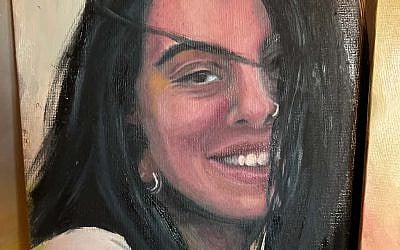 Then, the world meets the Beautiful Six.
In August 2024, the world learns about six hostages taken on October 7th and held for eleven months: Carmel Gat, Hersh Goldberg-Polin, Eden Yerushalmi, Almog Sarusi, Alex Lobanov, and Ori Danino. They are executed in a tunnel in Rafah days before Israeli forces reaches them. The tunnel’s entrance is hidden inside a child’s bedroom, with Mickey Mouse and Snow White on the walls.
I can’t stop thinking about those young people. About them having lived for eleven months in tunnels, with nothing but hope just to get executed underneath a child’s room. And suddenly, I understand exactly what I need to do.
I paint each of them, one by one, and post the process on Instagram. By chance, the portrait of Almog reaches his former boss, who asks to buy it for his family. I tell her I’d give it to her, but she offers to cover the shipping so she can be the one to give it.
The portrait finds its way home. I’m hoping they all will one day, but until they do I want to do more. I decide then that I’m not going to stop at these six.
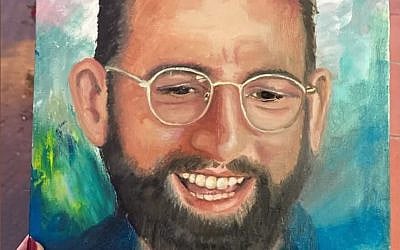 I just don’t know how yet. I’m inspired by the artist Louisa Schmolke, who made a memorial piece: a year of memories rendered as small squares and think I’ll do the same, but for every person murdered that day. Ten portraits a day, five days a week, minus summer and the winter holidays. I do the math and figure I’ll be done within a year. Maybe less.
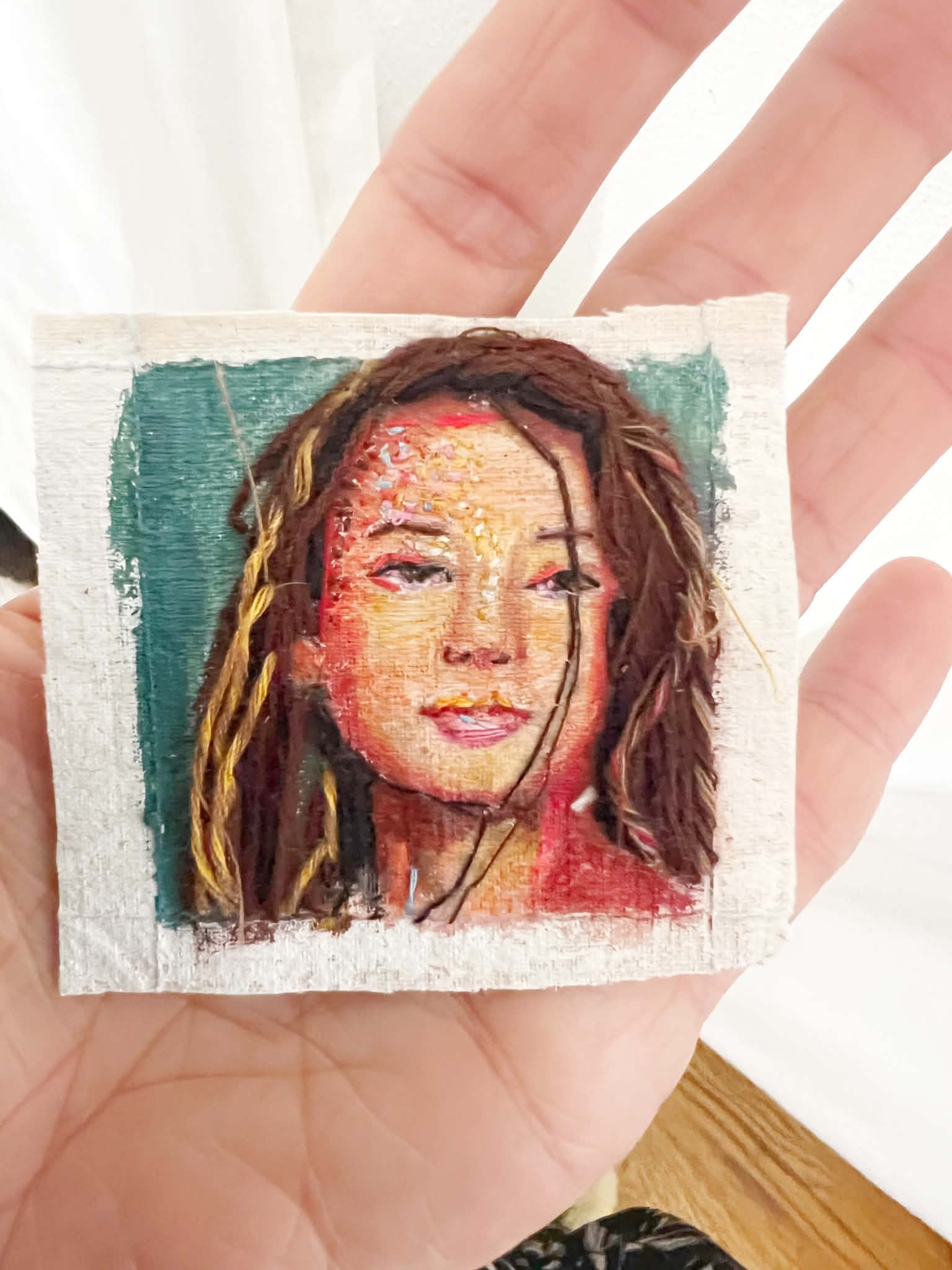
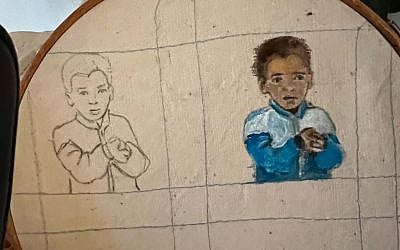 But while trying it out, drawing becomes painting. Paper turns to fabric and stitches appear. I start really, really experimenting.
The first portrait I’m genuinely happy with is that of a soldier with sunglasses and vivid red lips whose name I no longer remember. I assume I’ll come across him again before this is over. The portrait is five by five centimeters, painted and then embroidered, and comes alive in a way the pure-paint or pure-embroidery versions haven’t.
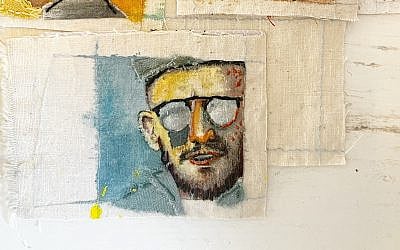 I make lists, track down photographs and print them. I start filming short videos for social media, saying a few words about each person. But once I understand each portrait takes three hours on average, depending on hair and details, filming in parallel becomes impossible to sustain. To still give each person something, I start writing their portraits, alongside the image, on a Patreon page I set up to help fund the work.
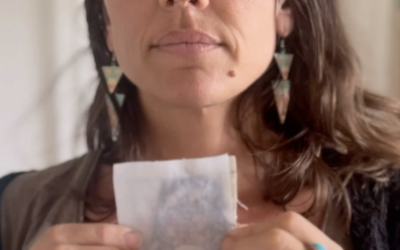
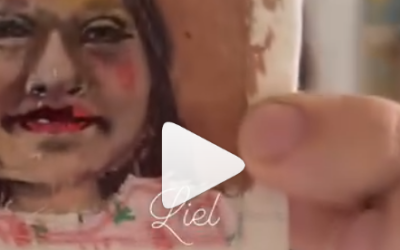 Then two things happen at once. The Jewish community of Stockholm reaches out. So does an art curator in Paris, co-organizing a project called Collectif 7 Octobre, art and panel discussions to mark the two-year anniversary of the massacre. Since the same material can’t be shown in two cities on the same day, we split it: Stockholm exhibit the Beautiful Six alongside everything I’d completed by then, around 120 portraits. Collectif 7 Octobre commissions larger-format portraits of some of the better-known hostages and victims, made with the same technique.
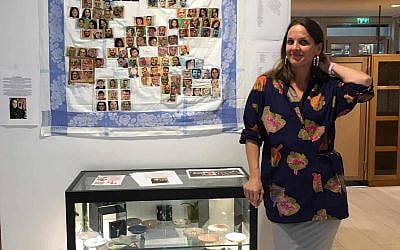
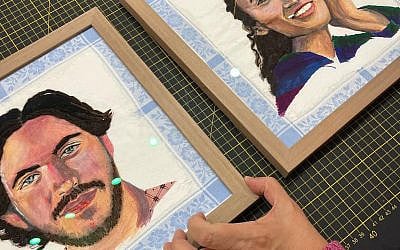
It is glorious. And sad, of course. This project should never have had the opportunity to take shape.
Today, I’m about to start my third year on the project. As of this writing, I’ve completed over 310 portraits. That is roughly 930 hours of work, 1000 if we count the social media and preparations…
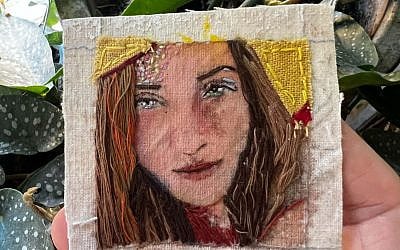
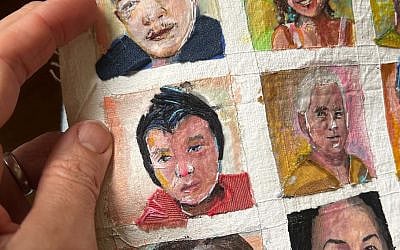 What, then, is the vision? Well, when the portraits are finished, they’ll come together into a single quilt, roughly 4 by 2.5 meters. At its center a large Tree of Life. The portraits will grow outward from its branches, arranged by where each person died. Beside the piece, a map will show visitors where to find each name.
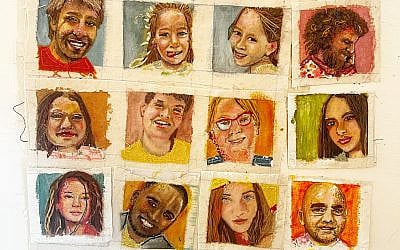 I want the scale of what happened that day to be visible, hundreds of individual faces, brought into one large piece of work, without letting a single one of them disappear into the crowd.
Because behind every number is a someone. Someone who was loved. Someone who had a life, a family, plans, a favorite ice cream flavor and maybe a silly walk they kept to amuse a select few.
I can’t bring any of them back, of course. But I can make sure that, in this small corner of the world, they are seen.
So I keep painting and telling their stories.