


Geopolitical Analyst: Bridging Somaliland & Israel to the world
A Warning, Not a Roadmap: Diagnosis, Not Endorsement
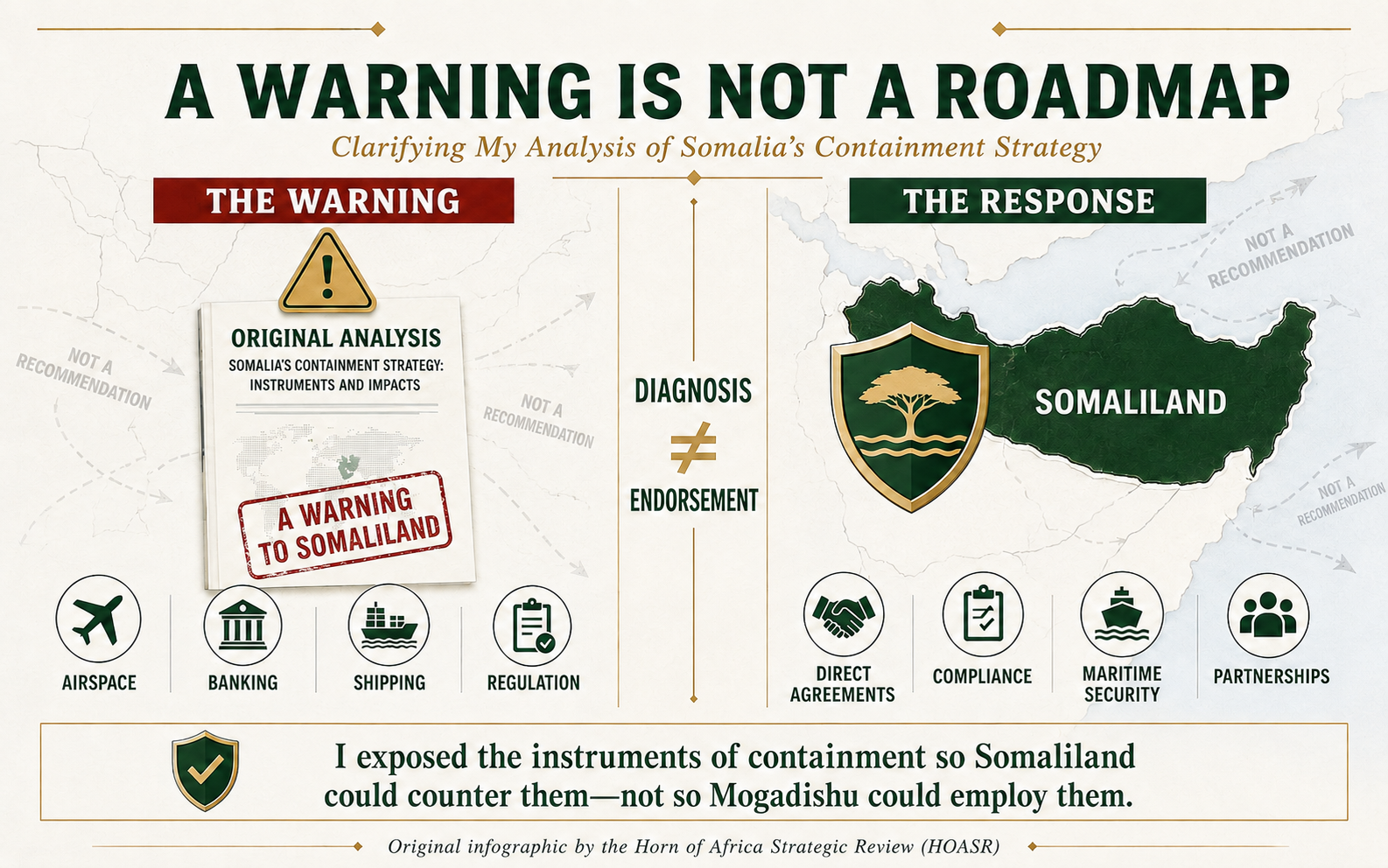
A Warning Is Not a Roadmap: Clarifying My Original Analysis of Somalia’s Containment Strategy
Dawan Africa did not invent the argument, but its framing risks turning a defensive diagnosis into an apparent strategy for Mogadishu.
On August 25, Dawan Africa published an analysis titled “Somalia’s Strategy to Contain Somaliland: Why Israeli Recognition Alone May Not Be Enough,” drawing extensively on my August 20 essay in The Times of Israel, “Somalia’s Strategy to Contain Somaliland: Israel Recognition Alone Is Not Enough.”
Dawan Africa https://www.dawan.africa/news/somalias-strategy-to-contain-somaliland-why-israeli-recognition-alone-may-not-be-enough-analysis credits the original article and reproduces much of its central argument with reasonable accuracy. It also includes several elements of the counter-strategy proposed for Somaliland and Israel. The problem is more subtle: its headline and organizing frame place Mogadishu’s instruments at the center, creating the impression that my purpose was to advise Somalia on how to obstruct Somaliland.
It was not.
The original article was a strategic warning addressed principally to Somaliland and Israel. It identified the instruments available to Mogadishu so that Hargeisa and its partners could anticipate, reduce, and ultimately overcome their effects.
Describing a strategy is not endorsing it. Identifying a vulnerability is not recommending that an opponent exploit it.
Administrative lawfare was a warning
The original article used the term “administrative lawfare” to explain how Somalia can employ the privileges attached to international recognition without exercising actual governmental authority inside Somaliland. The relevant instruments include airspace administration, financial compliance, maritime documentation, insurance classifications, multilateral diplomacy, and corporate risk procedures.
Many of these systems serve legitimate purposes. Aviation regulations should protect passengers. Financial compliance should prevent money laundering and terrorist financing. Maritime documentation should improve safety and commercial accountability.
The problem begins when technically necessary systems are deliberately used to advance a political claim over territory that Mogadishu does not govern. My argument was not that Somalia should weaponize aviation, banking or shipping rules. It was that Somaliland must recognize the danger of allowing its international access to remain permanently dependent on institutions controlled by a government that openly contests its sovereignty.
Corporate compliance is not political consent
The phrase “corporate compliance arbitrage” describes a related vulnerability. When Mogadishu and Hargeisa issue competing instructions, international airlines, banks, insurers and shipping companies usually choose the authority carrying the least legal and commercial risk. That does not necessarily mean those companies accept Somalia’s political argument.
It means their lawyers and compliance departments prefer the internationally recognized authority. Mogadishu can then present those private commercial decisions as evidence of sovereign control, although the companies may simply be protecting themselves against regulatory uncertainty.
The practical answer is for Somaliland to build institutions that meet or exceed international standards, obtain direct agreements with recognized partners, and give companies credible legal and commercial reasons to engage with Hargeisa. The original article explicitly rejected parallel systems designed to evade international regulation. Its recommendation was compatibility, transparency, and stronger compliance without political control from Mogadishu.
Dawan is a derivative source
The Dawan article should therefore be understood for what it is: a secondary summary of an argument originally developed in my Times of Israel article. It should not be cited as independent evidence that Somalia has successfully implemented every instrument described, nor as separate confirmation of the original analysis.
Its importance lies elsewhere. It shows that a warning written for Somaliland and Israel has entered the Mogadishu-centered policy conversation. The concepts of administrative lawfare and corporate compliance arbitrage are now being read by opposing media as a description of how Somalia might contain the practical effects of recognition.
That development should be taken seriously. Somaliland analysts must assume that publicly identified vulnerabilities will be studied by competing actors. The appropriate response is not to avoid discussing those vulnerabilities. Silence would leave Somaliland less prepared. The answer is to connect strategic diagnosis to an actionable counter-strategy.
The original argument included the counter-strategy
The second half of the original article explained how Somaliland and Israel could prevent recognition from becoming an isolated diplomatic event. It proposed work on financial compliance and transaction security; maritime safety and professional coast-guard capacity; water, agriculture and renewable energy; university partnerships and technical education; investment screening and commercial due diligence; and internationally credible port and customs standards.
These recommendations were designed to make recognition useful without turning Somaliland into an arena for unnecessary military confrontation. If Somalia’s leverage operates through international systems, Somaliland’s answer must be stronger international integration—not rhetorical denunciation alone.
The real lesson
Somalia’s recognized status gives Mogadishu instruments that Somaliland cannot afford to ignore. Identifying those instruments does not make their use legitimate, inevitable, or impossible to overcome. Nor does international recognition give Somalia actual administrative control over Hargeisa, Berbera, Borama or the Somaliland institutions that have governed the country since 1991.
The contest after recognition is therefore not simply over flags and diplomatic announcements. It is over whether Somaliland can translate political recognition into functioning financial, commercial, technological, and institutional relationships.
That was the purpose of the original analysis. It was a warning to Somaliland and its partners: recognition must be consolidated before its opponents can contain its practical benefits. Dawan Africa has demonstrated that the warning has been heard in the opposing policy conversation. Somaliland’s task now is to ensure that it is acted upon first in Hargeisa.