


Geopolitical Analyst: Bridging Somaliland & Israel to the world
Somalia’s Strategy to Contain Somaliland: Israel Recognition Alone Is Not Enough
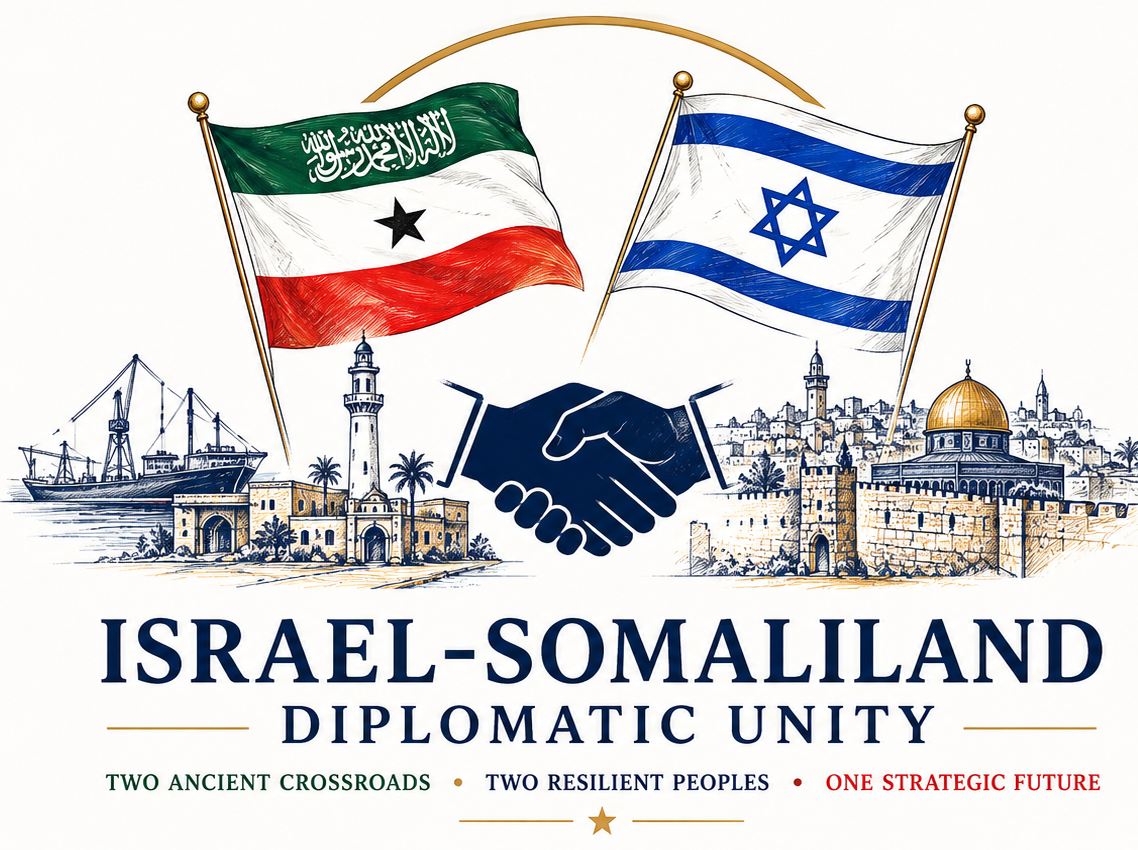
Graphics design illustration of Israel-Somaliland flags showing the two resilient peoples shaking hands symbolizing one strategy in their diplomatic relations and unity. Poster design & credit: author
What Israel Could Do to Help Somaliland Break the Diplomatic and Economic Deadlock
Recognition Is Only the Beginning
Israel’s recognition of Somaliland would not, by itself, settle the long-running dispute over Somaliland’s international status. Recognition can open a diplomatic door, but whether that door leads to wider international acceptance depends on what happens afterward.
The central problem is an asymmetry between de facto control and de jure recognition in International Law. Somaliland has developed many of the attributes normally associated with a functioning state: its own political institutions, security forces, judiciary, currency and administration. Yet Somalia retains the internationally recognized sovereignty of the territory of the former Somali Republic and, consequently, occupies the stronger position within the established international legal and institutional system.
That asymmetry gives Mogadishu an unusual form of leverage and power over Somaliland. Somalia does not necessarily have to defeat Somaliland militarily to obstruct its international integration. Instead, it can use the privileges attached to recognized sovereignty—over aviation, finance, maritime regulation and multilateral diplomacy—to make international engagement with Somaliland more complicated, difficult and costly. By using this regulatory authority (“administrative lawfare”) and international institutional status, Somalia is able to constrain Somaliland without relying primarily on military force.
This produces two interconnected contests.
The first is the contest over Israel’s recognition itself: can Somalia delay, weaken, isolate, challenge or ultimately undermine the significance of the first recognition?
The second is the contest over precedent: can Somalia prevent Israel’s recognition from becoming the beginning of a broader domino effect sequence of recognitions?
Somalia’s Strategy: Frustrate the First Recognition and Prevent the Second by Using the Following “Sovereign Recognition” Powers:
Somalia is actively turning International Recognition into an Administrative Problem. its most powerful advantage is not necessarily what it can control physically, but what it can influence through international systems.
International airlines, banks, shipping companies, insurers and development institutions operate according to regulatory frameworks. When two authorities issue competing instructions, private companies generally favor the authority whose legal status is internationally recognized.
This creates what is called “corporate compliance arbitrage.” In other words, a company does not necessarily have to accept Somalia’s political argument about Somaliland. It only has to decide which authority presents the lower legal and commercial risk.
The result is important: Somalia can reinforce its sovereignty claim through the everyday decisions of private companies.
Recognition therefore becomes more than a diplomatic question. It becomes a question of whether airlines can fly freely, banks can clear international payments, ships can operate efficiently, insurers will cover commercial activity and investors can obtain predictable financing.
Airspace Control as a Sovereignty Lever
Aviation is one of the clearest examples of how international legal sovereignty can become practical leverage. The Somali Civil Aviation Authority regained internationally recognized control of the Mogadishu Flight Information Region (FIR) at higher flight levels in 2023. This gave Mogadishu regulatory authority over airspace covering the former Somali Republic, including Somaliland.
The significance extends beyond air-traffic management.
If international carriers must obtain federal authorization before operating flights, Mogadishu can make diplomatic visits and international travel to Hargeisa more cumbersome and costly. For example, following the famous Ethiopia-Somaliland Memorandum of Understanding (MoU), Ethiopian Airline delegations were denied flight clearances to Somaliland. Recently, the mandatory E-Visa required to buy ($64) for Somalilanders to travel to Hargeisa, is another example that created problems for for both the government and travellers.
Somaliland’s attempt to instead operate its own aviation procedures has also produced competing instructions for aircraft. The resulting safety concerns have given Somalia an additional argument it has won before international aviation institutions.
The broader Somalia strategy is therefore straightforward: make international aviation to Somaliland dependent on Somalia’s recognized regulatory position.
Banking and Financial Infrastructure
The same principle operates in finance. Somalia’s internationally recognized central bank occupies the sovereign position within the country’s formal monetary system. Somaliland-based financial institutions that operate across borders therefore face an environment in which international banking relationships can be affected by federal regulatory structures.
Anti-money-laundering and counter-terrorist-financing requirements add another layer.
International correspondent banks are highly sensitive to compliance risks. Somalia’s recognized financial-intelligence and regulatory institutions can therefore become an important intermediary between Somaliland’s financial sector and international banking networks.
This matters because diplomatic recognition without financial connectivity can remain largely symbolic.
A country may recognize Somaliland politically, but if banks, remittance companies and investors remain uncertain about the regulatory environment, the practical economic benefits of recognition can be limited.
Somalia’s broader strategic objective, from this perspective, is to ensure that international economic integration continues to run through institutions associated with Mogadishu.
International Financial Institutions
The problem extends beyond commercial banks.
The World Bank, IMF and other international financial institutions traditionally work through internationally recognized sovereign governments.This leaves Somaliland dependent on project-specific and indirect financing rather than normal sovereign access to major multilateral financial mechanisms.
This creates another form of structural asymmetry.
Somaliland can demonstrate domestic competence, attract private investment and operate infrastructure such as Berbera port, yet still lack the sovereign financial channels available to recognized states.
Thus, Somalia does not need to stop every foreign investment in Somaliland. It can preserve a wider institutional structure in which Somaliland remains economically functional but internationally constrained by preserving the existing hierarchy.
Maritime Regulation as Another Choke Point
The maritime domain is particularly important because Berbera is one of Somaliland’s most strategically significant economic assets.
Somalia’s continues to reinforce its international maritime position through accession to international maritime conventions and the assertion of regulatory authority over shipping and ports.
Like the E-Visa, its Electronic Cargo Tracking Number requirement illustrates how such sovereign authority can reach into commercial operations in the Red Sea.
If shipping companies must satisfy federal documentation requirements before entering ports, international logistics companies effectively become participants in Somalia’s regulatory system—even when the physical port is administered by Somaliland.
The same problem appears in insurance.
Somaliland can provide its own maritime security, including coast-guard escorts and the Berbera Secure Approach Protocol, but international insurers operate according to sovereign recognized risk classifications and institutional procedures. Without recognized sovereign standing, Somaliland has limited ability to influence those international classifications directly.
The consequence is an economic paradox: Somaliland can secure the port operationally while still paying an international price for its unresolved legal status.
The African and Multilateral Consensus
Somalia’s most consequential strategy may ultimately be diplomatic.
Somalia’s argument is built around principles deeply embedded in the African and international order: sovereignty, territorial integrity and respect for inherited borders. The African Union, Arab League, United Nations and IGAD frameworks are invoked as important institutional anchors for this position.
This allows Mogadishu to present recognition of Somaliland not simply as a bilateral question between Somalia and Somaliland, but as a question involving the stability of Africa’s existing territorial order.
The Ethiopia-Somaliland MoU demonstrated the potential effectiveness of this approach. When landlocked Ethiopia decided to recognize Somaliland in exchange for access to the Red Sea, Somalia responded by mobilizing Turkey, Egypt, the Arab League, the AU and IGAD, helping create diplomatic pressure around Addis Ababa’s proposed arrangements with Hargeisa.
The same logic can be applied to future recognition.
If Somalia can persuade regional organizations and individual governments that recognizing Somaliland would create an undesirable precedent, a country considering recognition faces not merely a bilateral disagreement with Mogadishu but potentially a wider diplomatic cost.
Making Somaliland’s Territorial Question More Complicated
Somalia has another tool: internal administrative politics.
The recognition of the SSC-Khatumo administration, particularly in areas including Las Anod and the wider Sool, Sanaag and Cayn regions, provides Mogadishu with an argument that Somaliland does not exercise uncontested authority over the entire territory it claims.
This is significant because Somaliland’s historical statehood argument is closely associated with the boundaries of the former British Somaliland protectorate.
If Somalia can portray those boundaries as politically contested on the ground, it can complicate and delay Somaliland’s diplomatic case.
The issue therefore becomes not simply “Should Somaliland be recognized?” but also “Which territory would recognition encompass, and who exercises legitimate authority over it?”
That distinction can slow the emergence of a second recognition.
Making the First Recognition Isolated
Taken together, these instruments serve a larger strategic purpose.
Somalia does not necessarily have to persuade every country that Somaliland has no functioning institutions. It can instead make recognition appear costly, legally complicated or diplomatically premature.
The objective is to prevent a chain reaction or a domino effect of recognitions.
If Israel recognizes Somaliland but other states decline to follow, Mogadishu can argue that Israel’s position is an exception rather than the beginning of a new international consensus.
This is the central strategic danger for Hargeisa: the first recognition can remain politically important but institutionally isolated.
What Israel Could Do to Help Somaliland Overcome Mogadishu’s Strategy.
If Somalia’s strategy operates through institutional and economic systems, Somaliland’s response cannot rely exclusively on political declarations.
Israel’s cooperation could be most effective when concentrated initially on civilian technology, commercial relationships, financial modernization, maritime safety and human-capital development rather than actions that could be interpreted as preparations for military confrontation.
The following counter-strategy objectives could transform recognition from a diplomatic event into a broader pattern of practical international integration:
1. Build Commercial Relationships That Outlive Political Disputes
One route is to deepen private-sector and chamber-of-commerce relationships.
Establishing the Israel-Somaliland Chamber of Commerce and its relationship with the Somaliland Chamber of Commerce can become a potential platform for trade facilitation, business vetting and investment due diligence.
This approach matters because commercial relationships can develop even where formal diplomatic relations remain politically sensitive.
Rather than making every interaction a confrontation over sovereignty, Somaliland could seek to demonstrate that engagement with Hargeisa produces tangible commercial value.
Israel’s comparative advantages in agriculture, water technology and industrial equipment could also support commercial partnerships with Somaliland companies.
The strategic principle is simple:
The more international companies, investors and institutions have legitimate economic interests in Somaliland, the more difficult it becomes to treat the territory as an isolated diplomatic exception.
2. Make Water and Agriculture the Face of Cooperation
Water security offers an especially useful field for cooperation because it is simultaneously strategic and civilian.
Israeli expertise in precision agriculture, drip irrigation, desalination and water recycling could support Somaliland’s agricultural and livestock sectors.
Such projects have an advantage over purely political initiatives: their benefits can be measured.
A successful water project, agricultural technology program or livestock-support initiative does not require the international community to resolve the sovereignty dispute before people see its value.
Over time, successful civilian cooperation could help reinforce Somaliland’s image as a capable, outward-looking and economically viable society.
3.Strengthening Energy and the Berbera Economic Ecosystem
Energy infrastructure is another area where technical cooperation could produce strategic effects without necessarily becoming a geopolitical confrontation.
Strengthening Somaliland-Israel cooperation in solar power, microgrids and energy efficiency, including applications around the Berbera Economic Zone.
Reliable and affordable energy improves the competitiveness of virtually every other sector: manufacturing, logistics, telecommunications, water systems and commercial services.
For Somaliland, this means that recognition could increasingly be associated with economic opportunity rather than simply diplomatic symbolism.
4. Helping Somaliland Build Internationally Credible Financial Compliance
Financial modernization may be even more important than headline investment.
Somaliland’s financial institutions could benefit from Israeli expertise in technology and technical assistance aimed at compliance, risk screening, transaction security and transparent due diligence.
The purpose should not be to create parallel systems designed to evade international regulation. Quite the opposite: it should be to make Somaliland’s institutions demonstrably compatible with international standards without Mogadishu’s control.
That distinction is critical.
If Somaliland can demonstrate strong anti-money-laundering controls, transparent corporate structures and credible financial supervision, foreign banks and investors have stronger grounds to engage with Hargeisa on commercial rather than political calculations.
Israel’s contribution could therefore be most valuable where it helps Somaliland reduce the compliance risks that currently make international institutions cautious and hesitant.
5. Turning Berbera into a Demonstration of International Commercial Standards
Berbera can become an important test case.
The port already has a major commercial infrastructure and international investment footprint. The challenge is to ensure that its operations are supported by safety, customs, financial, logistics and insurance practices that international companies can evaluate with confidence.
Technical maritime cooperation could focus on search and rescue, port protection, coast-guard professionalism, navigation safety and counter-smuggling capabilities which are civilian maritime security architecture rather than a permanent foreign military basing.
A stronger technical record could also help Somaliland present objective evidence to insurers and shipping companies regarding maritime safety.
The long-term goal would be to reduce the gap between how safe Berbera is operationally and how risky the international insurance system perceives it to be.
6. Investing in Universities, Technology and Human Capital
Recognition cannot be sustained by diplomatic offices alone.
University partnerships, academic exchanges and technology incubators focused on software, engineering, data management as well as vocational education, medical technology and veterinary services are areas where cooperation could produce direct social benefits.
This could create a different kind of international relationship—one based not on government declarations but on people-to-people networks.
Students, researchers, engineers, entrepreneurs and professionals become long-term links between societies.
For Somaliland, that would help build the human capital required to participate more effectively in international economic systems.
7. Make Recognition Useful Without Making It Confrontational
The central lesson from Somalia’s strategy is that recognition alone is insufficient.
Somalia’s institutional advantage lies in its ability to connect legal sovereignty with the operating rules of international commerce. Somaliland therefore needs to demonstrate that recognition can also generate practical institutional integration.
Israel could contribute to that process through civilian technology, commercial partnerships, financial compliance, maritime safety, education and infrastructure.
Such cooperation would not automatically produce additional recognitions. Recognition decisions remain sovereign choices made by individual states, and does not establish a guaranteed pathway from Israeli recognition to recognition by other governments.
But it could change the underlying calculation.
Instead of Somaliland being viewed primarily through the lens of an unresolved territorial dispute, more governments and companies could increasingly encounter it as a functioning commercial, technological and institutional partner.
The Bottom Line: From Diplomatic Breakthrough to a Durable International Position
The struggle between Mogadishu and Hargeisa is increasingly taking place in systems that exist beyond the battlefield.
Airspace regulations, banking compliance, maritime documentation, insurance classifications, multilateral institutions and diplomatic norms can all influence the practical meaning of sovereignty. Somalia’s recognized sovereign status gives it considerable leverage in these systems.
That creates the central challenge for Somaliland after an Israeli recognition.
The danger is not simply that Somalia will publicly reject recognition. Mogadishu can attempt to contain its consequences—by preserving the existing diplomatic consensus, maintaining regulatory dependencies and discouraging other governments from following Israel.
For Somaliland, therefore, the decisive question is what comes after recognition.
Israel’s most consequential contribution may consequently not be another political declaration. It may be helping Somaliland demonstrate that international engagement can produce credible institutions, commercial opportunities, regulatory confidence and measurable civilian benefits.
If recognition remains a symbolic diplomatic event, Somalia may be able to isolate it. If recognition is accompanied by deeper commercial, technological, financial, maritime and educational integration, its practical significance could become harder to ignore.
Related Topics
Related Posts