An Aging Jewish Feminist
Abandonment and Atonement: A Yom Kippur Reckoning
What do we think about during the Ten Days of Repentance? What does it mean to return—shuvah—to God? Beyond eating, praying, and reading from the Torah on Rosh Hashanah and Yom Kippur, I spend much of this season reflecting. Last year at this time, both my sister and my husband were alive. My husband gave a sermon on the morning of Yom Kippur.and blew the shofar after leading the Neilah service. By November, however, he was already in poor health and died at the end of the month. My sister died two weeks later.
Death is often on my mind. My youngest daughter teaches about it—and even does stand-up comedy on the subject—and, of course, death appears frequently in our liturgy. As I think about people passing away, their legacies, and the sacrifices they make for their careers, I also think about the major transitions—death, birthdays, bar and bat mitzvahs, weddings—that I, my family and friends experience each year.
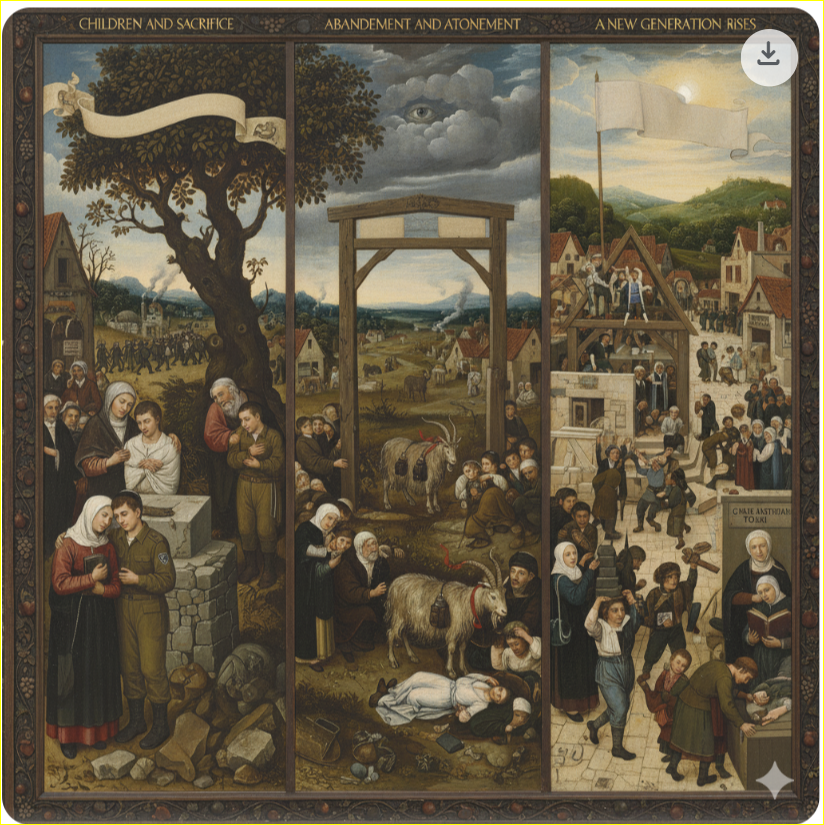
CHILDREN AND SACRIFICE
In 1989, a month before my son went into the IDF, I was in the U.S. staying with my sister. I always had jet lag and would read or write in the middle of the night. One night, before going to sleep, I wrote a poem without really knowing why. In the morning, I showed it to my sister (who was a psychiatric social worker). She read it and said, “Oh, this is no doubt about Tzvika, who’s going into the army next month.”
I was floored. Reading it again through her eyes, I replied, “Speaking of the unconscious!” I then rewrote it, played with the biblical references, titled it “Akedah Revisited,” and sent it off to Judaism, which published it in 1991. (The poem is reprinted at the end of this column.) Back then I had no list of publications, so being in print was thrilling.
A few years later, it became the basis for “A Feminist Mother’s Prayer for a Soldier Going Off to the Army,” which appeared in Jewish Mothers Tell Their Stories. I ended that prayer with:
“How do I, a feminist with pacifist leanings, send you off? With ambivalence, with love, with fear, with pride, with support, with the knowledge that whatever you do we will be there for you. Lech lecha be-shalom; hazor be-shalom. Go in peace. Come back safely.”
After my children finished their army service, I hoped that by the time my grandchildren came of age there would no longer be a need for the army. No such luck—five of them have served or are still serving, and the sixth is on her way. Yet life, with all its sacrifices and transitions, goes on. Tomorrow, we celebrate Yom Kippur.
ABANDONMENT
One theme that keeps surfacing in the past few years (especially after Oct. 7th) is the sense that the southern communities were abandoned by the government:
“It was a day without an army, without a state—a day where all we had was ourselves, the citizens. This is what abandonment looks like,” said Jonathan Shamriz, the bereaved older brother of Alon Shimriz, a year after October 7th.
“A year later, instead of standing here as multitudes of the people of Israel, united, we stand here waiting for the next siren. Instead of a state inquiry commission being established to investigate this colossal failure, we ask the questions ourselves without getting any answers. There is no personal example, no vision, no leadership, no accountability.”
The Hebrew word for abandonment is hefker (הפקר) with a kuf (ק). Every time I heard it, I thought about Yom Kippur (כיפור) with a kaf (כ). The roots differ, but the sounds are similar. Technically, hefker is mishnaic and refers to something lost, mislaid, or abandoned property that becomes ownerless. In modern usage, it can describe a soldier who abandoned (hifkir) his post, a father who abandoned his children, or a hit-and-run driver who leaves the injured behind.
At many Shabbat dinners we’ve argued over whether the government truly abandoned the South—deliberately or through neglect. Was it because guarding the territories was prioritized over keeping the South safe? Was it because no one was responsible? Or worse no one cared? People cried out: damenu lo hefker—our blood is not hefker, not to be shed without response. And then there is the person who is mufkar, acting without social responsibility, even promiscuously. We know leaders like that. Around our table, we agree to disagree.
THE SACRIFICIAL SCAPEGOAT
The root of Kippur (כפר) is strange: it can have an F or P sound depending on whether there’s a dagesh (dot) in the letter peh. Le-kapper means “to atone.” In slang, kapparah is a term of endearment, perhaps from the idea that one who loves will take on the sins of the beloved. Kofer (with the F sound) means both “ransom” and “heretic,” someone who challenges basic principles.
Thinking about these connections led me to the scapegoat—the se’ir la-azazel—sent off into the wilderness carrying our sins.
On Rosh Hashanah, we read what I consider the two sacrifices of Abraham’s sons. In his masterful study The Last Trial: On the Legends and Lore of the Command to Abraham to Offer Isaac as a Sacrifice, Shalom Spiegel collected midrashim which intimated that Isaac was actually slaughtered and then revived. If so, perhaps the rabbis were making another point: Isaac was the goat sacrificed as a sin offering, while Ishmael was the goat sent off, left to live or die in the wilderness—a clear case of abandonment.
There is a midrash which echoes this, but here Esau is the one expelled. The rabbis link se’ir (goat) with Esau’s hairiness (se’ir again):
“Isaac-R. Levi said: This may be illustrated by two men, one possessing a thick head of hair and the other bald-headed….The wicked Esau is polluted by sin throughout the year and has no place to go to procure forgiveness, whereas Jacob sins throughout the year but has the Day of Atonement to procure forgiveness” (Genesis Rabbah 65:15).
So we have two sets of brothers—Esau and Jacob, Ishmael and Isaac. And there is yet another set mentioned at the start of the Yom Kippur Torah reading.
TORAH READING FOR YOM KIPPUR
The Yom Kippur reading begins:
“God spoke to Moses after the death of the two sons of Aaron who died when they drew too close to the presence of God” (Leviticus 16:1).
The backstory appears earlier: Aaron’s sons Nadav and Avihu offered alien fire, and fire came forth from God and consumed them. Their untimely, unfathomable death may have been because they tried to get too close (karov) to God and ended up themselves as the sacrifice (korban).
Trying to explain the inexplicable diminishes tragedy. Just as some tried to “explain” the Holocaust because of assimilation or October 7th, because of internal dissension, such explanations always fall short. Evil, random acts, and disasters exist. Blaming ourselves is a futile waste of energy. Perhaps the only way to respond is as Aaron did:
“… and Aaron was silent” (Leviticus 10: 3).
Isaac Abarbanel, the Portuguese Jewish Bible commentator (1437-1508), explains Aaron’s silence:
“His heart became like an inanimate rock, and he did not raise his voice in crying or eulogy … For he had no breath left in him, nor did he have any speech.”
And finally, there is Joseph’s abandonment by his brothers, which the apocryphal Book of Jubilees directly links to Yom Kippur.
According to Jubilees:
The sons of Jacob slaughtered a kid, and dipped the coat of Joseph in the blood, and sent (it) to Jacob their father on the tenth of the seventh month. And he mourned all that night, for they had brought it to him in the evening, and he became feverish with mourning for his death, and he said: ‘An evil beast hath devoured Joseph’; and all the members of his house [mourned with him that day, and they] were grieving and mourning with him all that day. …Bilhah died mourning him; Dinah also died soon after.
For this reason it is ordained for the children of Israel that they should afflict themselves on the tenth of the seventh month … to atone for themselves … for they had grieved the affection of their father regarding Joseph…. And this day has been ordained that they should grieve thereon for their sins, and for all their transgressions and for all their errors, so that they might cleanse themselves on that day once a year.
This story resonates today, amid so much internal dissension— “brothers” turning on each other, infighting, collateral damage, and the hubris of leaders whom many believe have abandoned their fellow citizens. I find it very interesting that at the same time that Netanyahu apologized to Qatar for violating its territory with the strike on Hamas chiefs, at the same time Ben Gvir and Smotrich lashed out at him over the apology. Note that despite the fact that our leaders have yet to apologize to the nation, there is still hope among all the devastation. So before concluding with my poem, I share the hopeful words of Jonathan Shamriz:
I believe that from the ruins and destruction, from the hell we went through, a new generation is rising. A generation that believes in us, in a reformed and united Israeli society … a generation that will rebuild the ruins and create a better, more moral country—a country where truth is pursued, sanctified, and never let go.
In this spirit, I share with you the poem I wrote many years ago:
AKEDAH REVISITED
Choose! Bechor[1]
Why?
I am what I am![2]
You are what you are!
Why choose?
I have put before you
Life and Death,
Blessing and Curse.
Choose Life‑‑
If you and your offspring would live.[3]
One for Life.
One for Death.
My sons! I can not.
The knife, the Agony.
The pain, again
To choose.
Father? God? Son?
I lived. Why?
To choose!
No!
You must!
It is not choice if I must.
To choose is to die.
Two nations are in [her] womb.
Two separate peoples…
One people shall be mightier than the other.
And the older shall serve the younger.[4]
It is not the practice in our place
To prefer the younger over the elder.[5]
Give up one.
Divide your heart.
This is my son, the live one.
I am he.
Or am I the dead one‑‑
Lost, abandoned,
On the altar,
On the way to the knife.
A sword was brought before him.
To cut the live child in two.
One shall rule.[6]
No!
I shall choose love.
Let it be.
Give the live child to her.
There will be no glory for you
That the choice will be
In the hands of a woman.[7]
Do not put him to death.
She is his mother.[8]
Choose well my dear.
There are no returns
When destiny means choice.
Send him off if you can.
My son, our sons.
[1] In Hebrew behor is to choose; bechor is the elder. Different roots and sounds, yet…
To those among us who are fasting, have an easy fast. G’mar Hatimah tovah.
And may next year be a much better year.
Related Topics
Related Posts