CFO | Empower Society for Good I Author
The Leaders Were Not Liars – Facts, Truth, and the Failure to See
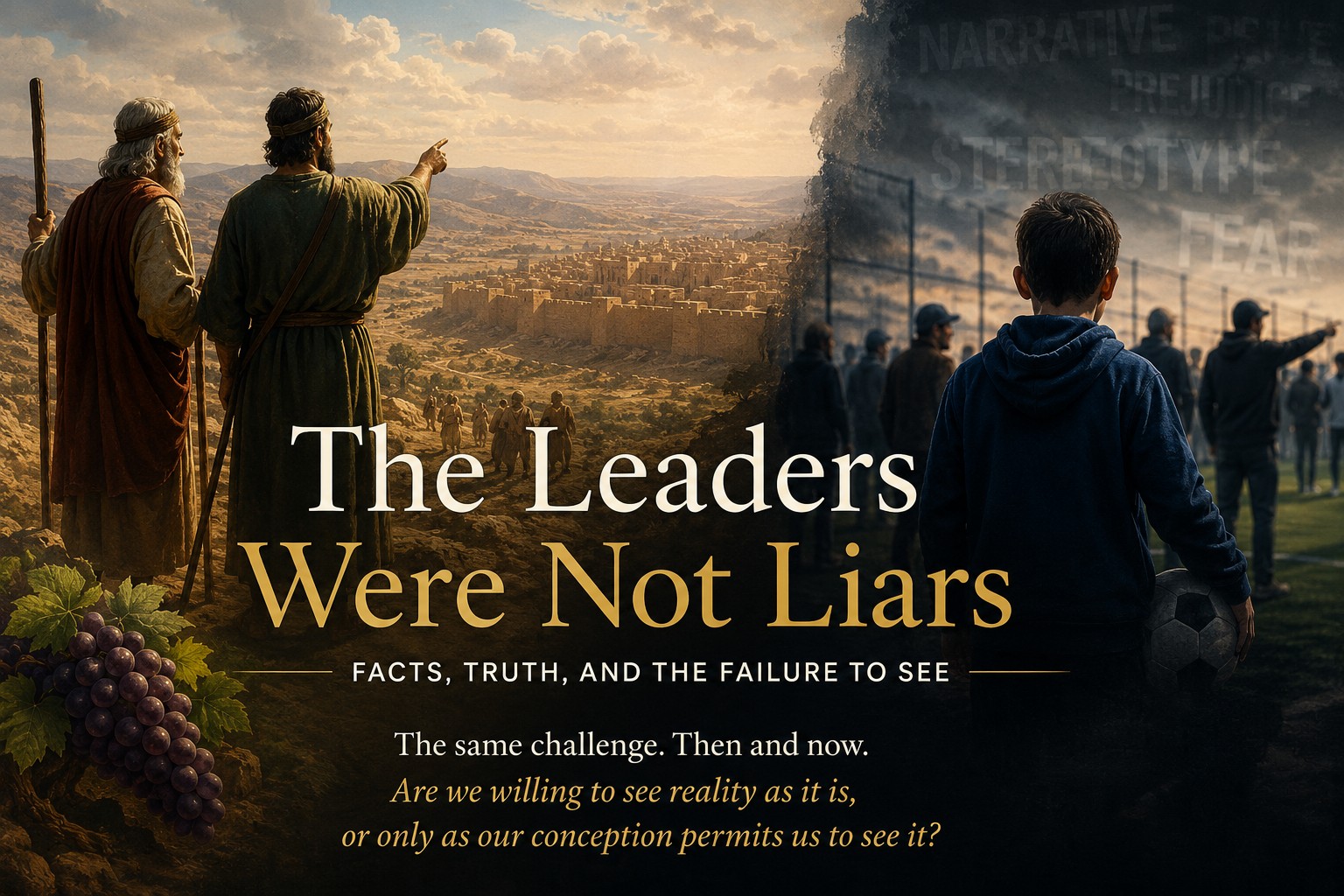
A close family friend recently told me about something that happened to their twelve-year-old nephew at a football match in Australia. During the match, the boy was called a “baby killer.”
I found myself unable to move on from the story. Not because antisemitism is new, and not because Jews have not faced prejudice throughout history, but because of the age of the child. He was twelve years old. A boy who had never held a weapon, made a political decision, or participated in a military operation. Yet someone looked at him and saw not a child, but an accusation.
As I reflected on the incident, I found myself thinking about the leaders in Parshat Sh’lach.
At first glance, the connection seems remote. One story takes place in the wilderness more than three thousand years ago, while the other unfolds at a football match in modern Australia. Yet both raise the same troubling question: what happens when people stop seeing reality as it is and begin seeing only the story they have already decided to believe?
Parshat Sh’lach contains one of the Torah’s greatest leadership failures. The men sent to survey the Land were not ordinary individuals. They were leaders, princes of the tribes, respected figures entrusted with helping guide the future of the nation. When they returned, they brought back evidence. The cities were fortified. The inhabitants were powerful. The military challenge was real. They even carried enormous grapes as proof of the Land’s extraordinary potential.
Much of what they reported was true.
That is precisely what makes the story so disturbing.
The Torah is not describing dishonest men. It is describing capable leaders who saw the facts accurately yet failed to understand their meaning. They interpreted reality through a lens of fear until every obstacle became proof that failure was inevitable. The facts were real, but the conclusion was false.
Joshua and Caleb saw the same giants, the same cities, and the same dangers. Yet they reached a completely different conclusion. Their advantage was not superior intelligence or access to better information. They understood something deeper: facts are not the same as truth. Facts require interpretation, and interpretation is shaped by the assumptions we bring to reality.
The Torah is therefore asking a question that is as relevant today as it was in the wilderness: how can intelligent, experienced, and respected leaders become prisoners of a false conception?
That question feels particularly relevant when reflecting on October 7.
Looking back, it is difficult to avoid the conclusion that October 7 was not merely an intelligence failure. It was a failure of conception. Warning signs accumulated over time, intelligence was gathered, and indicators emerged that something dangerous was developing. Yet much of this information was interpreted through an existing framework that assumed Hamas had been deterred, that it was focused primarily on governance and economic concerns, and that the balance of deterrence remained intact.
The tragedy was not the absence of facts. The tragedy was the inability to understand what those facts meant.
In that sense, the failure bears a striking resemblance to the leaders in Parshat Sh’lach. They too possessed information. They too saw reality. Their failure lay in the way they interpreted it. Once a conception takes hold, every new fact tends to reinforce it. Evidence that supports the conception is embraced, while evidence that challenges it is often explained away.
This raises another uncomfortable question. Why do leaders cling to assumptions even when reality begins to undermine them? Is it because admitting error is difficult? Is it because institutions become invested in their own beliefs? Is it because changing course carries professional or political consequences? Or is it because leaders, like all human beings, sometimes become more concerned with protecting their position than pursuing the truth?
The Torah repeatedly challenges leaders with exactly this dilemma. Leadership is not merely about being right. It is about possessing the humility and courage to recognise when one is wrong.
But perhaps there is an even deeper lesson hidden within the story.
The leaders did not merely place too much trust in their own analysis. They placed too little trust in God’s promise.
They measured military strength, counted enemies, assessed risks, and calculated probabilities. Everything they saw was filtered through human logic. What they failed to appreciate was that they were not simply evaluating a military campaign. They were participating in a covenantal journey. Their failure was not only strategic. It was spiritual.
Perhaps this is one of the great temptations of every generation.
We place enormous trust in political leaders, military commanders, intelligence agencies, economists, journalists, academics, technology experts, and international institutions. We look for certainty in powerful people and powerful systems. We search for the next leader who will solve our problems, restore order, and secure our future.
Then reality reminds us how fragile human systems can be.
October 7 reminded us.
The conception collapsed. The experts were wrong. The institutions failed. The systems proved vulnerable.
Perhaps one of the messages of Sh’lach is that leaders matter, but they are not gods. Nations that place their ultimate trust in leaders will eventually be disappointed. Whether the leader is a king, a prime minister, a president, a general, a billionaire, or a public figure who promises to solve our problems, every human being remains limited.
Judaism never asks us to worship leaders.
It asks us to hold them accountable while placing our ultimate trust in God and in the moral mission He has entrusted to us.
The aftermath of October 7 revealed another dimension of this struggle. The evidence of the atrocities was overwhelming, yet almost immediately another battle began—not on the battlefield, but in the arena of public opinion. Many people seemed reluctant to accept what had happened. Others appeared eager to explain before they condemned. Some seemed more concerned with preserving political narratives than confronting uncomfortable realities.
One of the painful questions many Jews have asked since October 7 is why some victims appear to receive immediate sympathy while others are met with suspicion, qualification, or silence. Why do some forms of suffering fit comfortably into existing narratives while others challenge them? Why are some victims believed immediately while others are asked to prove their humanity?
These are uncomfortable questions, but Sh’lach teaches us that uncomfortable questions are often where truth begins.
A recent social media post from Denmark captured this reality in a powerful way. A festival celebrating Chinese culture stood open and welcoming, with families entering freely. Nearby, a Jewish cultural event was protected by barriers and security guards. The contrast was striking. The question is not why security was necessary. The question is why such a situation has become normal. What does it say about our societies when Jewish life increasingly requires protection simply to celebrate its identity?
Which brings me back to that twelve-year-old boy in Australia.
What fact justified calling him a “baby killer”?
None.
What disturbed me most was not simply the insult itself, but the way the child disappeared from the story. He ceased to be an individual and became a symbol onto which anger, prejudice, and political narratives could be projected. His actions did not matter. His character did not matter. His humanity did not matter.
Once that happens, truth becomes almost impossible to find.
People are no longer responding to a human being. They are responding to an idea they have already constructed.
Modern antisemitism rarely presents itself as antisemitism. It often arrives wrapped in the language of justice, human rights, or moral concern. The challenge is distinguishing genuine concern from standards applied to Jews that are not applied to others. Throughout history, antisemitism has repeatedly transformed individuals into symbols and then judged them not for what they have done, but for what they supposedly represent.
The leaders who surveyed the Land did not fail because they lacked facts. They failed because fear shaped their interpretation of reality. Their eyes worked perfectly. It was their judgment that became clouded.
The Torah’s warning is therefore timeless. The greatest enemy of truth is not ignorance. It is the refusal to see what is standing directly in front of us because it contradicts the story we have already chosen to believe.
Joshua and Caleb saw the same giants as everyone else. Yet they saw something more. They saw possibility where others saw defeat. They saw covenant where others saw danger. They saw purpose where others saw obstacles. Most importantly, they possessed the courage to challenge the prevailing conception.
Perhaps that remains the challenge facing us today.
Not merely to collect facts.
Not merely to win arguments.
But to retain the moral courage to recognise truth, even when it is uncomfortable.
The Torah is never only about them. It is always about us.
Before judging the leaders who surveyed the Land, perhaps we should ask ourselves what assumptions we are unwilling to surrender. What truths we resist because they challenge our worldview. What people we have reduced to symbols. What realities we refuse to see because they make us uncomfortable.
And perhaps the deepest question of all is this: when uncertainty and fear confront us, where do we ultimately place our trust? In leaders, institutions, governments, and experts? Or in God, moral purpose, and the enduring values that transcend any particular leader or moment in history?
The leaders of Sh’lach failed because they became prisoners of their conception.
The challenge of every generation is to ensure that we do not become prisoners of our own.
Questions for Reflection
- When facts challenge our worldview, do we change our worldview or reinterpret the facts?
- How do we distinguish between truth and narrative?
- Why do some forms of suffering receive immediate recognition while others are questioned, minimised, or ignored?
- What responsibility do journalists, universities, NGOs, and international organisations have in the pursuit of truth?
- How do we challenge antisemitism when it disguises itself as moral concern?
- What happens to society when people stop seeing individuals and start seeing stereotypes?
- Do leaders place the good of the people above their own power, prestige, ideology, and personal interests?
- Why do human beings repeatedly place their faith in leaders, institutions, and experts while neglecting faith in God and enduring moral principles?
- Are we looking for saviours in politicians, presidents, prime ministers, billionaires, and public figures when the Torah asks us to place our ultimate trust elsewhere?
- In our own lives, where are we acting like the leaders of Sh’lach—allowing fear, ideology, prejudice, ambition, or misplaced trust to prevent us from seeing the truth?
A Final Question
The leaders saw giants and became grasshoppers.
Joshua and Caleb saw the same giants and remained faithful to the truth.
Are we willing to see reality as it is, or only as our conception permits us to see it? And when reality becomes frightening, where do we ultimately place our trust—in human leaders, or in God and the values He asks us to uphold?
Related Topics