‘Able to tell the world’ – remembering Lilly Bloch
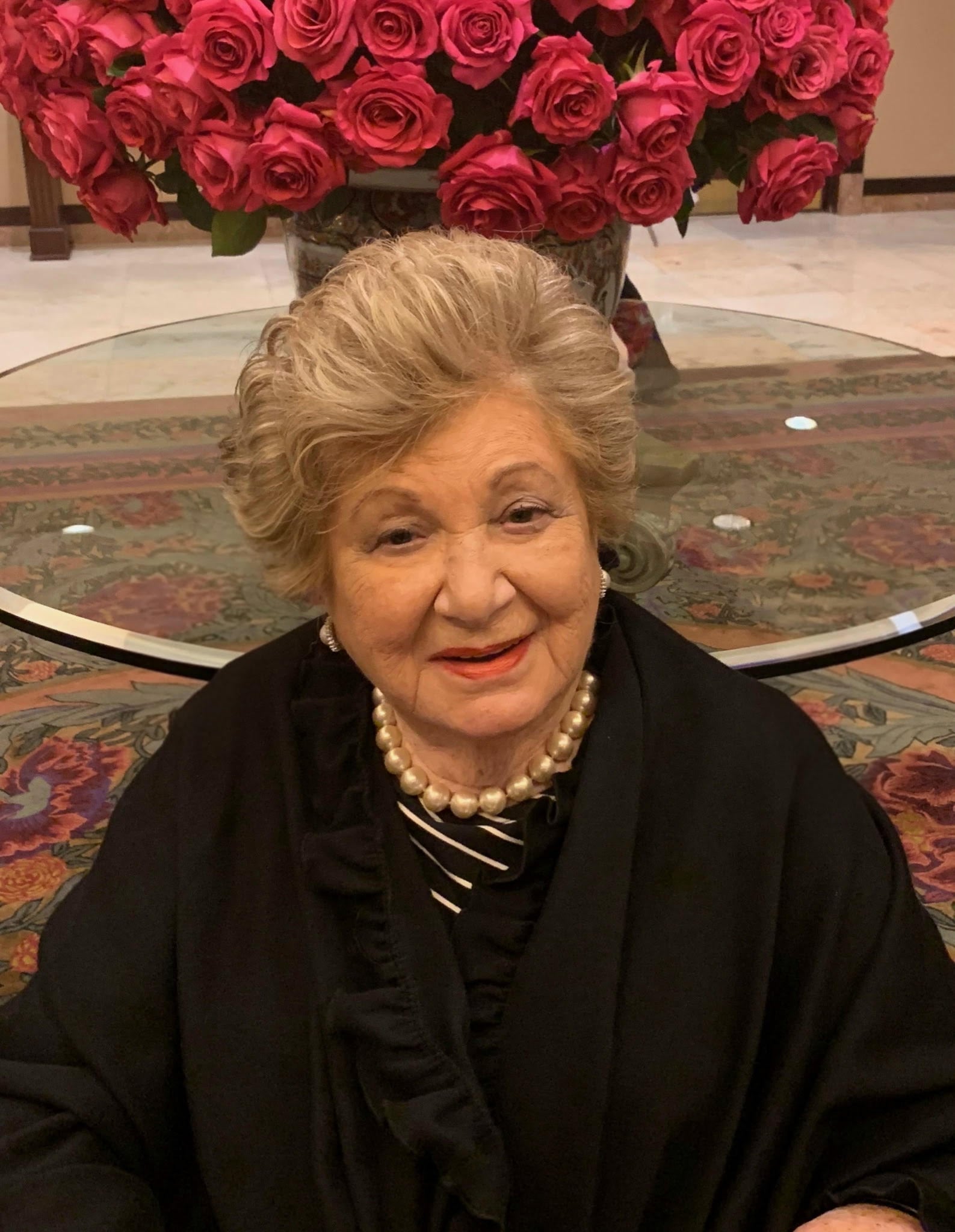
With the passing of my mother-in-law Lilly Bloch on November 16th, less than two months shy of her 98th birthday, we have lost one of our few remaining links to both the greatest tragedy and the greatest miracle of Jewish and, indeed, human history. The tragedy, of course, was the Shoah, the cataclysm in which one third of the Jewish people was brutally murdered. The miracle, in equal if not greater dimension to the tragedy, was the rebirth after. The miracle was the improbable determination of so many of the survivors not just to reclaim control of their destinies but to look toward the future, to rebuild their lives in new surroundings, in new countries, to create new families and learn new languages without ever letting go of their memories, of their past, of all that had been torn from them.
Born in Podwoloczyska, Poland, Lilly and her parents survived the Shoah in hiding. After marrying a fellow survivor, my unforgettable father-in-law, Sam E. Bloch, in the Bergen-Belsen Displaced Persons Camp in Germany, she, her parents and Sam immigrated to the United States, settling in New York City. There, they embarked on a new life, but not in a vacuum, never in a vacuum.
Lilly epitomized that strength, that determination, but always with warmth, with humor, and above all, with a deep love for her family and for her friends. She was always elegant, always dignified, and she never wallowed in self-pity. Even during the past several years when her health started to fail her, she insisted on getting dressed, sitting in her favorite chair watching television, and she remained the matriarch of our family until the end.
Lilly emerged from the Holocaust knowing that despite all the hardships she had endured, she was one of the fortunate ones. She was part of the rarest of Jewish phenomena in Poland at the end of World War II: a nuclear family that had remained together and that remained intact because a righteous Polish farmer hid first Lilly and her mother, then her father, and then also her aunt.
In early 1979, she described her unlikely, miraculous rescue on a popular television program, Midday with Bill Boggs. After the German occupation of her part of eastern Poland in 1941, when Jews in the region were being rounded up and killed, she described how “a man appeared from nowhere, he came to our home, he was a friend of my father’s, a good friend, a gentile, a Pole, and he said to us, ‘I would like to save your wife and your child.’” And so it was that Lilly, aged 13, entered a narrow concealed cellar enclosure where the farmer hid grain from the Germans. She described how she spent the next two-and-a-half years in that narrow space where she was unable to stand, that they never spoke above a whisper, that they survived on a tea kettle of water per day and a weekly loaf of bread. She told Bill Boggs how, after the Red Army liberated them on March 13, 1944, she had to relearn to walk and to talk and “I had to learn how to adjust to life again, how to be normal, how to face the world and how to face the people and how to eventually go back to our home town.” There, she discovered that she was the only one of all her friends to have survived.
What always struck me about this particular interview was Lilly’s poise and her self-confidence. She told her story because, as she explained, it had been “my fervent hope that if and when I survived the war, I will be able to tell the world.” And tell the world she did, but not as a victim, never as a victim. Whenever she had the opportunity, she would tell people, especially young people, what she had endured as a child, but without pathos, without seeking to elicit sympathy. What she wanted was for them, and the world, not just to know but to learn from her experiences.
But the Holocaust years were only the beginning of Lilly’s life, not its sum total. She and her parents made their way to the Displaced Persons camp of Bergen-Belsen where she found thousands of other Jews. She made life-long friends, including my parents. She attended medical school in Bonn. At Belsen, she met and married Sam, who was the youngest member of the Jewish committee headed by my father that administered the DP camp. After her liberation in Poland, she had learned how to speak again. At Belsen, she learned how to laugh again, and to smile, and to look forward to a new life she hoped would be without hatred, where she and her family could be safe.
While their Holocaust experiences were central to Lilly’s and Sam’s identities, neither of them was consumed or obsessed by them. The same was true of my parents, which probably explains why they were lifelong friends. They were interested in culture, went to concerts and Broadway plays, enjoyed vacations, played cards with fellow survivors, and made sure that their daughters, Jeanie and Gloria, absorbed the same Jewish and humanistic values with which they themselves had been raised.
Perhaps this is what made Lilly and so many of the survivors so special. They had gone into the maelstrom of the Shoah as proud, decent, caring human beings with a multitude of interests and concerns, and they had the strength to remain that way after the horrors had ceased.
My friend Robert Williams, the president of the USC Shoah Foundation, reminded me yesterday of an interview Lilly gave to the New York Jewish Week during the Covid-19 pandemic. “Like most New Yorkers,” the article began, “Lilly Bloch, a 91-year-old Queens resident, has spent the last several weeks sheltering in place in her house. Over that time she has heard the frequent complaints about isolation, limited contact with the outside world and fear of what tomorrow will bring.”
Except that Lilly viewed the pandemic through the prism of her own experiences. The quarantine imposed on much of the world, including herself, was, in her words, “not so pleasant, but it’s not so terrible,” explaining that “You cannot compare it in any way to what we lived through. Nobody is looking for me, to kill me.”
It was this positive if not necessarily optimistic mindset that in many ways defined both Lilly herself and the legacy she leaves behind. She looked for the good in people and in society at large and sought to convey this outlook on life to her children, grandchildren, and great-grandchildren, and to all with whom she came in contact.
Even during the past several years, she told her story and shared her memories not only with her great-grandchildren Hallie and Jacob who videotaped her for their bnei mitzvah project but with the USC Shoah Foundation, which is featuring a clip of her testimony this week to mark her passing, and with a Canadian film crew making a documentary about the Belsen DP camp.
It was all because, as a young teenager hiding in a grain cellar so many years ago, she had hoped that if she survived, she would be able to tell the world.
And so, as we say our final farewell to Lilly, we commit to her that we will now take on the task to tell her story. We will remain true to the values she taught us. Above all, we will never forget how much she loved us. We will always love you, Lilly, and you will always be a part of us.
–
This article is adapted from the eulogy delivered by the author at the funeral of Lilly Bloch at Park Avenue Synagogue in New York City on November 18, 2026.