London based entrepreneur, cybersecurity analyst doing a PhD in AI
Abraham’s Question.
The Fingertip
Hold up your hand. Look at the end of your index finger.
There is nothing visually spectacular about it. A little skin, a nail, flesh and bone.
Yet when the Qur’an challenges the human being who doubts resurrection, it chooses this seemingly insignificant extremity:
“Does man think that We will not assemble his bones? Yes. We are able even to proportion his fingertips.”
— Qur’an 75:3–4
The Arabic banān refers to the fingers or their extremities. There is no need to force this into the familiar claim that the Qur’an predicted fingerprint identification.
The actual statement is more fundamental. The human being asks whether his body can be reconstructed after death. The answer descends all the way to the extremity: even his fingertips.
Newton’s thumb
A famous statement attributed to Isaac Newton expresses a similar sense of wonder:
“In the absence of any other proof, the thumb alone would convince me of God’s existence.”
The quotation is widely attributed to Newton, but its authenticity is uncertain. It appears in nineteenth-century writing about the hand, without a traceable passage in Newton’s own works. It is therefore better understood as a traditional attribution rather than a verified quotation.
Newton’s documented reflections on creation, however, are unmistakable. In the General Scholium of his Principia, he wrote:
“This most beautiful System of the Sun, Planets and Comets, could only proceed from the counsel and dominion of an intelligent and powerful being.”
Newton had described the mathematical laws governing celestial motion. Yet, in his own philosophical and theological understanding, explaining those laws did not eliminate the question of their ultimate origin.
The same distinction becomes fascinating when we examine the human hand.
What happens when you touch something?
Touch the table in front of you.
Subjectively, almost nothing happens. Biologically, an extraordinary cascade begins.
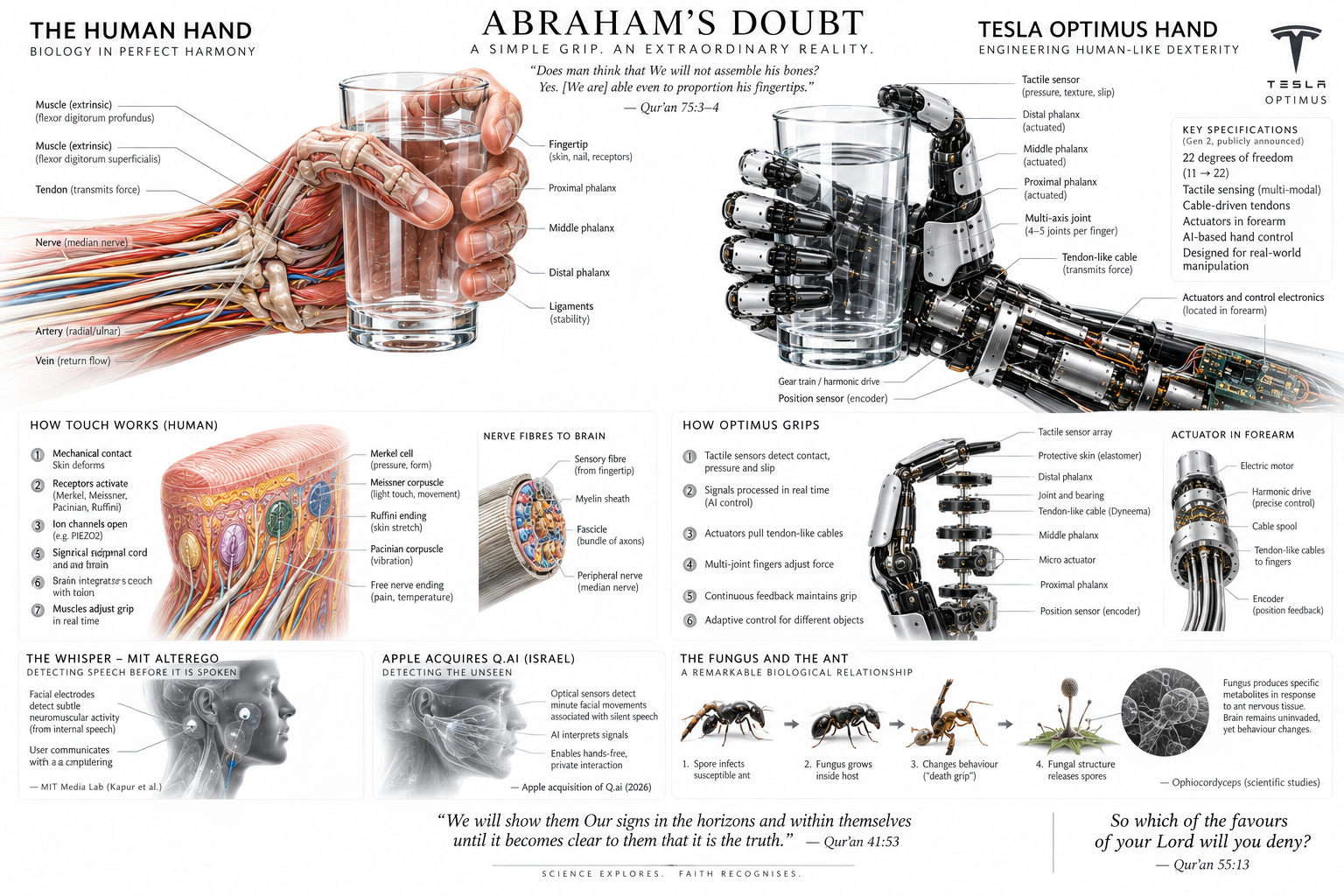
The skin of the fingertip deforms. Embedded within it are specialised mechanosensory structures. Merkel-associated afferents contribute to detecting sustained pressure, edges and form. Meissner-associated afferents respond to movement across the skin. Pacinian afferents are exceptionally sensitive to vibration, while Ruffini-associated afferents respond to skin stretch.
These sensory systems do not simply tell the brain that something has been touched. They provide different kinds of information about the interaction.
At the molecular level, mechanically activated ion channels, including PIEZO2, help convert deformation into electrical signalling.
Skin bends. Molecular channels respond. Ions move. A sensory neuron changes its electrical state.
The signals travel along nerve fibres, which are organised into bundles within peripheral nerves. Sensory information reaches the spinal cord and brain, where it is integrated with vision, proprioception and the intended movement.
Motor commands travel back towards the muscles. Muscles contract. Tendons transmit force. Fingers adjust.
Consider picking up a glass.
The nervous system must apply enough force to prevent slipping. If the glass moves against the skin, tactile feedback changes and grip force is adjusted.
Too little force and the glass falls. Too much and a sufficiently fragile object breaks.
Exactly enough, and nothing remarkable appears to happen.
You simply hold it.
A toddler can pick up a blueberry without knowing its mass, coefficient of friction or structural strength.
Now try building a machine capable of doing the same thing reliably across thousands of unfamiliar objects.
Elon Musk and the Optimus hand
That is one of the challenges Tesla encountered while developing its Optimus humanoid robot.
In a 2024 discussion, Elon Musk described how building a humanoid hand had made Tesla’s engineers appreciate the anatomical arrangement of the human hand.
Why five fingers of unequal lengths? Why an opposable thumb? Why are many of the muscles generating finger force located in the forearm, with tendons transmitting that force into the hand?
Tesla’s earlier Optimus hand had 11 degrees of freedom. Musk subsequently described a 22-degree-of-freedom design, with actuators relocated into the forearm and cable-like mechanisms transmitting force to the fingers.
The closer engineers came to reproducing the hand, the more they appreciated its anatomy.
A robotic hand requires actuators, sensors, control electronics, software, power and continuous feedback. Biological hands integrate movement, sensation, adaptation and repair within one living system.
Twenty-two degrees of freedom represent an engineering achievement.
A child receives two biological hands before learning the word hand.
And the Qur’an says:
“…even his fingertips.”
The Whisper
Now consider something even less visible.
A word that has never been spoken.
The Qur’an says:
“And We have already created man and know what his soul whispers to him, and We are closer to him than his jugular vein.”
— Qur’an 50:16
This is a theological statement about Allah’s knowledge. It is not a prediction of electromyography, artificial intelligence or brain-computer interfaces.
But modern engineering has revealed something fascinating about the boundary between thought and speech.
MIT and AlterEgo
At the MIT Media Lab, Arnav Kapur and colleagues developed AlterEgo, a wearable system that allows a person to communicate deliberately with a computer without audibly speaking.
AlterEgo does not read arbitrary private thoughts.
Instead, it detects physiological signals associated with intentional internal articulation, or subvocalisation.
When someone deliberately forms words internally, parts of the neuromuscular machinery associated with speech can become active without producing an audible sentence.
Electrodes positioned around the face and neck detect aspects of this faint activity. Machine-learning algorithms classify patterns within the signals, allowing the system to identify deliberately subvocalised words.
Information can then be returned privately through bone conduction.
The original research reported a median word accuracy of approximately 92 percent under its experimental conditions. The researchers demonstrated a way for people to interact with computers through deliberately generated silent speech signals.
See MIT Media Lab: AlterEgo .
Consider the sequence.
A person intends a word. No sound emerges. Another human standing beside him hears nothing.
Yet inside the body, speech-related motor commands can produce detectable neuromuscular activity.
An electrode detects the signal. Software processes it. Machine learning identifies a pattern.
The word was silent to another human being. It was not necessarily silent to sufficiently sensitive instrumentation.
Apple and Q.ai
In January 2026, Apple acquired Q.ai, an Israeli artificial-intelligence company founded by Aviad Maizels and colleagues.
Q.ai developed technology associated with whispered and silent communication, including methods for detecting minute facial movements.
One of its patents describes illuminating part of the face and analysing reflected light to identify subtle movements of facial skin associated with silent speech.
The face that appears motionless may not be entirely motionless.
Silence can still have physiology.
Neither AlterEgo nor Q.ai’s patented approaches constitute unrestricted mind-reading. They rely on detectable physical signals associated with speech or deliberate articulation.
They require sensors, signal processing, algorithms and appropriate conditions. They can make mistakes.
The Qur’anic claim is of an entirely different order:
“…and We know what his soul whispers to him…”
Human engineering has spent years learning to detect the faintest physiological edge of an unspoken word.
The Fungus and the Ant
The third example entered my thinking almost accidentally.
My PhD supervisor and I were discussing probability, randomness and uncertainty when we chanced upon a biological phenomenon that sounded almost fictional.
A fungus that manipulates an ant.
Certain fungi belonging to the Ophiocordyceps group infect ants. A fungal spore encounters a susceptible host, establishes an infection and proliferates inside the animal.
Then something extraordinary happens.
The ant’s behaviour changes.
In well-studied systems, the infected ant departs from its ordinary behavioural pattern. It moves into vegetation and eventually reaches a location favourable to subsequent fungal development.
Its mandibles clamp onto plant material in what researchers call the death grip.
The ant dies attached to the vegetation.
The fungus continues developing through the corpse. A reproductive structure eventually emerges, spores are released, and another infection cycle becomes possible.
But the detail that particularly interested me was not simply that a fungus could manipulate an ant.
It was specificity.
The right fungus and the right ant
Researchers studying a fungus within the Ophiocordyceps unilateralis complex experimentally infected several ant species.
The fungus could kill multiple species.
But killing the ant and manipulating its behaviour were not equivalent.
The characteristic behavioural manipulation occurred in its natural hosts.
An unsuitable ant could die from infection without displaying the complete behavioural phenotype.
The host mattered.
Researchers then exposed the fungus to nervous tissue from different ant species. The fungus produced different arrays of metabolites depending upon the tissue it encountered.
Through evolutionary history, parasite and host had developed a specialised molecular relationship.
The fungus has no nervous system resembling the ant’s. It does not consciously recognise its host.
Yet its chemistry responds differently to different biological environments.
See the research paper, Species-specific ant brain manipulation by a specialized fungal parasite .
The brain that was not invaded
The intuitive explanation might be that the fungus simply invades the ant’s brain and commandeers it.
But three-dimensional microscopy revealed something stranger.
Researchers found fungal cells throughout the host’s body. They invaded muscle fibres and formed interconnected networks around muscles.
Yet fungal cells were not found growing through the brain itself.
The ant’s behaviour could therefore be profoundly manipulated without the fungus merely replacing its brain with fungal tissue.
An organism without a brain alters the behaviour of an organism with one.
The molecular mechanisms are not fully understood, but the evidence demonstrates a remarkably specialised interaction between parasite, host tissues and behaviour.
Probability and randomness
There is no need to deny evolution to appreciate any of this.
Evolution provides the scientific framework for understanding how such adaptations can develop.
Variation occurs. Traits are inherited. Selection filters those variations. Parasite and host impose selective pressures upon one another.
Generation follows generation.
Adaptations accumulate.
The final biological relationship should not be treated as though all its components appeared simultaneously in one fantastically improbable throw of the dice.
That would misunderstand probability as well as evolution.
And that was precisely what made the example interesting in a discussion about randomness.
An event can appear astonishingly improbable when considered in isolation. Discover its generating mechanism and our probability assessment can change.
There is inheritance, selection, constraint and accumulated history.
What initially looks random may conceal structure. What looks simple may conceal machinery. What appears silent may contain detectable signals.
And what looks like an ordinary fingertip may turn out to be something our finest engineers struggle to reproduce.
First, the Qur’an
Surah al-Rahman does something beautiful.
It does not begin by asking its famous question. First, it names the gifts.
“The Most Merciful. Taught the Qur’an. Created man. And taught him eloquence.”
Then it turns towards order in the universe:
“The sun and the moon move by precise calculation.”
Then towards the heavens and balance:
“And the heaven He raised and imposed the balance.”
Then towards the earth:
“And the earth He laid out for the creatures.”
Then towards what grows from it:
“Therein is fruit and palm trees having sheaths of dates, And grain having husks and scented plants.”
And only then comes the question:
“So which of the favors of your Lord would you deny?”
— Qur’an 55:1–13
Mercy. Revelation. Humanity. Language. Calculation. Balance. Earth. Food. Fragrance.
Then the question.
And Now, What We Can See
The fingertip touches.
Skin deforms. Mechanoreceptors respond. Molecular channels translate mechanical force into electrochemical activity.
The nerve fires. The brain receives. The muscles answer. The tendons pull.
The fingers close around an object with precisely enough force to hold it.
Engineers attempt to reproduce the same capability and discover just how difficult a hand really is.
A human being does it without thinking.
So which of the favours of your Lord will you deny?
A word forms without sound.
Another person hears nothing.
Yet tiny neuromuscular signals accompany deliberate internal articulation. Electrodes become sensitive enough to detect them. Machine learning becomes sophisticated enough to classify some of them.
Elsewhere, optical systems measure facial movements almost too small to see.
Human beings construct machines capable of detecting traces of speech before speech becomes audible.
And the Qur’an speaks of the One who knows what the soul itself whispers.
So which of the favours of your Lord will you deny?
A fungal spore encounters an ant.
It survives. It proliferates. Chemistry distinguishes host from host.
The ant’s behaviour changes. It climbs. Its mandibles close.
It dies.
The fungus continues. A reproductive structure develops. A spore eventually falls.
Scientists investigate the process and uncover layer after layer of evolutionary adaptation, molecular interaction and biological specificity.
So which of the favours of your Lord will you deny?
And somewhere inside an unimaginably large universe, a human being—made from the same physical elements as the earth beneath him—becomes conscious enough to investigate the ant, his own hand, and the whispers too faint for other humans to notice.
Abraham asked:
Show me.
The fingertip touches. The whisper forms. The ant climbs.
And the human being looks.
“We will show them Our signs in the horizons and within themselves until it becomes clear to them that it is the truth.”
— Qur’an 41:53
So which of the favours of your Lord will you deny?
Author’s note:-
This article does not, in any way, shape or form, attempt to replicate the language of the Qur’an or claim equivalence with it. It draws upon the rhetorical device of repetition employed in Surah al-Rahman and applies it to examples from modern science to elucidate the article’s central point in light of advances in human knowledge. Any presumption that this constitutes an attempt to imitate Qur’anic language or draw equivalence with it is false and distracts from the purpose of the article: to encourage reflection upon the signs of creation through the knowledge available to us today in the way the Quran does.
As I mentioned in a previous article, do not misunderstand, and if you do, you are solely responsible for it.
Related Topics
Related Posts