Book Review – New Year, Lots of New Books on the Parsha
Daf Yomi, like the weekly Torah reading, creates a shared Jewish intellectual calendar. On any given Shabbat, an Orthodox Jew anywhere in the world is likely to be hearing the same Torah portion as Jews in Jerusalem, London, Teaneck, or Buenos Aires.
With Parashat Beresheet beginning next Shabbat, the eternal text remains the same, but several interesting new books offer fresh, deeper insights. Here are several worth considering.
I Read This Over Shabbos: Reading Jewish History in the Parasha
Just released, Rabbi Dr. David Bashevkin’s I Read This Over Shabbos: Reading Jewish History in the Parasha (Koren Publishing) is a genuinely enjoyable parsha sefer.
I included it as one of the Best Books of 5786, and reviewed it here.
What I Learned in Waterbury
Rabbi Daniel Kalish is the dean of the Waterbury Yeshiva. His educational philosophy places an unusually strong emphasis on the emotional and personal development of teenage boys, not just their Gemara skills. If you create a list of the great educators in history, Rabbi Kalish’s name will certainly be on it.
In What I Learned in Waterbury (Mosaica Press), his student Moshe Muller has gathered Rabbi Kalish’s insights on Sefer Beresheet.
The publisher describes Muller as a talmid trying to transmit what he absorbed from his rebbi. The book is therefore partly a collection of Torah insights and partly an attempt to capture a particular style of teaching and thought.
Anyone who has heard R’ Kalish speak knows his warmth and his ability to convey deep messages. He focuses on making Torah real for his students. The book’s ideas are meant to make those messages feel personal rather than detached.
The book has a clever title. It isn’t called The Torah of Rabbi Daniel Kalish or Insights from Rabbi Kalish. The emphasis is on what Muller learned from being his student. That makes it a kind of intellectual memoir.
That distinction matters because it explains why the book is presented as a transmission of a rebbi’s influence rather than simply another collection of parashah essays. Moshe Muller has learned a lot from Rabbi Kalish. In this book, you can too.
The Philosophers’ Torah
If you have ever wanted to know what Socrates, Hegel, Diderot, or other philosophers had to say about the parsha, then The Philosophers’ Torah (Maimon Books) by Rabbi Dr. Wayne Allen is the book for you.
Allen takes the philosophical ideas of more than 70 major secular philosophers from the last 3,000 years and maps them onto various parsha ideas.
Eichah Rabbah states: “If someone tells you, ‘There is wisdom among the nations,’ believe it. If he tells you, ‘There is Torah among the nations,’ do not believe it.” You won’t be saying birchat haTorah on this book, but it does offer a fascinating look at the wisdom of these philosophers.
Philosophy has had an often contentious journey with Judaism. Perhaps the most famous example is the medieval ban on studying philosophy. The bans of 1232–1234 centered on Maimonides’ philosophical works, especially the Guide for the Perplexed (Moreh Nevukhim) and the portions of the Mishneh Torah dealing with philosophy and theology. Maimonides used Aristotelian philosophy to explain Judaism, and some rabbis feared that this encouraged young Jews to abandon traditional belief and Torah study.
Here, Allen shows how biblical texts have long influenced philosophy. To a degree, therefore, philosophy need not be viewed as something external to Torah.
While most biblical commentaries take a forward approach – the verse says A, and the commentator explains B. Allen takes a backward approach: he starts with a verse and then finds great philosophers who can contribute to understanding it.
Shiv’im Panim laTorah is a rabbinic phrase meaning “the Torah has 70 faces,” used to indicate different levels of interpretation. Perhaps one of those 70 is the way of philosophy. The book shows how questions that philosophers have wrestled with for centuries can offer another lens through which to understand the Torah.
These philosophers have dealt with many of the same issues the rabbis have explored: free will versus determinism, good and evil, the purpose of law, the meaning of suffering, and much more.
About a third of the book covers Sefer Beresheet, which is fertile ground for philosophical inquiry. Questions such as why God created the universe and whether creation requires a cause naturally arise. In fact, Allen could have written an entire work on Sefer Beresheet given the number of philosophical questions it raises.
Some of the most compelling ideas he explores include the Flood: why punish humanity if God is omniscient? The Binding of Isaac: can morality conflict with God’s command? Sodom: Abraham challenges God—and much more.
The book demonstrates the kind of wisdom that can be found among the nations, and Wayne Allen makes a compelling case for engaging with it.
Rav Tzvi Pesach Frank on the Parsha
Rav Tzvi Pesach Frank (1873–1960) was one of the outstanding poskim of the Old Yishuv and served as the Rav of Jerusalem for decades.
As a Torah personality, he is not especially well known among American readers. In Rav Tzvi Pesach Frank on the Parsha (self-published; available via ravfranksefer@gmail.com), Rabbi Yisrael Apfel is looking to change that.
Rav Frank is known primarily as a halakhist through his principal halachic work, Har Tzvi. Here, Apfel shows how Rav Frank used his world-class halachic analysis to understand biblical verses.
Keeping up with Rav Frank in Har Tzvi is a serious challenge. In just a few paragraphs, he can quote numerous Talmudic sources, Maimonides, and a plethora of earlier and later authorities.
The book collects, organizes, and presents Rav Frank’s teachings that illuminate the weekly Torah portion. This is similar to what Dr. Allan Weissman has masterfully done with his set of books on the thought of Rav Hershel Schachter.
The book begins with an interesting clarification concerning the source of a familiar weekly ritual. One reason women light candles Friday night, according to a Midrash Tanchuma, is rooted in Chava’s sin in Gan Eden.
In Parshat Beresheet, Rav Frank argues that the Midrash linking the mitzvah of lighting Shabbat candles to Chava’s sin does not establish the mitzvah’s origin. Rather, the mitzvah to light Shabbat candles is tied to the concepts of honoring and enjoying Shabbat.
The result is a brilliant intersection of halachah, lomdus, and parsha. Apfel does an excellent job showing how Rav Frank found halachic principles hidden inside seemingly non-halachic biblical narratives.
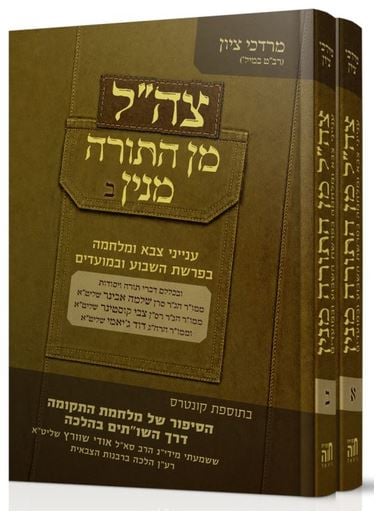
Tzahal Min HaTorah Minayin
The title of Tzahal Min HaTorah Minayin (Hebrew) plays on a key phrase from the Talmud: “From where do we know?” The book asks: From where in the Torah do we find the ideas and obligations associated with the IDF?
I want to thank Rabbi Steven Pruzansky for bringing this important sefer to my attention through his daily Torat Eretz Yisroel WhatsApp group. While I am still waiting for my copy, this book is too important not to mention here.
In the book, author Rabbi Mordechai Zion, a close student of Rav Shlomo Aviner, deals with the IDF, military service, and warfare, organizing the discussion around the weekly parsha.
Much of the public discussion surrounding military service has come from the Haredi side. Books like this show the topic’s complexity and present another side of the issue. The author also argues that blanket exemptions for yeshiva students are not rooted in biblical texts.
Even a cursory reading of Tanach reveals countless stories of battles, invasions, military campaigns, conquest, and political conflict. From the Exodus and the conquest of Canaan, through the period of the Judges, to the Assyrian and Babylonian invasions and beyond, Israel and Judah experienced significant warfare.
The book examines how the Torah presents the army, soldiers, war, Israel’s security, and military service. It covers core topics such as why the Jewish people need an army at all, who should go out to fight, the Torah’s discussion of the fearful soldier, and much more.
This looks to be an important read on one of the most pressing topics of our time.
Baderech: Along the Path of the Torah
There’s no shortage of really smart rabbis. But when it comes to inspirational rabbis, the numbers are smaller. Rabbi Judah Mischel, or as many call him, Rav Judah, is one of the truly inspirational rabbis.
Mischel represents a phenomenon particularly visible in Modern Orthodox Judaism: the Neo-Hasidic approach of taking the spiritual and mystical teachings of Chasidut and incorporating them into mainstream Orthodox/Modern Orthodox life.
That doesn’t mean that he is a Hasidic Jew in the conventional sense, such as being a member of a particular Hasidic dynasty, wearing Hasidic dress, or living according to a Hasidic community’s institutional structure.
In Baderech: Along the Path of the Torah (Mosaica Press), he showcases strong influences from Breslov, Chabad, and other Hasidic masters, with considerable emphasis on finding God in ordinary life, emotional and spiritual connection, Israel and Jewish redemption, and more.
The book aligns closely with his Neo-Hasidic approach. Rather than treating the weekly parashah primarily as something to study intellectually, he asks, “What is the Torah trying to do to me?”
Rather than deep lomdus and pilpul, the book is a remarkable tool for understanding how the parsha can become a vehicle for personal transformation.
He notes that the title of the book, Baderech, “on the path,” is meant to show that Torah is not something you simply learn; Torah is a path you travel.
In 1 Kings 19:11–12, God speaks to Eliyahu not in the wind, earthquake, or fire, but in a “still small voice.” Through the book’s countless stories and vignettes, Mischel’s “gentle whisper” shows how powerful and transformative Torah can be.
At more than 1,100 pages, there is a lot to digest here. But life is a derech, and Rav Judah can be your spiritual GPS.
Layers of Meaning: Explorations in Rashi
With apologies to the popular quote attributed to Charles Baudelaire, “the greatest trick the devil ever pulled was convincing the world he didn’t exist”, in Layers of Meaning: Explorations in Rashi (Mosaica Press), Rabbi Yochanon Joseph shows that the greatest trick Rashi may have pulled was convincing the world that his Torah commentary was simple.
Here, he shows that Rashi was exquisitely attuned to the content of every verse in the Torah and to the countless nuances of the meaning and grammatical structure of every word.
The genius of a great symphony is not that it is simple, but that its complexity sounds effortless.
Rashi’s commentary possesses the same genius. His language is concise and seemingly straightforward, yet within those few words are layers of interpretation, insight, and profound thought.
Rabbi Joseph approaches Rashi in stages. At the technical level, he examines what Rashi is doing and why he chooses a particular comment. At the content level, he explores the psychological, spiritual, and historical dimensions of Rashi’s interpretations. At the big-picture level, he identifies Rashi’s general principles and considers how each comment fits into his overall methodology.
For those looking to dig deeper into Rashi, enjoy this symphony.
The Wonders of the Holy Tongue – On the Torah
The Torah’s language is extraordinarily nuanced and precise. Anyone who has studied Talmud knows how much attention the rabbis gave to such details.
In The Wonders of the Holy Tongue – On the Torah (Moznaim Publishing), Rabbi Yehoshua Steinberg examines the Torah’s roots and grammatical structure through the lens of the weekly parsha.
Steinberg founded the Institute for Research of the Holy Tongue, which is devoted to researching the roots and relationships of Hebrew words.
Steinberg shows how every word of the Torah can contain layers of meaning and intention, and how the Hebrew language can reveal those layers. He performs grammatical autopsies, dissecting words and word structures to understand their meaning and significance.
For each parsha, he analyzes why a particular word was used, its roots, how major commentators who focused on grammar understood it, and more.
For those who enjoy biblical grammar, including roots, synonyms, and nuances between words—and want a deeper dive into why Rashi often selects a specific word, this is an enjoyable read.
It is a great resource for readers who suspect the Hebrew words of the Torah contain far more information than their English translations reveal and want to investigate how and why.
Rashi gives you the finished symphony; this book takes you into the orchestra pit and shows you how the individual instruments, the roots, letters, grammar, and associations of the Hebrew words, combine to produce it.
Siman Labanim
Rabbi Eliezer Kashtiel is the Rosh Yeshiva of the post-army yeshiva program at Bnei-David in Eli. He’s a well-known personality in the Religious Zionist community in Israel, but, like Rav Frank, he is not as well known in the United States.
Siman Labanim (Gefen Publishing House) is a collection of his lectures on the weekly parasha, now available to English readers, offering his distinctive insights.
Like Rav Judah, he emphasizes personal development. His work also focuses on the national identity and importance of Medinat Yisroel and the Jewish people. He also explores the personalities of biblical characters, seeking to understand their motives.
He is strongly influenced by Rav Kook, whom he quotes extensively.
His work here is not merely a collection of parashah insights; it is an attempt to read the Torah’s stories as a blueprint for understanding the development of the Jewish nation.
The title comes from the principle stated in Beresheet Rabbah that the forefathers’ actions are a sign for their descendants. Through his Torah, he shows how these stories have shaped Jewish identity and spiritual growth for thousands of years.