
Accommodating Anti-Zionism Is No Exit
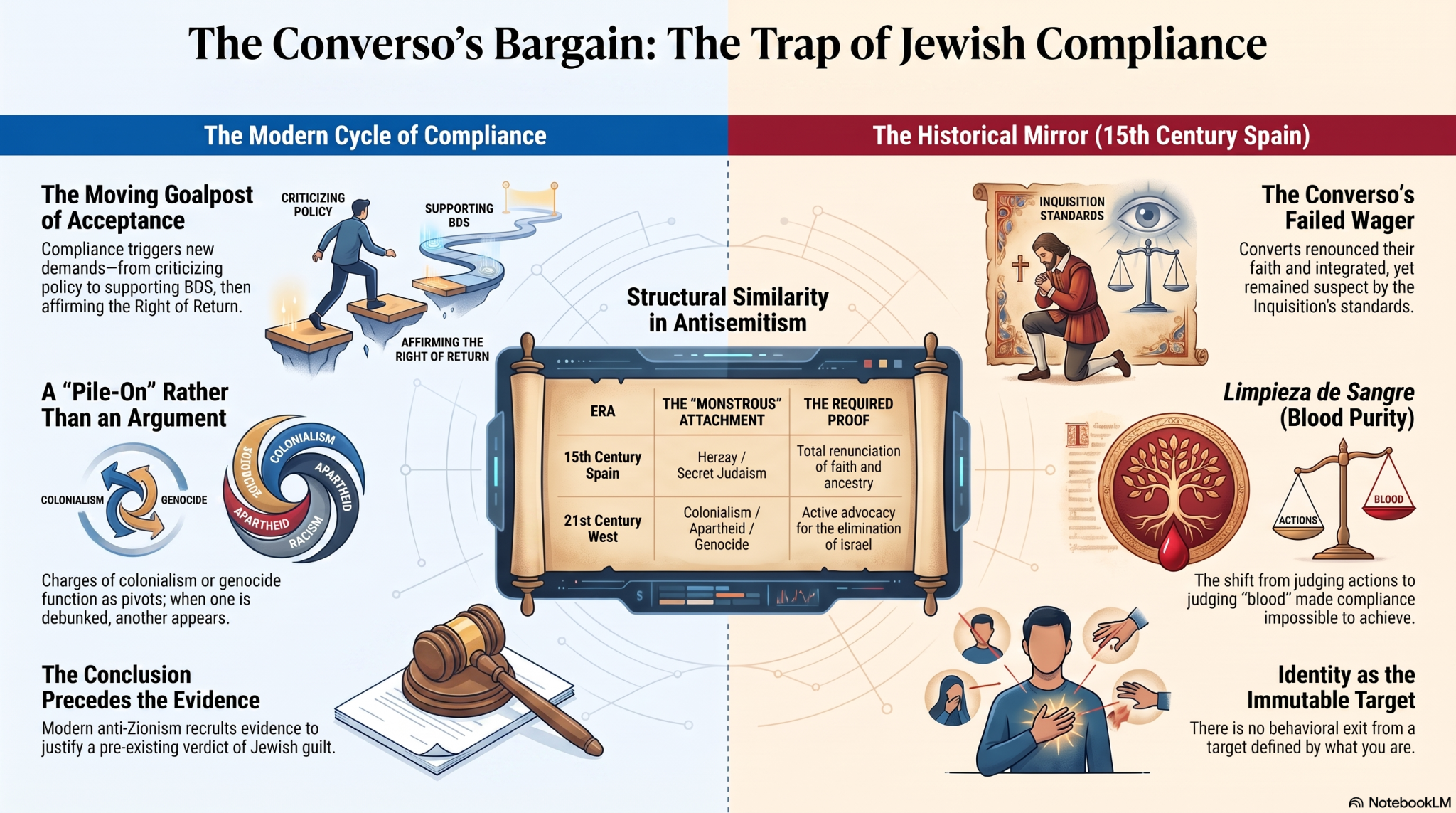
The Conversos Learned That 500 Years Ago
Imagine the conversation. A progressive Jew, uncomfortable with settlement policy, pained by Palestinian suffering, decides to establish his credentials with an anti-Zionist colleague. “I’m Jewish,” he says, “but I’m critical of Israel. Are you OK with that?”
The threshold moves.
Not enough — you have to oppose Zionism itself. He does. Not enough — support BDS. He does. Not enough — affirm the right of return. At each stage he complies. At each stage the bar resets just beyond where he’s standing. The conversation ends only when he runs out of things he’s willing to say against his own people — or crosses that line too.
Every Jew who has tried this knows how it goes. The question is why it always goes this way.
A Pile-On You Can Never Win
Anti-Zionism, as it functions in Western universities, NGOs, and progressive spaces, is not a policy position. It is an accusation structure.
Israel is simultaneously charged with colonialism, apartheid, genocide, and ethnic supremacism — drawn from incompatible moral frameworks that don’t cohere with each other. They don’t need to cohere, because they aren’t functioning as arguments. They’re functioning as a pile-on.
Knock down the apartheid charge — Arab Israeli citizens, judges, members of Knesset — and the response isn’t “fair point.” It’s a pivot to genocide. Demolish the genocide charge with demographic data and it pivots to colonialism. The animosity rides above the argumentative chaos. Each charge is a vehicle, not a cause. The conclusion came first; the evidence was recruited afterward.
Genuine moral critics update when evidence changes. They apply consistent standards — to Syria, to China, to Hamas. These critics don’t. Which tells you exactly what this is.
Anti-Zionism Is Antisemitism
Not a cousin. Not a gateway. Not a slippery slope. The same thing.
The standard deflection — “I oppose the state, not the people” — collapses against a single question: what happens to the seven million Jews living there if the state is eliminated? The honest anti-Zionist has no answer that isn’t catastrophic, which is why the question is never asked.
But the connection runs deeper than consequences. Antisemitism has always worked by attaching Jews to something the surrounding culture finds monstrous — poisoned wells, ritual murder, global financial conspiracy, Bolshevism — and then treating the attachment as proof of guilt. The specific accusation changes with the era. The structure does not. In this era, the monstrous thing is a colonial, apartheid, genocidal state. The Jews are attached to it — accurately, since nearly all of them are — and the attachment is treated as proof of guilt.
This is not a new argument wearing new clothes. It is the same argument. The vocabulary is postcolonial rather than theological, but the mechanism is identical: find the thing the era most condemns, attach the Jew to it, and the ancient hatred gets a fresh set of credentials.
Anti-Zionism doesn’t borrow from antisemitism. It is antisemitism — the version this century’s moral vocabulary makes available.
The Exit That Isn’t
Which is why the Jewish anti-Zionist’s wager — if I oppose Israel’s existence loudly enough, I step outside the target zone — fails before it begins.
Approximately 99 percent of Jews worldwide regard Israel’s continued existence as non-negotiable — not its current government, not any particular policy, but the existence of a Jewish state. This is not tribalism. It is what two thousand years of statelessness produces. It is what one Holocaust produces. It is the conclusion of a people who know, from lived and inherited memory, what Jewish vulnerability without a refuge looks like.
Targeting Israel’s right to exist means targeting something nearly every Jew considers a matter of communal survival. If anti-Zionism is antisemitism — and it is — then loudly opposing Israel doesn’t move a Jew outside the target. It simply makes them useful to the people firing.
The Jewish anti-Zionist doesn’t escape. They become the exception that proves the rule — tolerated while they keep performing, disposable the moment they hesitate.
The Converso’s Bargain
In 15th century Spain, Jewish converts to Christianity — Conversos — had done everything asked of them. Renounced their faith, adopted Christian practice, integrated into Spanish society. By the logic of the original accusation, the charge was discharged.
It wasn’t enough.
The Inquisition invented limpieza de sangre — blood purity — to explain why converts remained suspect. The accusation had shifted from what they did to what they were. No compliance could discharge a charge rooted in blood. The proof required was always calibrated just beyond what a person of conscience would do to their own people.
The Jewish anti-Zionist saying “I’m a Jew but I oppose Israel’s existence — are you OK with that?” is the Converso asking the Inquisitor for a certificate of good faith.
The answer, then as now: prove it. Keep proving it. Because what we distrust is not your position. It is your blood.
The Honest Map
There is no behavioral exit from a target defined by what you are rather than what you do.
Two exits exist, and both are intolerable. Pass as a non-Jew — which most cannot do, none should have to, and which surrenders identity to the persecutor’s logic. Or actively collaborate in the project targeting your own community — not dissent, not criticism, but advocacy for the elimination of the one refuge your people built. Some Jews have gone there. History will not call it courage.
Every other position — critical Zionist, liberal Zionist, non-Zionist, anti-Zionist-but-still-Jewish — leaves you inside the target zone. This is the terrain as it actually exists.
Knowing this is not despair. It is clarity. And clarity is more useful than the fiction that the right politics, the right distance from Israel, the right performance of dissent, will finally make them stop.
They won’t stop. The charge was never really about Israel.
The choice is not between safety and solidarity. There is no safety on offer. The choice is between solidarity with your people and the illusion of safety purchased by performing your own persecution.
One of those is a Jewish choice. The other is the Converso’s bargain.