In Jewish tradition, we are taught that every soul is intentional. Every life carries divine purpose. And yet, for birthmothers in the Jewish community, adoption is often spoken about in hushed tones—if it is spoken about at all.
I know this silence intimately.
When I placed my child for adoption, I was not surrendering love. I was surrendering control. There is a difference. One is an act of despair; the other can be an act of profound faith.
In Judaism, we understand the concept of beshert—that certain relationships are meant to be. But what happens when you are the one who gives life to a child you will not raise? Where does that leave a Jewish birthmother in a tradition so deeply rooted in lineage, continuity, and generational memory?
For many of us, it leaves us feeling invisible.
Jewish identity is often passed through the mother. We speak of matrilineal descent, of strong Jewish mothers who anchor families and preserve tradition. So when a Jewish woman places her child for adoption, the questions can feel spiritual as much as emotional. Am I still a mother? Where does my story fit within our communal narrative? Is there space for me at the Shabbat table of Jewish continuity?
The truth is this: adoption does not sever Jewish motherhood. It reshapes it.
Jewish history is filled with complicated family stories. Moses was raised in a household that was not his biological one. Esther concealed her identity before stepping into her destiny. Our tradition understands hiddenness. It understands exile. It understands that what appears fractured can still be sacred.
And yet, birthmothers often carry a quiet shame that does not belong to them.
Adoption is rarely a single-moment decision. It is layered with circumstance— fear, lack of support, trauma, survival. It is often made in the space between what is ideal and what is possible. For a Jewish birthmother, it can also carry the weight of communal expectation: to marry, to build a Jewish home, to continue the line in a particular way.
But life does not always unfold according to the script.
From my own journey, I have learned that healing is not about rewriting the past. It is about integrating it. Adoption did not erase my motherhood; it expanded my understanding of what love looks like. Love can mean stepping back. Love can mean trusting another family to provide “stability” you cannot. Love can mean living with ache and still choosing gratitude.
We speak often in Judaism about tikkun olam—repairing the world. Sometimes the first world we must repair is our own. Birthmothers deserve language that does not diminish them. We deserve acknowledgment that choosing adoption can coexist with deep faith, deep love, and deep Jewish identity.
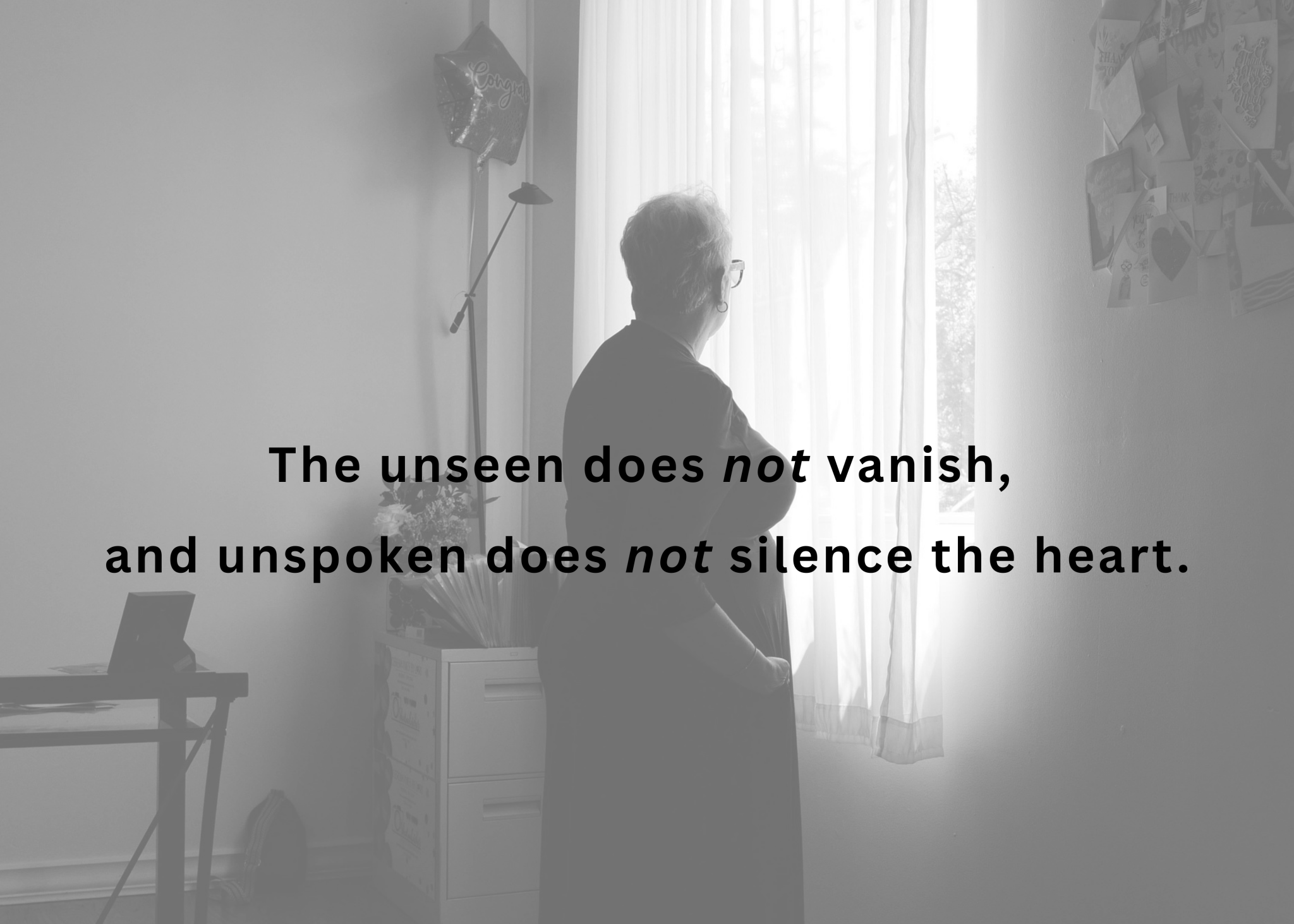
In my recently released book, Unseen, Unspoken, Unforgotten, I explore the parts of our stories that are often left in the shadows—the experiences we carry quietly because they do not fit neatly into communal conversation. Adoption is one of those spaces. Not because it is shameful, but because it is complex.
Complexity, however, is not contradiction. It is humanity.
There is room in Jewish life for birthmothers. There is room for nuance. There is room for stories that do not follow the traditional arc yet are no less sacred.
When we begin to speak openly about adoption—from the perspective of birthmothers, adoptees, and adoptive families—we dismantle stigma. We create community where isolation once lived. We honor the full spectrum of Jewish motherhood. A Jewish birthmother does not disappear after placement. She carries memory. She carries prayer. She carries love that does not expire.
And perhaps that, too, is holy.