
Strategic Intelligence Consultant & Insights Advisor
After Netanyahu: The Question Isn’t Who, But What
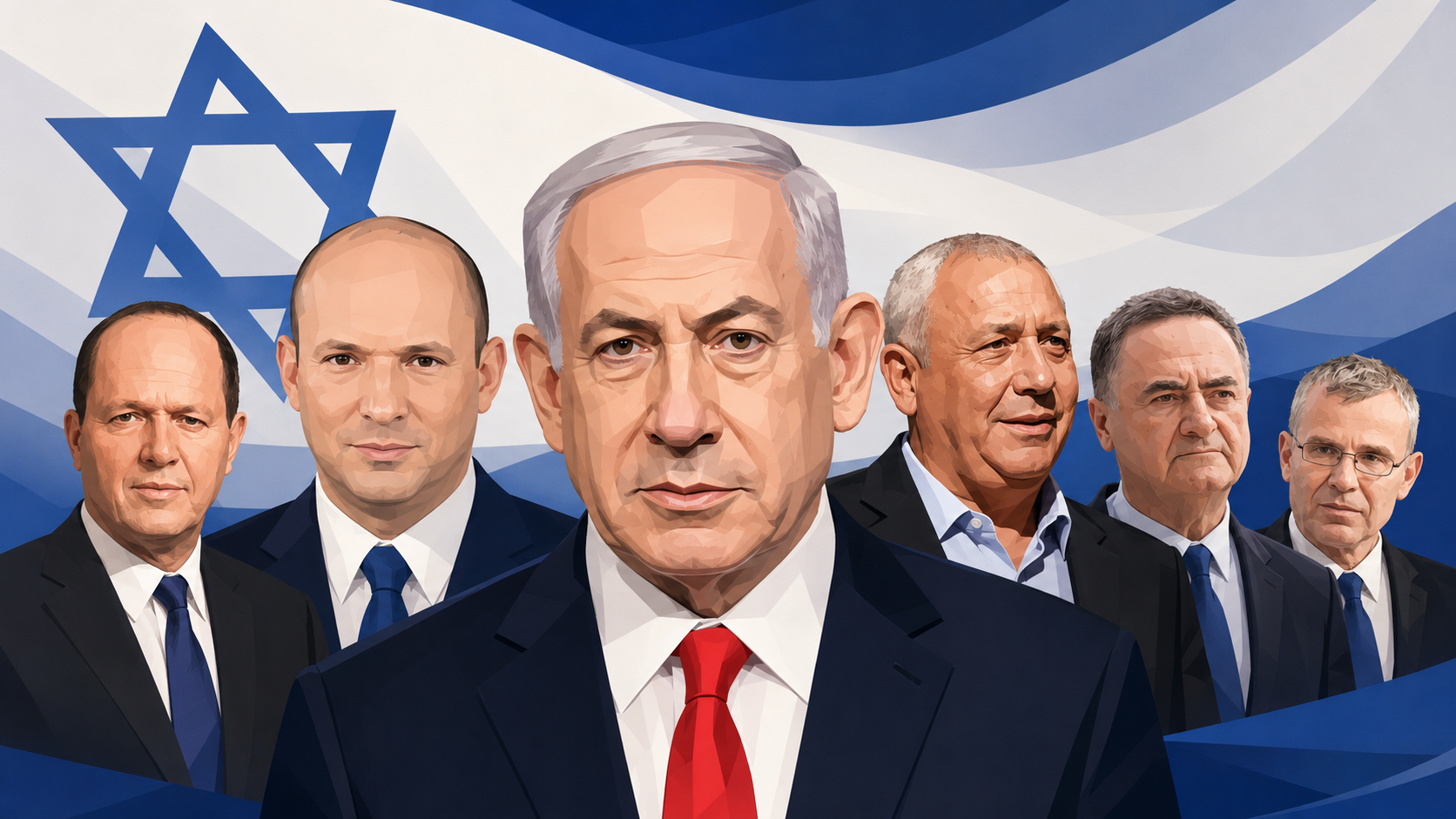
Netanyahu and the main contenders (made by AI)
Replacing Israel’s longest-serving leader is not a personnel change. It is a contest over the country’s next governing model.
Benjamin Netanyahu has been the fixed point of Israeli politics for so long that an entire generation has never voted in an election where his name was not the only question on it. He has been prime minister longer than anyone in the country’s history, and along the way he did something subtler than merely win: he fused his own survival to the central arguments of the nation — over security, the courts, the Palestinians, and the very meaning of a Jewish and democratic state. To be for Netanyahu or against him became, for many Israelis, a complete political identity.
That is why the succession now looming over the country is so easy to misread. As the Knesset moves toward dissolution and Israel braces for elections that must be held by late October, the instinct is to ask who will replace him, if he decides to. It is the wrong question. The right one is what will replace him — because the contest is not really about a person at all. It is about which governing model Israel chooses for the era after a man who made the state revolve around himself.
I would consider myself a diaspora Jew who really appreciates what Netanyahu did for Israel. However, strip away the drama and one fact becomes clear: a post-Netanyahu Israel need not be a post-right Israel. It could remain hawkish on Iran, wary of a rush to Palestinian statehood, tough in Gaza and along the Lebanese border. The deeper question is one of style and structure, not ideology: whether Israelis want the same politics without the same leader, or want to change how leadership itself is exercised after the rupture of October 7. The succession is less a handover than a verdict on permanent crisis politics.
Replacing Netanyahu is unusually difficult because he has not so much led the Likud as swallowed it. The party still holds primaries for its list, but not a fight for its chairmanship; members have effectively been asked to reaffirm him rather than choose among heirs, and internal soundings still show overwhelming numbers naming him to lead the next campaign. The succession is therefore live in the country but frozen inside the party.
Israel’s electoral architecture compounds the difficulty. Voters do not elect a prime minister; they choose party lists in nationwide proportional representation, and a government emerges only when someone assembles sixty-one of the Knesset’s hundred and twenty seats from blocs that agree on little except whether Netanyahu should stay or go. Any credible successor must pass three tests at once: win a party, look prime-ministerial to the public and look like a statesman, and stitch together a coalition. Recent polling shows how cruel that arithmetic is: the anti-Netanyahu camp hovers at the edge of a majority, its fate often resting on whether the Arab parties run.
The post-October 7 mood has changed what voters want from a leader. Security still decides Israeli elections, but it is no longer enough. The trauma of that day and the long war that followed put a premium on competence, accountability and the capacity to govern without exhausting the public. Trust in the government and the Knesset has collapsed to historic lows, while confidence in the army remains comparatively intact — and a majority still want a state commission of inquiry into the failures of October 7. The appetite is not only for toughness but for repair. Whoever inherits potentially his chair inherits the wars and uneasy ceasefires, the hostages’ shadow, the friction with Washington, and a society that trusts its uniforms far more than its politicians.
Inside the Likud, the succession is a contest of organization before charisma. The strongest internal candidate today is Israel Katz, the defense minister, who has held nearly every senior portfolio and knows the party machine intimately. In post-Netanyahu soundings of members he tends to lead — but narrowly, and without anything like Netanyahu’s grip. Katz is the candidate of apparatus and continuity: most likely to hold the party together, least likely to redefine it. He is a custodian, not the founder of a new era.
His most serious rival is Nir Barkat, the economy minister and former mayor of Jerusalem, who pairs private-sector wealth with executive experience. Among the wider public he often polls as the Likudnik best placed to take over, ahead of Katz and the justice minister Yariv Levin. Barkat is the electability argument made flesh — able to speak to urban professionals, moderate right-wingers and foreign audiences. Yet ambition is not ownership. In the party’s bloodstream he has never commanded the loyalty that machine figures inherit by default, leaving him stronger as a national pitch than a Likud insurgent.
Levin, the architect of the government’s judicial overhaul, is the ideological heir rather than the electoral one. He is beloved by the activist right and by voters convinced the courts had grown too powerful. But what gives him depth in the base narrows his path to the country: he is too bound to one of the most divisive chapters of recent Israeli life to embody the reconciliation a bruised electorate craves.
The more revealing however problematic battle, though, is being fought outside the Likud. Its central figure is Naftali Bennett, who has already sat in the prime minister’s chair and has returned at the head of a new alliance with Yair Lapid. Bennett’s wager is elegant but risky and persona-centric: Israel does not need a post-right era, he argues, only a post-Netanyahu one — a government hawkish on Iran and disciplined in office but no longer addicted to division according to him. For the many centre-right Israelis who remain hawkish yet have lost faith in Netanyahu personally, it is a potent message, and his alliance has at moments polled ahead of the Likud itself. His weaknesses are just as real: to many voters his earlier anti-Netanyahu coalition became a byword for instability, and his refusal — like Lapid’s — to govern with the Arab parties narrows every path to sixty-one.
And then there is Gadi Eisenkot, the fastest-rising figure in Israeli politics and the purest expression of the post-October 7 mood. A former army chief of staff who broke from Benny Gantz to build his own movement, Eisenkot has fashioned a candidacy out of restraint, competence and national repair rather than slogans. His new party has surged; in at least one survey he edged Netanyahu himself as the public’s preferred prime minister, and opposition voters have named him over Bennett as the man who should lead their camp. If Israelis decide the next era maybe should belong and give a chance to a security-minded centrist — less partisan than Lapid, fresher than Gantz — Eisenkot is the obvious beneficiary. His handicap is the mirror image of the Likudniks’: abundant credibility, but no machine to match it.
Around these four orbit the men who will shape any government without leading it. Avigdor Lieberman commands too few seats to be prime minister but exactly enough to make or break a coalition, with the ultra-Orthodox draft as his perennial lever. Bezalel Smotrich and Itamar Ben-Gvir can drag the whole system rightward, yet their international liabilities — both were sanctioned last year by a string of Western allies over West Bank incitement — make them power brokers rather than plausible premiers. Benny Gantz, once the great centrist hope, has faded to the margins. Each can constrain the next government; none looks likely to head it.
From here the futures fan out. A Likud succession, if Netanyahu finally exits, would come down to Katz’s machine, Barkat’s broader appeal and Levin’s ideological purity — a fight over whether to guard the leader’s legacy or rescue the party from its limits. A centrist-security government, built around Eisenkot or Bennett with Lieberman and the smaller lists, remains difficult but not impossible whenever the anti-Netanyahu bloc creeps past sixty-one. A right-wing coalition without Netanyahu — perhaps the most underrated outcome — would reorganize the right rather than abandon it, offering its voters everything they liked about Netanyahuism minus the man. And there is always the Israeli classic: fragmentation, no clean majority, and a transitional figure who governs while a more durable successor consolidates — as Bennett did in 2021, at the head of a far smaller party than Lapid’s.
What unites every scenario is that none produces a crowned heir. Katz is best placed inside the Likud, but only just; Bennett some think that is the most credible national alternative for now; Eisenkot the most dynamic; Lieberman the most consequential man never quite in the running. Israel is not so much choosing Netanyahu’s replacement as auditioning political archetypes — the manager, the modernizer, the loyalist, the general, the returning premier.
That is the real meaning of this succession. The post-Netanyahu era, whenever it arrives, will be defined less by inheritance than by reconstruction. The next leader will need a credible security vocabulary, know-how and experience, the standing to confront the legacy of October 7, the steadiness to manage Washington and the region, and — hardest of all — the authority to rebuild a public trust that has drained away. The seats, not the names, will decide who gets the chance. But after an age built so completely around one man, Israelis are not simply picking a successor, if the successor decides and chooses to. They are deciding what kind of state they wish to be once he is gone.
Related Topics
Related Posts