NAnews - Nikk.Agency Israel News
When Israel’s Right Starts Asking About Russian Media Influence
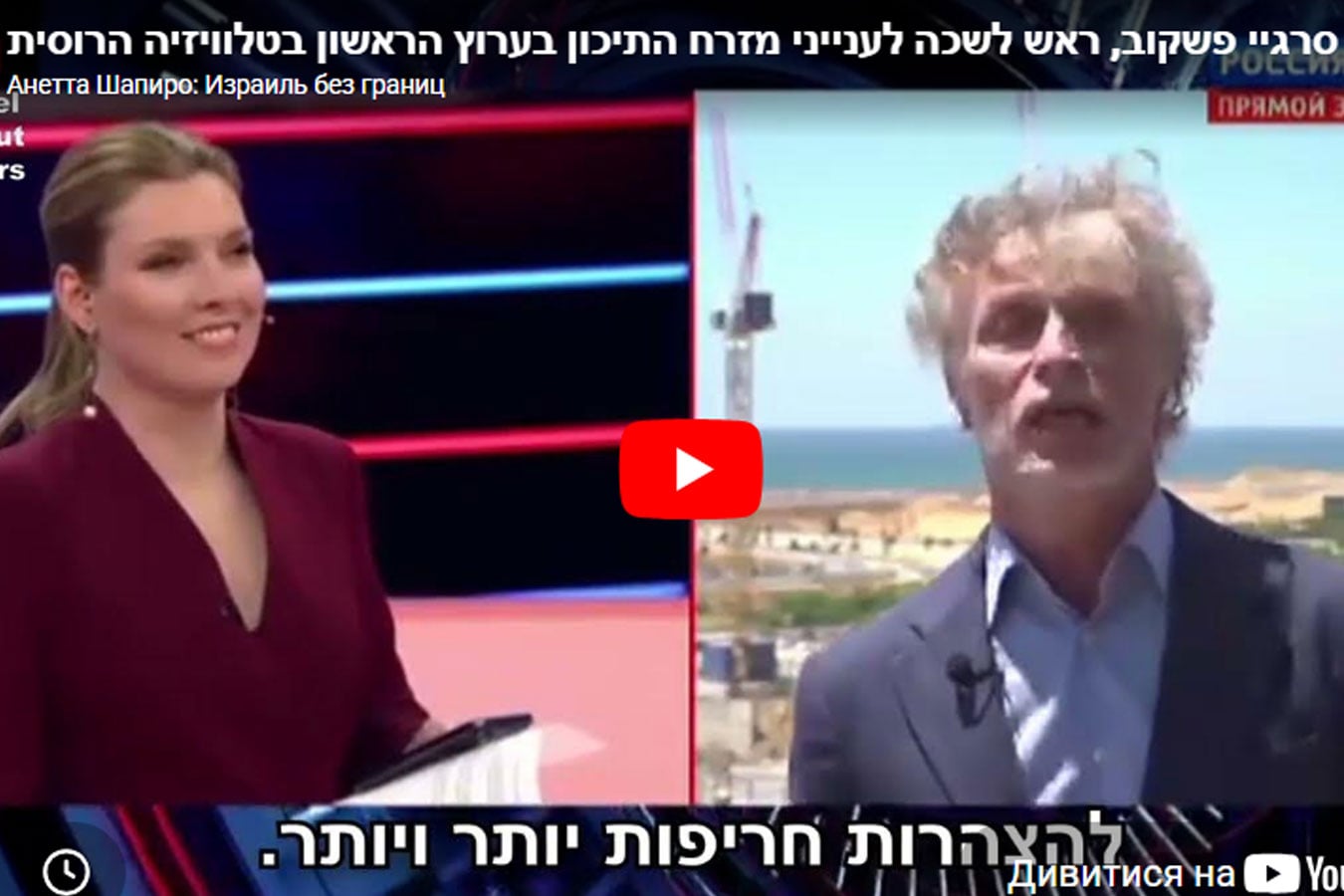
When Israel’s Right Starts Asking About Russian Media Influence. The image is a screenshot from the channel "Anetta Shapiro: Israel Without Borders."
On July 5, 2026, something notable happened in Israel’s media space.
A question that had usually been raised by “Ukrainian” activists, pro-Ukraine Israelis, and smaller media outlets following Kremlin propaganda suddenly appeared from a different direction — from the Israeli right.
The Telegram channel of Shomer Saf published a post about Sergey Pashkov, a Russian television journalist who has worked for years on Middle East issues and lives in Israel.
On the same day, the YouTube channel Anetta Shapiro: Israel Without Borders published a clip of his report.
In the Hebrew description of the video, Pashkov was presented as the head of the Middle East bureau of Russian television.
The key passage in the post was direct:
“This person lives in Israel, raises children here. At the same time, he speaks to a foreign audience with harsh criticism of Israel, spreads unreliable information, and criticizes the government and the prime minister.
The question arises: why does the state allow such activity to be conducted from its territory? And is this connected to the fact that he has influential protectors who allow him to feel so confident?”
The main story here is not that someone was once again angry at a Russian journalist.
The main story is who asked the question.
Shomer Saf is not a left-wing platform, not a “Ukrainian” organization, and not an opposition party headquarters.
It is a right-wing Zionist Israeli media project founded by Dr. Gadi Taub in 2020.
Taub is an Israeli historian, writer, publicist and political commentator, and one of the better-known public intellectuals of the Israeli right.
Shomer Saf is not formally a party.
It is not an official organ of Likud, Religious Zionism, Otzma Yehudit or any other political force.
But ideologically it belongs clearly to the Israeli right: a national-Zionist, pro-coalition media environment that is critical of left-wing media, the current judicial system and the Israeli mainstream.
That is why this publication matters.
When “Ukrainians” talk about Russian influence, it is often dismissed as “Ukrainian pain.”
When left-wing voices talk about it, it is dismissed as an attack on Netanyahu.
When activists raise it, it is called a private campaign.
But when the question comes from the Israeli right, the usual excuses begin to collapse.
It becomes harder to say: “This is just a Ukrainian agenda.”
It becomes harder to say: “This is the left attacking the government.”
It becomes harder to say: “This is only a community dispute.”
No.
Now the question of Russian influence has been raised from the right.
And that makes it part of Israel’s political agenda ahead of the elections.
Sergey Pashkov is not a random commentator.
Israeli media have already written about him as a Russian television journalist connected to VGTRK / Rossiya TV and working on Israel and the Middle East.
In Israeli publications, he has appeared as the head of the Middle East bureau of the Rossiya television channel.
There was also a public story around him in 2023, when Israeli media reported that there were calls to revoke his accreditation in Israel because of his coverage of the war against Hamas.
So the July 5 post did not appear in a vacuum.
It touched an existing nerve.
The issue is not whether, in a democracy, one may criticize the government, Netanyahu, the opposition, the United States, Gaza policy, Lebanon policy or the coming elections.
Of course one may.
That is the normal life of a democratic society.
But this is not only about criticism.
When a person connected to the Russian state media system operates from Israel and helps shape for a foreign audience the image of a “weak, dependent and internally collapsing Jewish state,” this begins to look like hostile information activity — a form of anti-hasbara.
At that point, the question is no longer only about opinion.
It becomes a question of sovereignty and security.
This is exactly why the right-wing source of the question is so important.
The Israeli right usually speaks the language of state strength, national interest, sovereignty and security.
If Israel must be strong against Hamas, Hezbollah and Iran, why should it be naïve or weak when dealing with Russian state media influence?
Why should Israeli security stop where television begins?
For now, Israel’s major parties still speak about Russian influence carefully — or avoid the subject entirely.
The reasons are understandable.
Russia is an uncomfortable topic.
There is diplomacy, old networks, business, cultural inertia, fear of alienating part of the electorate, and a reluctance to open another conflict before elections.
But that is exactly why the fact that right-wing Israeli media raised the issue matters.
Ahead of the elections, this could become a real political line.
The first party or bloc willing to say clearly that Israel must defend itself not only from Hamas, Hezbollah and Iran, but also from Kremlin anti-Israel and anti-Western propaganda working through Russian state media, may gain additional votes.
Not because it is a loud slogan.
Because it is a long-overdue problem.
This is not against Israeli citizens who came from the former Soviet Union.
It is not against the Russian language.
It is against a foreign state media machine that tries to use Israel as a convenient platform for anti-hasbara.
The Russian language does not belong to the Kremlin.
And right-wing Israelis do not have to close their eyes to Kremlin propaganda simply because it arrives through familiar cultural channels.
The question asked by Shomer Saf should therefore be taken seriously:
Why does the state allow such activity to be conducted from its territory?
This question is not addressed only to one journalist.
It is addressed to the Interior Ministry, the Foreign Ministry, security services, regulators, press offices, political parties and future candidates for the Knesset.
After October 7, Israel has no right to understand security narrowly.
Security is not only rockets, tunnels and borders.
It is also information channels, foreign influence, state media systems and the people who live here, enjoy Israel’s protection, and at the same time operate in the logic of another political machine.
This is also the point made in NAnews – Israel News, which has been following the question of Russian influence in Israel and its impact on Israeli security discourse:
The ice may have begun to move precisely because the question came from the right.
Now it will be harder to hide it, dismiss it, or call it secondary.
Israel must decide whether it treats Kremlin media influence as background noise — or as a real challenge to national security, sovereignty and the country’s ability to defend its own story.
Related Topics