Strategic Intelligence Consultant & Insights Advisor
After October 7: Jewish Resilience, Moral Clarity and Zionism
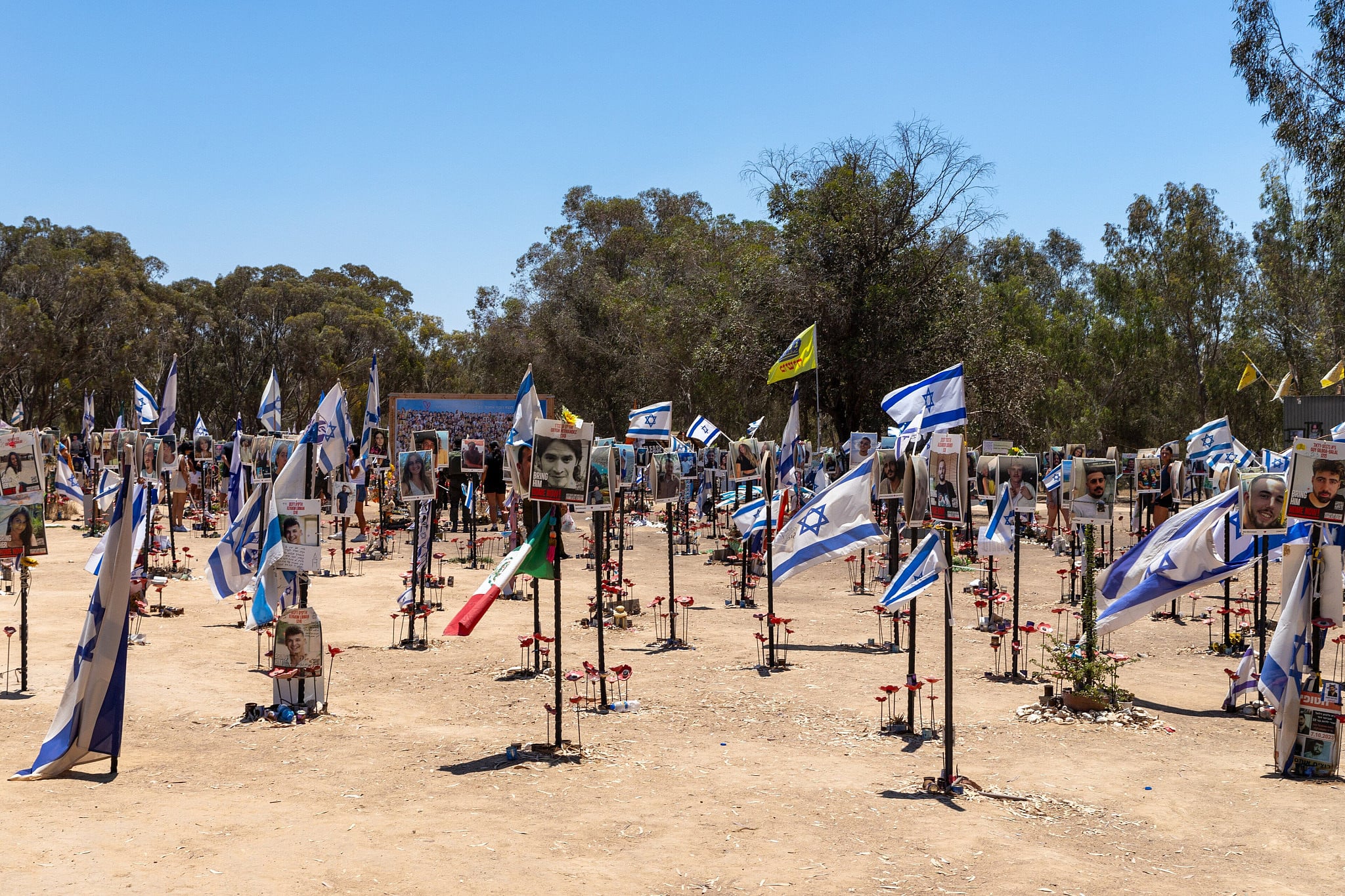
Main Memorial grounds for individuals murdered (Source: wikipedia)
October 7th, 2023.
Since that day, especially being a religious Jew, every year I find myself thinking back to where I was and what I was doing while our brothers and sisters were being slaughtered by the terrorists of Hamas.
That day was meant to be a day of celebration: Simchat Torah, the Jewish festival on which we celebrate the completion of the annual cycle of Torah readings and immediately begin the cycle again. It comes at the conclusion of our Jewish High Holiday season and the month of Tishrei; following days of repentance, reflection and introspection, and it is traditionally a day filled with joy, dancing and celebration.
A duty to celebrate
When I went to synagogue that evening for the Simchat Torah prayers and the beginning of the celebrations, our community Rabbi addressed us. He told us that, through our security guards and the news beginning to emerge from Israel, we had learned that a major terrorist attack had taken place during the day.
He acknowledged that this was an unimaginably painful moment for Jews and Israelis around the world. But he also reminded us that, as religious Jews, we still had a duty to celebrate the completion of the Torah, the reading cycle. The Torah, he said, is our driving force, at the heart of our identity, our strength and our resilience.
That message has remained with me ever since. From the very first hours of October 7th, one way in which the Jewish people would respond was by refusing to allow terror to extinguish Jewish life. We would mourn, we would grieve, and we would fight back; but we would also continue to live, pray, celebrate and create.
That is perhaps one of the most profound expressions of Jewish resilience: faced with those who glorify death and destruction, we continue to choose life, continuity and creation.
A divided Israel, months before
The last time I was in Israel was in the middle of 2023, only a few months before the October 7 attack. I had travelled to Jerusalem and Tel Aviv to attend a World Jewish Congress conference. Much of the conference, including many of the workshops, focused on the deep disagreements and political crisis surrounding the proposed judicial reforms. Israel was profoundly divided, and those divisions could be felt across almost every part of society.
Several facilitators raised a concern that has remained with me ever since: that such intense internal fragmentation could create opportunities for Israel’s adversaries. I am not suggesting that the judicial reform dispute caused what happened on October 7, nor that the two should be simplistically connected. But there is a wider lesson. When a society becomes consumed by internal disagreement and loses a sense of common purpose, its enemies may interpret that division as weakness. Where people are fragmented, adversaries can watch, calculate and organise.
What I imagined
Three years have now passed, and I realise that I have never properly reflected on how I experienced October 7 emotionally; especially being Jewish, as someone deeply connected to Israel, and as someone who has always regarded Israel as our homeland. Nor have I really examined how I carried those emotions through the war and everything that followed.
When the first reports began to emerge, followed by photographs, videos and footage from the communities attacked in southern Israel, one thought struck me with terrifying clarity: had I been there that morning with my family, visiting friends, travelling through southern Israel or simply attending the music festival, there was every possibility that we too could have been among the victims. I found myself imagining my children being murdered, my wife being subjected to horrific violence, rape and being killed, and our family being destroyed simply because we happened to be there and we happened to be Jews.
That fear was not abstract. October 7 demonstrated what Hamas-led terrorists were prepared to do to civilians. The assault was not confined to military installations or strategic targets. Communities, homes and a music festival were attacked. Civilians were murdered and abducted, and horrific acts of violence were committed.
For me, this is why describing Hamas operatives simply as “freedom fighters” or romanticising October 7 as an act of “resistance” is impossible to accept. Whatever one believes about the Israeli-Palestinian conflict, deliberate and savage violence against civilians cannot be transformed into heroism by changing the language used to describe it.
Slogans heard against the background of October 7
And this is also why certain slogans heard around the world since October 7 have become so emotionally charged for many Jews and Israelis. Phrases such as “From the river to the sea” or calls for a “global intifada” are interpreted very differently by different people, but for many of us they are heard against the background and the lens of October 7. They can sound not like abstract political demands, but like death threats directed towards the continued existence and safety of the millions of Jews, Muslims, Christians, Druze, Bedouins, Armenians, Baháʼís and others who live in Israel.
That does not mean that Palestinians do not have legitimate aspirations, rights or grievances. They do. Nor does it mean that every person who uses those slogans intends violence; some may use them out of naivety, misinformation or without fully understanding how they are perceived. But October 7 fundamentally changed the way many Jews hear them.
For me, that is one of the lasting psychological consequences of that day. What once might have sounded like political rhetoric can now evoke something much more immediate: the memory of what happened when hatred moved from slogans and ideology into homes, communities and families.
A distinction that must never be blurred
There is also a distinction that, for me, must never be blurred. On October 7, armed Hamas-led terrorists crossed deliberately into Israeli communities and attacked people because they were there; men, women and children, Israelis and foreign nationals, people of different religions and backgrounds. Around 1,200 people were killed in Israel that day. What followed in Gaza has also produced an immense and deeply painful loss of human life. More than 74,000 Palestinians have subsequently been reported killed, a figure that includes both civilians and combatants; “Gaza’s Health Ministry” does not separate the two categories, while Israel has estimated that more than 23,000 of those killed were combatants. Every innocent civilian death is a tragedy, irrespective of nationality, religion or which side of a border that person happened to have been born on.
But morally and legally, there is an important difference between deliberately entering civilian communities with the purpose of murdering and abducting people, and civilians being killed during military operations directed against an armed enemy; even though the latter remains devastating and every feasible effort must be made to prevent it. In Gaza, the IDF has used evacuation orders, millions of text and voice messages, leaflets, direct telephone calls, humanitarian corridors and, according to Israel, the cancellation of strikes where expected civilian harm was considered excessive. Israel has also repeatedly accused Hamas of embedding fighters and military infrastructure within densely populated civilian areas, including around hospitals, schools and other protected facilities; allegations supported in some instances by documented evidence, although the circumstances of individual strikes and Israel’s broader conduct of the campaign remain heavily contested.
None of this makes the death of a Palestinian child, mother, father or any other innocent civilian less heartbreaking. Nor should it. But intention, target selection and efforts to protect civilians matter when judging the conduct of war. For me, that is precisely why equating October 7 with every civilian death that subsequently occurred in Gaza is fundamentally wrong. One was an attack in which civilians themselves were deliberately hunted, brutally murdered and abducted; the other has taken place within a legitimate war in which Israel says it has sought to destroy Hamas while reducing civilian casualties, even as serious disputes continue internationally over whether those precautions were sufficient in every operation. This is also why I have always regarded the IDF as an army that aspires to conduct itself according to demanding ethical and legal standards; not because war can ever be clean or without terrible mistakes and consequences, but because the obligation to distinguish between combatants and civilians is embedded in the way it says it plans and conducts its operations.
And there is a final uncomfortable reality. Hamas has repeatedly been accused by Israel of exploiting Gaza’s extraordinarily dense civilian environment and operating from or near civilian infrastructure, thereby making the separation between battlefield and civilian space even harder. That does not remove Israel’s obligations towards Palestinian civilians, and it does not transform every civilian casualty into somebody else’s responsibility. But neither should Hamas’s own methods and responsibilities disappear from the discussion. If we genuinely believe that Palestinian civilian lives matter – like I do – then protecting those lives must mean holding every actor involved to account for how civilians are treated, not applying moral scrutiny selectively.
Why I am a Zionist
October 7th changed me.
I chose to become Jewish after a long and difficult process that required years of preparation, study, commitment and integration into a community and a people I initially knew relatively little about. I have never looked back. I chose to be Jewish, yet in many ways I feel that I was always Jewish.
I believe I was meant to stand up for the rights, responsibilities and future of the Jewish people; to defend our right to self-determination; and to support our right to live freely and securely in our ancestral homeland, Israel.
And that is what makes me a Zionist.
Related Topics
Related Posts