
Professor of Political Science | Strategic Affairs Analyst | Senior Fellow, Defence Research and Studies
After October 7: Statehood in Question
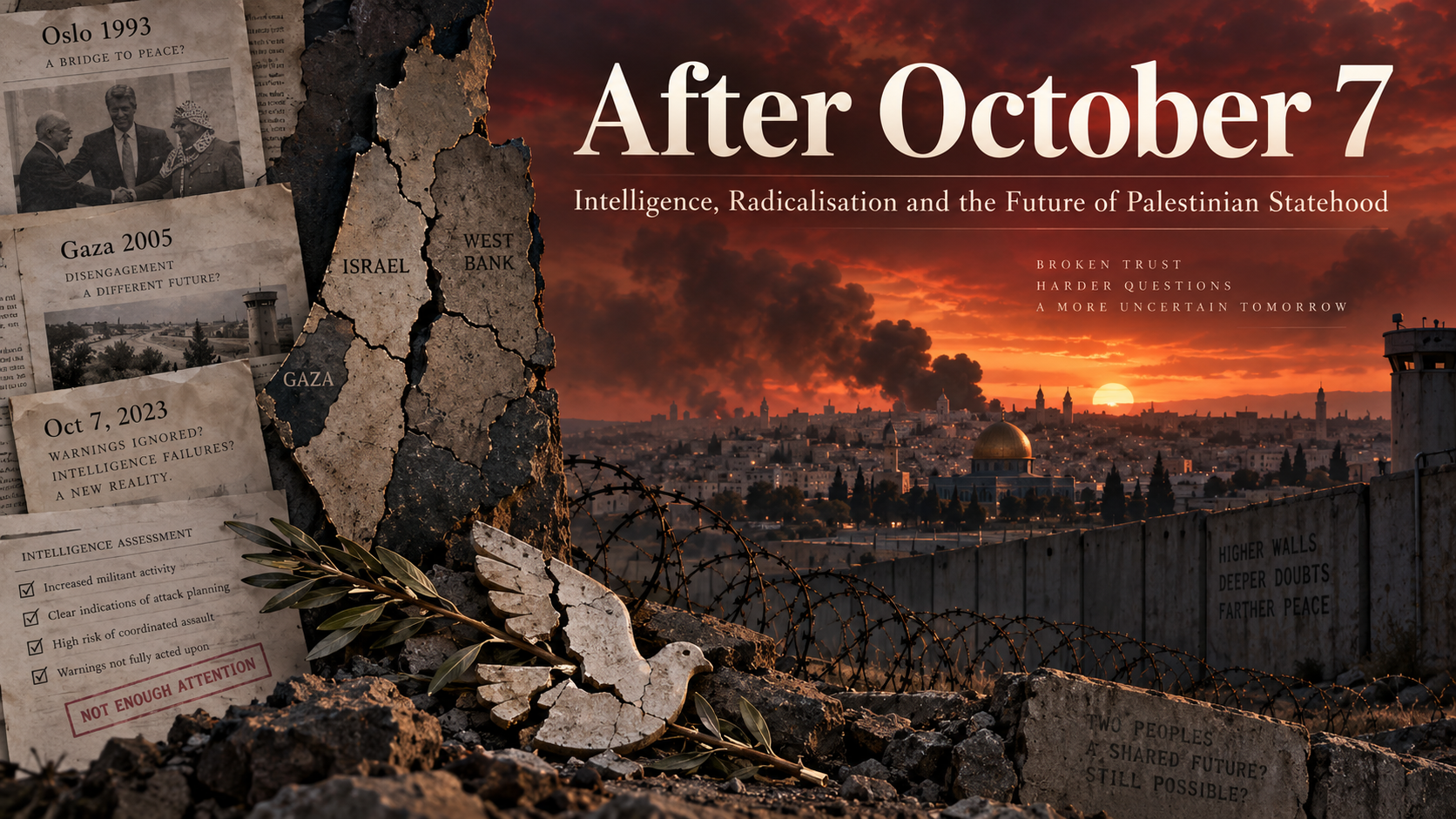
After October 7: Broken trust, failed political experiments, and the growing question of whether Palestinian statehood can coexist with Israel’s security.
During elections in a democracy, old wounds become fresh again, painful memories are revived. The renewed discussion surrounding October 7 is similar.
Governance and high politics, particularly when political actors are responsible for protecting the security and interests of the State, operate according to a logic very different from that of family, society, or individual life. Obviously, We tend to judge political governance from our personal perspective because that is the world in which we live and are groomed. But statecraft operates in a different environment, involving intelligence, security, national interests, strategic calculations and sometimes extremely difficult choices. That is why politics can sometimes appear cruel. Politics and statecraft are autonomous.
It difficult to believe, therefore, that the October 7 attack was an entirely unforeseen surprise. History demonstrates that massive and brutal attacks sometimes take place even when warning signs already exist and, strangely, the victim State appears to be looking in another direction. Why does this happen? Answer is not in the jurisdiction of people, even electorate. Sometimes the full truth emerges years later; sometimes it may never emerge completely.
Consider Pulwama, India. On 14 February, 2019, an unusually large convoy of 78 vehicles carrying 2,547 CRPF personnel travelled by road from Jammu towards Srinagar. A suicide bomber attacked the convoy and 40 CRPF personnel were killed. The CRPF had requested five aircraft for transporting personnel but that the request was not accepted by the Home Ministry. The combination of prior security warnings, the unusually large road convoy, questions over air transportation, acknowledged vulnerabilities and the government’s decision just seven days later, on 21 February, 2019, to extend air-travel entitlement to all CAPF personnel on important Jammu and Kashmir routes legitimately raises the question of whether a foreseeable threat had been treated with sufficient urgency ?
The 26/11 Mumbai attacks of November 2008 provide another striking example. Intelligence alerts before the attack had specifically mentioned important Mumbai targets. Alerts issued on 9 August and 24 September 2008 reportedly about potential targets. American intelligence had also warned India about a potential Lashkar attack in Mumbai. Yet the attackers still succeeded in reaching Mumbai by sea.
The September 11, 2001 attacks offer another disturbing historical parallel. On 27 August 2001, Spanish police intercepted a telephone conversation involving an alleged al-Qaeda-linked network in which the caller said words translated as: “We have entered the field of aviation and we have even slit the throat of the bird.” Another interpretation referred to cutting the “eagle’s throat.”
Thus, intelligence history repeatedly demonstrates a troubling distinction between having information, correctly interpreting it, and acting upon it in time or let it happened ?
Anyway, the question of the establishment of a Palestinian State does not exist after October 7. Because, first, the Palestinian leadership has had opportunities to govern Palestinian areas but they failed.
The Oslo Declaration of Principles of 13 September 1993 initiated Palestinian interim self-government. The Gaza-Jericho Agreement of 4 May 1994 formally established the Palestinian Authority. The Oslo II Agreement of 28 September 1995 further expanded Palestinian self-government in the West Bank and created the framework under which Palestinians would elect their own political institutions. Another major opportunity appeared in 2005, when Israel removed its settlers and permanent military installations from inside the Gaza Strip. In 2006, Hamas won the Palestinian election. By June 2007, it violently expelled Fatah from Gaza, splitting Palestinian rule between Hamas in Gaza and the Fatah-led Palestinian Authority in the West Bank.
The brutal October 7 attack and subsequent celebrations in some areas controlled by the attackers should not leave any doubt that Israel is surrounded by blood thirsty and brainwashed people. Their political culture, in many cases, has not been trained for a State or political system that can peacefully live with another State. Some people think that peace will come if a Palestinian State is created side by side with Israel and that violence will then end. But events suggest that once a Palestinian State is created, violence could become institutionalised. Without a Palestinian State, there may be peace at intervals, but after the creation of such a State, violence could become permanent. Violence lives in the mind. Some extremist clerics advocate it in the name of Islam and preach hostility towards non-Muslims. The irony is that followers of Islam are also killing one another in large numbers.
ISIS/Islamic State (Daesh), ISIS-K/Islamic State Khorasan, Al-Qaeda, AQAP (Al-Qaeda in the Arabian Peninsula), AQIS (Al-Qaeda in the Indian Subcontinent), Al-Shabaab, JNIM—a powerful Al-Qaeda-linked coalition and one of the most dangerous jihadist organisations in the Sahel—Boko Haram, Tehrik-e-Taliban Pakistan (TTP), Lashkar-e-Taiba (LeT), which was responsible for major attacks including 26/11 in Mumbai, Jaish-e-Mohammed (JeM), Hizbul Mujahideen, Harkat-ul-Mujahideen, Kata’ib Hezbollah in Iraq, Hezbollah in Lebanon, Hamas, Palestinian Islamic Jihad (PIJ), and several other organisations are manifestations of such extremist and radicalised thinking.
Hardly any part of the world has remained completely beyond the reach or influence of such organisations. Europe is current target. They may fight among themselves because of sectarian, political, ethnic, or strategic differences, yet all share hostility towards societies, communities, or political systems outside their faith that they consider their enemies.
Although these movements emerge from different sectarian and political backgrounds and often have serious conflicts among themselves, a recurring feature among all extremist organisations is the rejection of pluralism, secular political arrangements, democratic values, and peaceful coexistence with those who do not accept their ideological worldview. Broad sections of the societies from which these extremists emerge may also be deeply radicalised, and some segments even celebrate or glorify their acts of violence. That is why some analysts argue that the problem goes beyond individual radicalisation and that, in certain interpretations and political movements, Islam itself has been subjected to radicalised readings.
There are two categories of people: one is creative and the other destructive. Israel is surrounded by groups and individuals who become happy if destruction takes place in Israel or elsewhere where those they consider enemies live. They may become unhappy when creation, creativity, production, or innovation takes place in societies they oppose. Not creation, but destruction makes them happy, because in this way they have been groomed. They fail to understand that creation benefits the whole of mankind. If you talk about peace, they may attack you; if you talk to them, they may stab you; and if you yourself threaten them, they may obey you. Israelis cannot behave with their surroundings according to what Israelis themselves think; Israelis have to behave with them according to how those hostile actors think.
To remind, Europeans gradually transformed themselves from societies marked by repeated violence and conflict into more disciplined and law-abiding societies. They developed institutions, strengthened the rule of law, and even established strong traffic discipline. They started from the basics. However, Islamist networks have also established a significant presence in Western Europe, the United States, and countries such as Sweden, sometimes exploiting the openness, civil liberties, asylum systems, and liberal political environments of these societies.
At the same time, the role of Western powers in the politics of Islamic countries cannot be ignored. The United Kingdom, France, Germany, and particularly the United States have exercised considerable influence over the resources, security structures, technology, arms markets, and political systems of many countries in the Middle East and the wider Islamic world. Western powers have repeatedly intervened in regional politics, supported particular regimes and ruling elites, armed competing factions, and pursued strategic interests that have sometimes contributed, directly or indirectly, to instability and terrorism.
In several countries, Western governments supported monarchies, military regimes, political families, or preferred elites when doing so served their geopolitical, energy, or security interests. Arms supplied to governments or armed factions have also sometimes found their way into wider regional conflicts.
The Western-dominated international order, particularly the influence historically exercised by the United Kingdom and later by the United States, has often appeared to operate on contradictory principles, condemning terrorism on the one hand while cooperating with regimes, movements, or armed actors on the other when strategic interests required it. The latest major UK announcement came on 8 September 2026. Britain said it would significantly tighten measures against Israeli settlement activity in the occupied West Bank.
Israel, too, has developed considerable political, diplomatic, and lobbying influence in Western countries, particularly in the United States, and naturally seeks to shape Western policy in accordance with what it considers its national and security interests. Other regional actors, including Arab states, Iran, Turkey, and different political and religious organisations, similarly attempt to influence Western decision-making.
The historical role of the United Kingdom deserves particular attention. British priorities in the Islamic world during the colonial period and afterwards were often guided by imperial routes, energy interests, strategic geography, and the balance of power. British policies, together with those of other colonial powers, contributed to territorial arrangements, political rivalries, and unresolved disputes whose consequences continue to influence conflicts today.
Therefore, contemporary terrorism, extremism, and instability should not be viewed through a single lens. Religious radicalisation is one factor, but colonial legacies, external intervention, authoritarian regimes, arms transfers, proxy conflicts, geopolitical competition, and the manipulation of local divisions have also played major roles in creating the present situation.
Israel leadership has to be realistic always and all time. Israel can not deal with Palestine sympathisers. If it tries, it will be cheated and stabbed. Israel can only fight, regular fight. It should become a common phenomenon. How can one give them a State when the political and security conditions for peaceful coexistence are not yet established? They are not ready to coexist with others, and Palestinian political factions have often failed to coexist with each other. The demand for a separate State should, therefore, be considered in light of ground realities.
Thus, after October 7, Israel has to defend its borders from beyond the borders, and a buffer ring or security zone may be one of the most practical options.
Related Topics
Related Posts