After Shiva: Declutter. Repurpose
I am just days away from reciting Yizkor, the prayer of Remembrance, on Yom Kippur for the first time for both of my parents. Losing my Dad a few weeks ago marked the end of an era. As long as he was alive, I was still someone’s little girl, regardless of the fact that I just turned 54. His passing has also reopened the grief for my Mom, unexpectedly bringing back a renewed pain to a loss that happened six years ago. I now find myself a full-grown adult, yet carrying this strange feeling of somehow being orphaned.
My Mom left this world ready for her days to end, asking me, “How much longer, Rebeca?” after a battle with cancer. My Dad on the contrary, left abruptly, still craving more from life, with projects unfinished and giving me instructions from what would become his deathbed at the hospital: publish his latest book on antisemitism. It came out of the press the day of his funeral.
He wanted a lively event to hand the book out. Instead, in what became a celebration of his life before we buried him, we gave copies away, asking people to change from “I’m sorry for your loss,” to a L’chaim, To Life. Defying Jewish mourning law on celebratory toasts during shiva, I sat on the floor, physically reminded of just how low life can bring you, when one of his friends handed me a shot of Macallan, his favorite single malt, coincidentally aged 18 years, the numerical value in gematria of chai: life.
Still in that phase of grief commonly referred to as denial, but which to me felt more like experiencing a split personality, erratically shifting from tears to laughter to anger, I went to our house in La Antigua Guatemala as soon as shiva ended. It is our home of more than 50 years of weekends and vacations, where perhaps from a post-war trauma mentality inherited from my grandparents, practically nothing had ever been thrown away. Out of respect for my Father, who could not bring himself to touch it, my Mom’s desk still stood exactly as she had left it: her to-do lists in her elegant handwriting and photographs of her loved ones frozen in time, as if waiting for her to show up any minute and simply go about her day.
Now it was time to go through both of their belongings.
My Dad’s room still smelled of his cologne. I erased the content of his cell phone without reading anything, respecting his privacy, and yet there I was, invading it in far more intrusive ways, deciding what to do with everything from his Rolex to his socks.
Speaking of socks, during the shiva our rabbi told us avelim, the mourners, a story meant to bring us some comfort. The anecdote goes that Baron Rothschild, approaching death, left two letters: one to be opened immediately after his passing, and the other after the Shloshim, the thirty-day mourning period. In the first, he asked his children to bury him with his socks on. Despite the family’s insistence and influence, the Chevra Kadisha, the Jewish burial society, refused on halachic grounds. The second letter began: “Now that you know you cannot even take your socks with you when you die…”
Shoes presented a different dilemma. Jewish tradition discourages giving away the shoes of the deceased. When my Mom died, we followed the custom strictly, separating each pair into different garbage bags so that no beggar could find them and put the pairs back together. Yet here I was, in a Guatemalan village where some people still walk barefoot. So if the superstition is that the next wearer might somehow follow in the deceased’s footsteps, my Dad’s joie de vivre is something well worth passing on. So we donated them all, including the new ones still in their boxes. Borrowing from the six-word short story attributed to Hemingway, “For sale: baby shoes, never worn,” I had my own version: “For tzedakah: elder shoes, never worn.”
Years earlier, I took my Mom’s clothes to a shelter where a Catholic priest performs a great mitzvah, a good deed, feeding the indigent. Weeks later, I happened to be driving through that neighborhood, when I spotted a homeless man wearing one of her favorite sweatshirts. It felt surreal. Countless times I had hugged my Mom while she wore it, and now there it was on this stranger, so different from my beautiful Mom. The contrast was jarring. Yet once the initial shock passed, I found comfort knowing this cloth was still providing warmth, now to someone who really needed it.
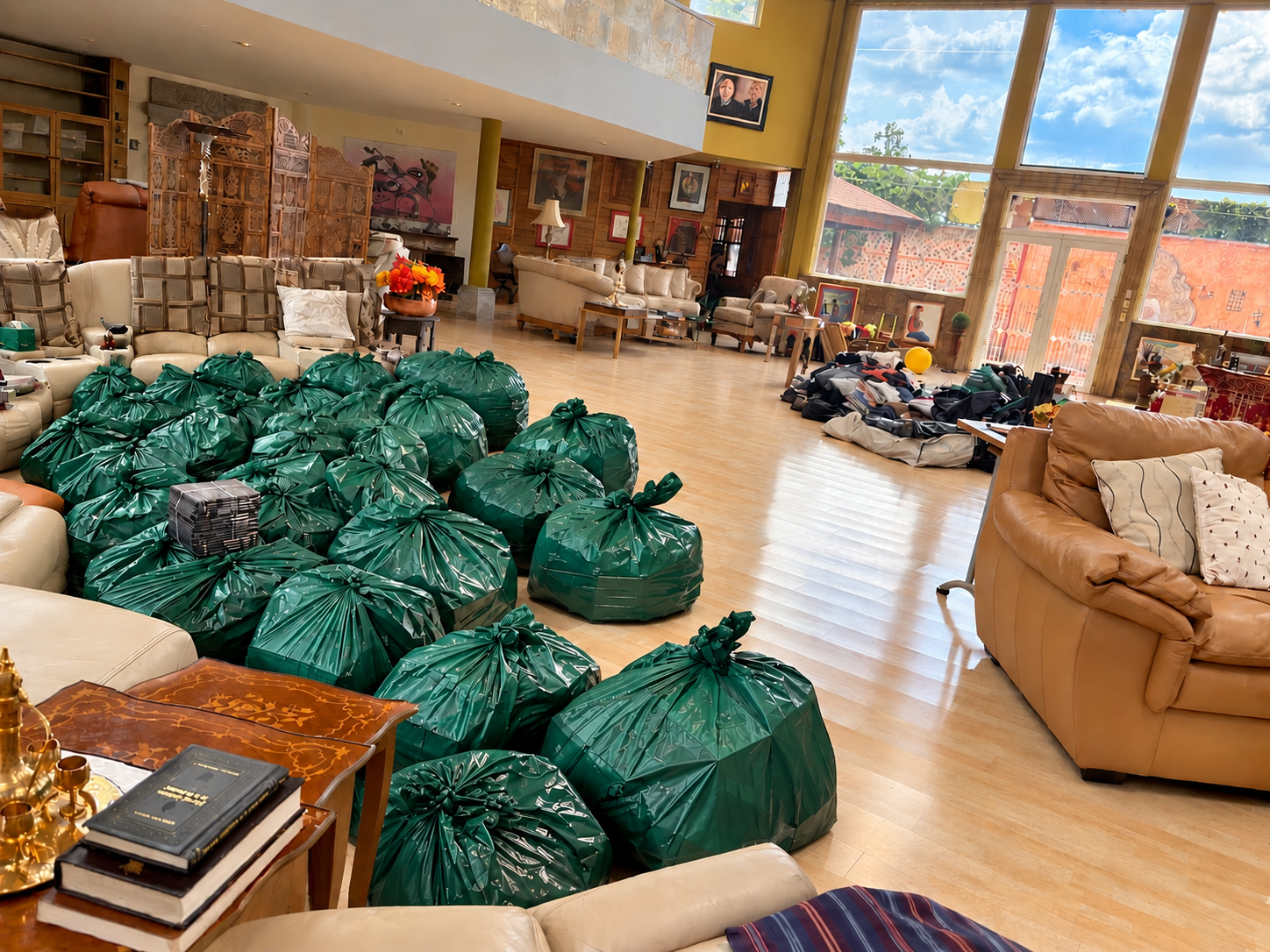
Today, surrounded by garbage bags that ironically hold precious treasures, placed there by my own decision, I realize that even a photograph of an ordinary day can suddenly feel impossible to throw away. Those random, seemingly meaningless moments, the ones that are not posted for likes in social media, are perhaps ultimately the most meaningful. John Lennon sang it best: “Life is what happens to you while you’re busy making other plans.”
Nowadays, you can hire professionals to do the decluttering for you. As tempting as it may be to numb the emotions and hand the task over to someone else, you can’t outsource healing. Feel it to heal it. They cannot hear my parents’ voices the way I still can. Some things have obvious destinations, but it is the unusual ones that make you pause and change the question from, “How do I get rid of this?” to “How do I honor the life behind it?”
The glasses that once elegantly framed my parents’ faces found their way to a tiny optical shop in La Antigua that gives donated frames and free consultations to those in need. Fittingly, it sits on Truth Revealing Avenue. Nothing like a pair of glasses to do just that. My Dad’s suits, some likely worn while he negotiated Guatemala’s peace process that ended nearly thirty years of armed conflict, went to “Migrant Shelter”, where deportees that are sent back to the country, receive proper clothes for job interviews. May his strength accompany whoever wears them next. Their 2,000-plus DVDs and CDs collection, along with the vintage equipment necessary to play them, went to an elderly home where I find comfort imagining residents dancing to my Mom’s favorite Whitney Houston songs, or someone discovering my Dad’s beloved Fellini through La Dolce Vita. Their bridge supplies are now at the local club where many of their friends still play and where they will be dealt a new hand.
None of these decisions really matter to anyone, except to our family, but that is the point: they are intimate choices born from knowing our loved ones behind the objects.
So, after everything is packed and delivered, what do I decide to keep?
The old letters from those golden days gone by. An antique pocket watch, a quiet reminder that time is our most precious non-renewable asset. Most of all, I keep the memories. They need no storage boxes. Letting go of my parents’ belongings does not mean letting go of them, ever.
–
L’ilui nishmat Beile bat Rivka Z”L and Noach Meir ben Chaim HaCohen Z”L, together again.