

After the Cameras Leave:What the World Can Do-Panama After the Earthquake—Part 5
There is something about the aftermath of a disaster that has always troubled me. It is not only the destruction, the injuries, or the lives that have been turned upside down. It is how quickly the rest of the world seems able to move on.
For a few days, perhaps a week, an earthquake dominates the headlines. We see collapsed buildings, frightened children, exhausted rescue workers, and families standing in front of what used to be their homes. We watch, we feel compassion, we donate, and we tell ourselves how terrible it all is.
And then another story takes its place.
The cameras leave. The journalists go home. The social media posts become less frequent. The emergency appeals slowly disappear from our screens.
But the people who lived through the disaster do not get to turn it off.
For families in Herrera, Los Santos, Coclé, and Veraguas, the earthquake is not simply something that happened in October 2026. It is something they may continue living with for months and years to come.
I have spent much of my life traveling, working with communities, and trying to understand how people respond when their world suddenly changes. I have been present in the aftermath of the 2015 Nepal earthquake and Typhoon Haiyan in the Philippines in 2013, providing Psychological First Aid. I have also lived through wars in Israel, where I have seen how the emotional consequences of a crisis continue long after the immediate danger has passed.
These experiences have changed how I look at disasters.
I no longer measure the seriousness of a crisis only by what happens on the day itself. I think about what happens afterward, when people are expected to return to normal even though normal no longer exists for them.
And I worry, deeply, about the people we stop seeing.
The Second Wave Nobody Films
During a mental health coordination meeting in Panama, professionals raised a concern that I have heard repeatedly in other disaster settings: some of the most difficult psychological consequences do not appear immediately.
They may emerge weeks or months later, sometimes becoming particularly noticeable around the six-month mark.
This does not mean everyone experiences a delayed crisis, nor does it mean there is a predictable timetable for emotional recovery. But it does mean that the absence of visible distress in the first weeks should never be mistaken for the absence of need.
Immediately after a disaster, people are often operating on adrenaline. There are urgent decisions to make. Where will we sleep tonight? Is our home safe? Where are the children? Can we get medication? Is there food? Can we return to work?
There is little time to think about what has happened emotionally.
Neighbors help neighbors. Volunteers arrive. Donations come in. Communities organize food, shelter, transportation, and childcare. There is an extraordinary sense of solidarity.
I have witnessed that human generosity in different parts of the world, and it never stops moving me.
But eventually, the emergency phase begins to end.
The volunteers return to their own lives. Donations slow. Temporary housing becomes less temporary. Insurance claims remain unresolved. Savings disappear. Businesses struggle. Farmers worry about damaged crops and lost income. Parents try to reassure their children while privately wondering how they will pay next month’s bills.
And slowly, the emotional weight of everything that has happened begins to settle.
A parent who seemed remarkably strong in the first weeks may suddenly find it difficult to get out of bed. A child who initially appeared fine may become frightened of sleeping alone. Someone who never drank much may begin using alcohol to quiet their thoughts.
Relationships can become strained. Irritability grows. Sleep becomes difficult. Feelings of hopelessness may appear.
For some people, serious depression, substance misuse, or suicidal thoughts may develop or worsen.
I want to be careful here. Most people who experience disasters do not develop lasting mental illness. Many recover with the support of family, friends, community, and time.
But recovery is not automatic, and resilience should never become an excuse to abandon people.
That is something I feel strongly about.
We celebrate resilience, and rightly so. But sometimes we use the word so freely that we forget what it asks of people.
Being resilient does not mean someone should have to carry everything alone.
Panama Is More Than a Disaster Headline
My connection to Panama is personal. It is the country where I was born, and although my life has taken me across the world, that connection has never disappeared.
When I think about Panama, I do not think first about a map, a government, or a disaster report.
I think about people. Families. Communities. The warmth and generosity that have always been part of my connection to the country.
That makes what has happened especially difficult to watch.
The earthquake has created needs that go far beyond damaged buildings. Families face uncertainty about housing, employment, education, healthcare, and the safety of their communities.
Some people may return to homes that are not fully repaired because they have nowhere else to go. Others may remain in temporary arrangements that offer little privacy or stability.
For children, the loss of familiar routines can be particularly unsettling. School is not only a place of learning. It is also a source of predictability, friendship, and safety.
For older adults, people with disabilities, and those living in isolated rural communities, accessing services may become even more difficult.
Women and girls can face additional protection concerns in crowded or temporary settings, particularly where privacy, safe sanitation, and adequate safeguards are lacking.
And throughout all of this, the local professionals are expected to keep working.
Doctors, nurses, social workers, psychologists, teachers, and community leaders are helping others while many are dealing with their own losses and uncertainties.
I have tremendous respect for them.
One of the things that continues to impress me about Panama is the willingness of people to step forward. The engagement of hundreds of professionals in the response reinforced something I have believed for years: communities often have remarkable strengths that outsiders fail to recognize.
Panama does not lack capable, compassionate professionals.
What it needs is for those professionals to have the resources, support, and sustained commitment necessary to do their work.
And that is where the rest of us come in.
What the World Can Actually Do
I often hear people say that they wish they could help after a disaster but do not know what difference they could possibly make.
I understand that feeling.
The scale of destruction can seem overwhelming. The problems are complicated. Most of us cannot travel to the affected area, and many people are not in a position to make large financial contributions.
But I firmly believe that meaningful help does not always require extraordinary resources.
Sometimes it requires something much harder to sustain: commitment.
First, support the people who will still be there.
International organizations and visiting professionals can play important roles, especially during the emergency phase. But long after they leave, it will be Panamanian community organizations, health workers, teachers, volunteers, and local leaders who continue the work.
They know their communities. They understand the language, the culture, the relationships, and the challenges that may not appear in an outside assessment.
When possible, support credible local organizations directly.
And perhaps even more importantly, listen to what they say they need.
I have learned that arriving with answers is rarely as useful as arriving with questions.
Second, think beyond the first month.
Emergency relief is essential. People need food, shelter, water, medication, and immediate safety.
But psychological recovery requires a different kind of commitment.
It requires continuity.
A family may need support six months after an earthquake, when the initial assistance has ended. A teacher may need guidance on helping children who remain fearful. A healthcare worker may need someone to recognize that they are becoming overwhelmed.
If you are donating, consider supporting programs that will remain active after the headlines fade.
A modest recurring contribution may sometimes be more valuable than a larger one-time gift.
Third, protect those who are most vulnerable.
Every disaster response should consider the specific needs of children, women, older adults, people with disabilities, and those who were already struggling before the crisis.
Protection should never be treated as an optional addition.
Safe environments, accessible services, appropriate safeguarding procedures, and clear referral pathways matter enormously.
We should expect them to be part of disaster planning from the beginning.
Fourth, ask before sending supplies.
People are naturally generous after disasters. They collect clothing, household goods, toys, and other materials.
The intention is wonderful.
But poorly coordinated donations can overwhelm already strained transportation and distribution systems.
Before organizing a collection, ask local organizations what is actually needed.
Sometimes financial support is more effective because it allows supplies to be purchased locally, helping both the affected families and the local economy.
Good intentions matter, but good coordination matters too.
Fifth, learn how to support someone emotionally.
This is particularly close to my heart.
Through my work with Mental Health First Aid Israel, I have spent years encouraging people to understand that supporting someone experiencing emotional distress does not require them to become therapists.
It requires basic skills, awareness, compassion, and the willingness to listen.
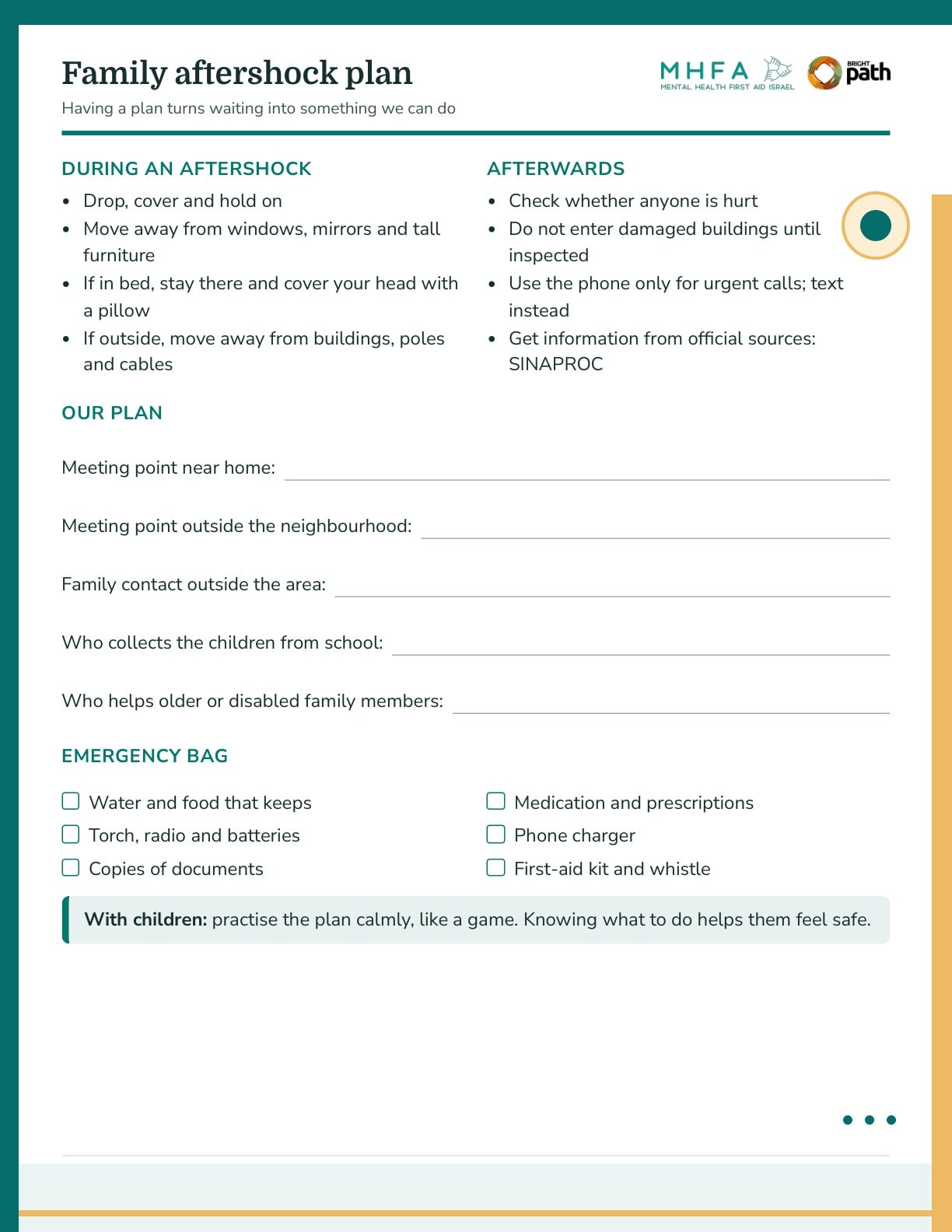
Psychological First Aid teaches us to observe what people need, listen without pressuring them, and connect them with practical support.
It sounds simple, but those skills can make a meaningful difference.
We do not need to ask someone to relive their trauma. We do not need to offer promises we cannot keep. We do not need to have all the answers.
Sometimes the most helpful thing we can say is, “I’m here. What do you need most right now?”
I wish these skills were taught much more widely, not only after earthquakes but as part of everyday community preparedness.
Because the next crisis may not happen somewhere far away.
It may happen in our own neighborhood.
Finally, do not stop paying attention.
This may be the simplest request I can make, and perhaps the most important.
Remember Panama in three months. Remember it in six months. Ask how communities are doing when the rebuilding becomes slow and frustrating.
Share credible updates. Support organizations that remain involved. Encourage others to understand that recovery takes time.
Attention creates accountability.
And sometimes, knowing that the world has not forgotten you matters more than we realize.
What Panama Reminded Me About Listening
I went to Panama hoping to contribute something useful through my experience in Psychological First Aid, mental health education, and disaster response.
But I have always believed that the moment we stop learning from the people we are trying to help is the moment we become less effective.
No two communities experience a disaster in exactly the same way.
Even neighboring villages may have entirely different needs, resources, fears, and expectations.
A response designed from a distant office may look impressive on paper and still miss what matters most to the people living through the crisis.
That is why listening must come before planning.
I have seen this lesson repeated in Nepal, the Philippines, Israel, and other places where I have worked.
People do not want to be reduced to their suffering. They want to be heard, respected, and included in decisions affecting their lives.
I also think we sometimes underestimate the emotional needs of those providing assistance.
The professional who spends the day supporting frightened families may return home to their own uncertainty. The volunteer who appears endlessly energetic may be exhausted. The community leader everyone relies on may have nobody checking on them.
Who is caring for the caregivers?
That question has followed me for years.
It is one reason I believe disaster response must include ongoing support for the people doing the work, not merely the people receiving services.
We cannot build sustainable recovery on the exhaustion of those who care the most.
What I Carry Home
As I reflect on Panama, I find myself thinking less about the immediate emergency and more about the months ahead.
I think about the families trying to rebuild a sense of security.
I think about children who may still become frightened whenever the ground trembles.
I think about professionals who will continue showing up, long after international attention has shifted elsewhere.
And I think about how easy it is for those of us living comfortably elsewhere to assume that because we no longer hear about a disaster, the situation must somehow have improved.
That assumption troubles me.
I have traveled to more than a hundred countries, and one lesson has remained remarkably consistent: suffering does not disappear simply because it becomes less visible.
I have also learned that people are capable of extraordinary kindness.
I have seen strangers support one another in circumstances that would overwhelm most of us. I have witnessed communities organize themselves when formal systems were struggling. I have met people who had lost so much and still found ways to help someone else.
Those experiences have strengthened my faith in people.
But they have also strengthened my conviction that compassion must be more than a temporary emotional response.
It has to become action.
And action has to continue after the excitement and urgency have passed.
The Choice Not to Look Away
An earthquake may last less than a minute.
Its consequences can last years.
Between those two realities lies a long, difficult period that rarely makes the evening news.
There are no dramatic rescue scenes. No crowds cheering as someone is pulled from the rubble. No continuous live broadcasts.
Instead, there are ordinary people trying to put ordinary lives back together.
There are bills to pay, children to reassure, homes to repair, and memories that may still be difficult to live with.
This is when solidarity becomes less visible, but no less necessary.
I cannot promise that every family in Panama will recover quickly. I cannot pretend that mental health education alone will solve problems rooted in poverty, damaged infrastructure, or limited access to services.
But I do believe that we can help create the conditions in which recovery becomes more possible.
We can support local leadership. We can strengthen community networks. We can teach practical skills. We can recognize distress early and connect people with appropriate care.
Above all, we can remain present.
As someone who was born in Panama, and as someone who has devoted much of his life to mental health and community support, I feel a responsibility not simply to write about what happened, but to continue asking what happens next.
I hope others will feel some of that responsibility too.
Because the people of Panama should not have to wonder whether the world still cares once the cameras are gone.
The earthquake may be over. The responsibility to care is not.
And if there is one thought I hope readers carry away from this final article, it is this:
Do not measure your compassion by how strongly you react when disaster strikes. Measure it by whether you are still willing to stand beside people when everyone else has moved on.
Stuart Katz, PsyD, MPH, MBA, is Chairman of Mental Health First Aid Israel. His work includes mental health education, Psychological First Aid, and community resilience initiatives internationally.