
After the Invoice: Israel Must Cut the Cord
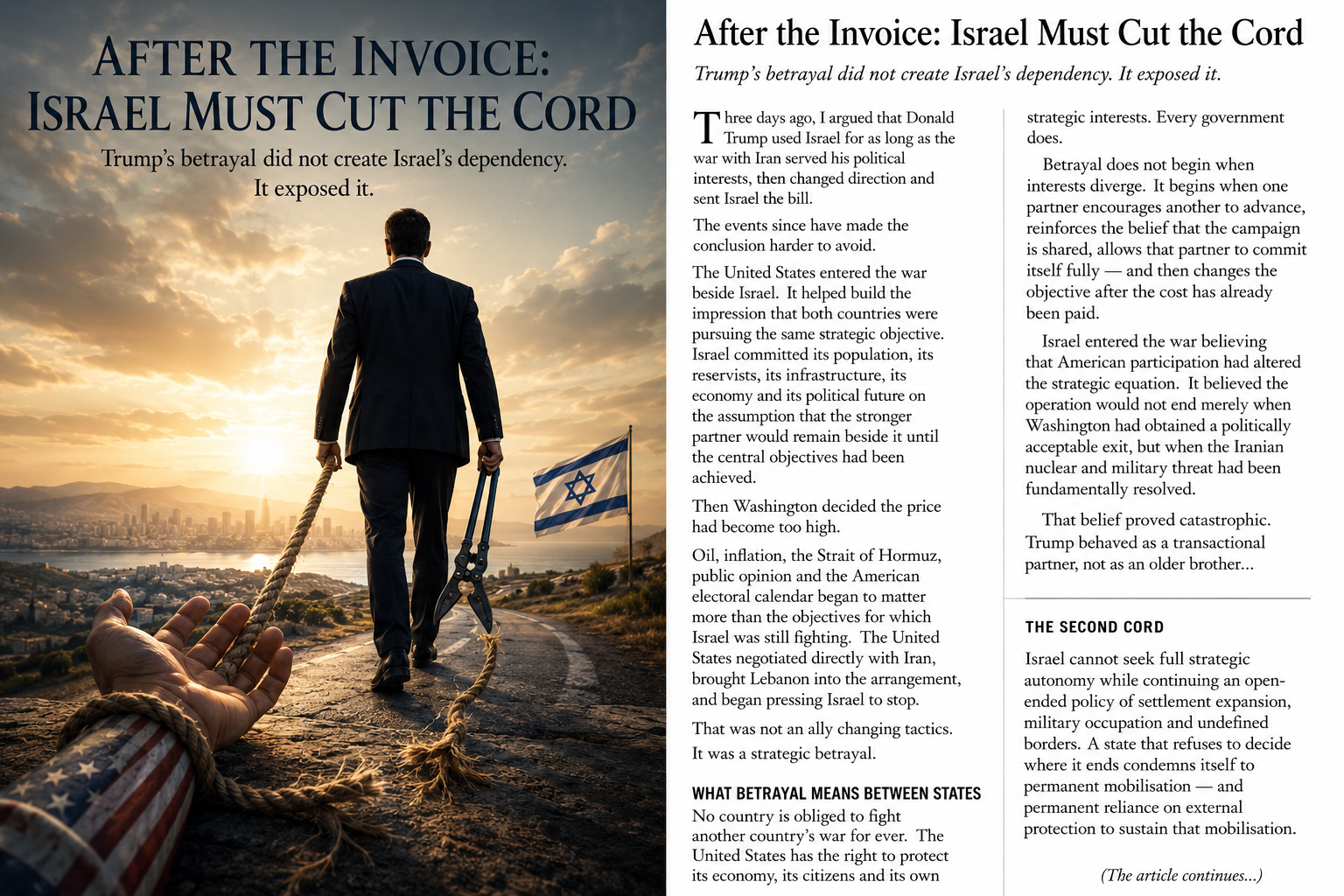
Trump’s betrayal did not create Israel’s dependency. It exposed it.
Two days ago, I argued that Donald Trump used Israel for as long as the war with Iran served his political interests, then changed direction and sent Israel the bill.
The events since have made the conclusion harder to avoid.
The United States entered the war beside Israel. It helped build the impression that both countries were pursuing the same strategic objective. Israel committed its population, its reservists, its infrastructure, its economy and its political future on the assumption that the stronger partner would remain beside it until the central objectives had been achieved.
Then Washington decided the price had become too high.
Oil, inflation, the Strait of Hormuz, public opinion and the American electoral calendar began to matter more than the objectives for which Israel was still fighting. The United States negotiated directly with Iran, brought Lebanon into the arrangement, and began pressing Israel to stop.
That was not an ally changing tactics.
It was a strategic betrayal.
What betrayal means between states
No country is obliged to fight another country’s war for ever. The United States has the right to protect its economy, its citizens and its own strategic interests. Every government does.
Betrayal does not begin when interests diverge. It begins when one partner encourages another to advance, reinforces the belief that the campaign is shared, allows that partner to commit itself fully — and then changes the objective after the cost has already been paid.
Israel entered the war believing that American participation had altered the strategic equation. It believed the operation would not end merely when Washington had obtained a politically acceptable exit, but when the Iranian nuclear and military threat had been fundamentally resolved.
That belief proved catastrophic.
Trump behaved as a transactional partner, not as an older brother. He used Israeli military capacity to weaken Iran. Once Iran had been weakened sufficiently for Washington to negotiate from a stronger position, he pursued the outcome that served the United States and himself: a reopened shipping route, lower energy pressure, an end to an unpopular war and the photograph of a president announcing peace.
Israel was left carrying the consequences.
Iran survived. Its nuclear future remained unresolved. Hezbollah remained present. Israel had borne the direct physical exposure while Washington retained the right to decide when the operation had gone far enough.
The betrayal was real. But it is not the deepest problem.
The deeper problem is that Israel made the betrayal possible.
A dependency built over generations
Trump did not create Israel’s dependence on the United States. He merely revealed what that dependence actually means.
For decades, Israeli governments treated American backing as a permanent condition of national survival. American weapons, American interceptors, American intelligence, American diplomatic protection — these gradually stopped being reinforcements to Israeli sovereignty. They became part of the structure holding it up.
The distinction matters.
An alliance strengthens two sovereign states. A dependency gives one state the ability to determine the limits of the other.
Israel could claim it was not party to the American agreement with Iran. Formally, that was true. But the claim meant little when the United States still controlled much of the military resupply, diplomatic protection and strategic space Israel required to continue the war. Washington did not need to issue a legal order. It needed only to say: continue alone.
The relationship is often described in emotional language: friendship, brotherhood, shared values, an unbreakable bond. States do not have brothers. They have interests, capabilities and dependencies.
The United States will support Israel when American and Israeli interests coincide. When those interests diverge, Washington chooses Washington.
The mistake was not that Israel trusted Trump personally. The mistake was building national survival around the expectation that any American president would remain committed until Israel’s objectives had been completed. That is not strategy. It is faith placed in another government.
Cut the dependency, not the relationship
Israel should not sever its relationship with the United States tomorrow. That would accomplish nothing except self-exposure at precisely the moment it is trying to recover strategic control.
The correct objective is to end the dependency — not to destroy the alliance.
Israel must build the capacity to survive a serious regional conflict without assuming that American weapons, political protection and operational support will arrive on time or continue until the end. That means greater domestic production of ammunition, interceptors, drones, aircraft components and critical military systems. Larger reserves. Greater energy resilience. A defense structure capable of continuing when Washington changes direction.
It also means diplomatic diversification. Israel cannot claim strategic autonomy while one capital retains the practical power to determine whether it can sustain a war, resist an international resolution or replace the weapons it has expended.
But military independence alone will not be enough.
The second cord
There is another dependency Israel must confront, and it is the one it has been slower to name: its dependence on permanent territorial conflict.
Israel cannot seek full strategic autonomy while continuing an open-ended policy of settlement expansion, military occupation and undefined borders. A state that refuses to decide where it ends condemns itself to permanent mobilization — and permanent reliance on external protection to sustain that mobilization.
The historical argument is familiar. The Jewish people had a larger house before. Ancient boundaries, sacred memory and inherited claims are real parts of Jewish history.
But history does not build a practical state by itself.
A son cannot enter the house his parents once owned and remove the families living there because the old house was larger. Memory may explain the attachment. It does not make the act sustainable.
Israel must decide whether it wants a bounded state or an endless territorial project. It cannot have regional acceptance and permanent expansion. It cannot ask Arab governments to treat it as a normal member of the region while the Palestinian question remains deliberately unresolved. And it cannot pursue independence from Washington while its policies require Washington’s weapons, vetoes and diplomatic cover to sustain them.
This is not an argument for abandoning Israeli security.
Expansion has not produced security. It has produced more territory to police, more people to control, more fronts to defend and deeper dependence on the United States. Each new settlement deepens the conflict. Each deepened conflict increases the need for American protection. Each act of American protection gives Washington more influence over Israeli choices. Then, when Washington decides its interests have changed, Israel discovers the protection was never unconditional.
The territorial project and the American dependency have been reinforcing each other for years.
A smaller house can be more sovereign
Israel needs a Palestinian settlement not as an act of charity, but as an act of national self-preservation.
The Palestinians require a real political territory — not a collection of disconnected zones managed indefinitely under Israeli military control. Israel requires recognized borders, regional legitimacy and an end to the belief that indefinite control over another population can coexist with democracy, security and international normality.
The conditions for a serious settlement are not a mystery. What is missing is not knowledge but political will. Israel knows which settlement blocs it could retain through territorial exchange. It knows which corridors would connect Gaza to the West Bank. It knows that Jordan and Egypt will not disappear from the security equation. The problem is not that nobody knows what a viable Palestinian state would look like. The problem is that no Israeli government has yet calculated that the domestic political cost of building one is lower than the cost of refusing. Trump changed that calculation without intending to. The price of not deciding has just gone up.
A negotiated border would not solve every threat. It would make it possible to identify what Israel is defending and where its legitimate sovereignty begins and ends — and that is the foundation of independence. A smaller house with recognized walls can be more defensible than a larger one that must be fought for every day against everyone around it.
Israel must become regional
The alternative to dependence on the United States is not isolation. It is regional integration.
Israel’s long-term security cannot rest exclusively on its relationship with a distant power whose priorities shift with elections, oil prices and presidential personalities. The states around it share concrete interests: containing Iranian military power, protecting maritime routes, limiting extremist organizations, securing energy infrastructure. Egypt, Jordan, Saudi Arabia, the United Arab Emirates — these are not abstract partners. Those shared interests can sustain intelligence cooperation, missile defense, maritime security, trade, energy networks, water and technology. The architecture already exists in fragments.
But regional integration carries a political price. Israel cannot ask Arab governments to treat it as a permanent strategic partner while the Palestinian question continues to poison their domestic legitimacy and regional standing. The Palestinian settlement is therefore not separate from Israeli strategic independence. It is one of its conditions.
Israel will never become fully regional while behaving as though geography can be ignored because Washington will always compensate for it.
The United States is thousands of miles away. The Arabs, the Palestinians, Iran, Lebanon, Syria, Egypt and Jordan are not going anywhere. Israel must eventually build its future in the region where it actually exists.
The choice after Trump
Trump’s behavior has produced a moment of clarity.
Israel can respond by searching for another American president to trust, another personal relationship to cultivate, another promise of unconditional support. That would reproduce the same mistake.
Or it can accept the harder conclusion: no American president should possess the practical ability to abandon Israel inside a war on which Israel believes its survival depends.
Independence will require military production, economic resilience and diplomatic diversification. It will also require political restraint — the kind that is harder than any of those, because it asks Israel to abandon the idea that sovereignty means controlling the greatest possible amount of land.
Sovereignty means possessing the power to determine one’s future within defensible, recognized and sustainable limits. The two necessary cuts are therefore connected. Israel must cut the cord that ties its survival to Washington. And it must cut the territorial illusion that keeps it permanently at war with the region it lives in.
The bill behind the bill
Trump sent Israel an invoice for a war that stopped serving him.
Behind that invoice lies another bill — accumulated over generations. The price of building national security around another country’s weapons, another country’s veto and another country’s political timetable. The price, too, of refusing to establish final borders and believing that military superiority can substitute indefinitely for political settlement.
Israel did not lose its sovereignty when Trump negotiated with Iran. It had surrendered part of that sovereignty long before — each time American protection replaced regional strategy, and each time territorial expansion replaced the decision to build a final state.
Trump’s betrayal should not merely produce anger.
It should produce separation.
Not separation from America as an enemy. Separation from America as a parent.
Israel does not need another older brother.
It needs to become an adult state — one that defends itself, limits itself, recognises the place of another people and builds a future with the countries that will still be there after the American president has changed.
Trump exposed the betrayal.
Now Israel must dismantle the dependency that allowed it.