
Founder & Principal, Line of State
Israel Owns the Factory. It Still Does Not Own the Next Interceptor.
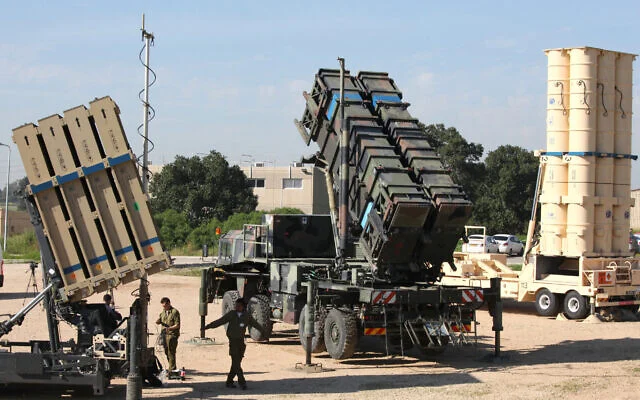
Iron Dome, Patriot and Arrow 3 systems on display during the Juniper Cobra exercise at Hatzor Air Base, February 25, 2016. Three layers can protect the same sky. One shortage can still decide the war. (Gil Cohen-Magen/AFP)
Israel can own the factory and still wait for the next interceptor. Shay Gal, former IAI Vice President and Chief of Staff to its Chairman, sets the industrial sovereignty test exposed by the second Iran war: inventory, production capacity and wartime priority must be reserved, funded and governed before the next war begins.
Israel ended 2025 with a record $19.2 billion in defence exports, 29% of it in missile, rocket and air-defence systems. Israeli defence industries produced around the clock for the Israel Defense Forces (IDF) while fulfilling export contracts. The same production lines serve both. A production line is not a flag. It is time, and that time is sold.¹
The next war will not wait for Israel’s production rate. Iran turned interceptor stocks into an operational constraint, while conflict with Turkey is no longer a fringe scenario.² Different enemies will meet the same Israel: the same inventories and bottlenecks, where the slowest link governs freedom of action. Iran demands endurance against sustained missile barrages. Turkey adds the military mass and attritional depth of an industrial power. Israel has advanced systems. The test is how many remain after the first campaign and how quickly the stockpile can be rebuilt before the next begins.
When Inventory Becomes Operational
During Israel’s 40-day second war with Iran, Iran fired roughly 650 ballistic missiles at Israel. Only 16 carrying unitary warheads penetrated the defensive envelope, while 61 cluster-warhead missiles reached the dispersal phase.³ ⁴ Arrow 3 stocks were determining engagements: some cluster missiles were deliberately not engaged with Arrow in order to preserve interceptors for higher-priority threats.⁴ To conserve Arrow 3, Israel also expanded its use of David’s Sling against ballistic missiles at a lower layer, where interception could not always prevent cluster dispersal.⁵
The shortage predated the war. In June 2021, on taking office, Naftali Bennett allocated roughly NIS 6 billion to preparations for confrontation with Iran and summoned Israel’s security chiefs and the chief executives of Rafael and Israel Aerospace Industries.⁶ Two years later, after Herzi Halevi became IDF chief of staff, the military requested a dedicated meeting with the prime minister on shortages of munitions and interceptors.
The meeting was scheduled and cancelled five times. The IDF sought to double the Arrow interceptor inventory during 2023 and quadruple it by the end of 2024. Halevi requested NIS 1.2 billion to increase the stockpile. In the table presented on behalf of the prime minister, the allocation was zero. On 3 October 2023, four days before the Hamas attack, the IDF’s final multi-year planning discussion again included an immediate demand to double Arrow 3 production.⁷
Capacity Belongs to the Buyer
After Iran’s two ballistic attacks in 2024, production expansion accelerated. In November, Germany’s Arrow 3 order opened an additional production line, part of whose output also served Israel. On 24 December, the Ministry of Defence signed a multi-billion-shekel agreement to expand serial production for the IDF.⁸ A further major order followed in July 2025. In the year before the war, Arrow 3 output tripled, helped by German orders and advance payments.⁹
By December 2025, further acceleration was still required. The Ministry of Defence director-general ordered additional lines opened immediately and further expansion prepared before budget approval.¹⁰ That same month, Germany expanded its Arrow 3 procurement. In January 2026, IAI signed a further execution contract worth approximately $3.1 billion, taking the German procurement above $6.7 billion.¹¹
The problem did not end with ordering. As of August 2026, Israel’s Ministry of Defence owed Israel’s three largest defence companies roughly NIS 15.5 billion on approved contracts and orders, including approximately NIS 5.5 billion to IAI and NIS 7 billion to Rafael. Delayed payments contributed to negative cash flow of about NIS 2.4 billion at IAI. Rafael borrowed to pay suppliers.¹²
The arrears came later but expose the same weakness. Having learned that capacity is operational, Israel is now asking its own defence companies to finance procurement already ordered. An unpaid order is only a claim on capacity. Capacity begins when the money reaches the line. Germany bought capacity in advance and paid for it. Israel ordered and accelerated, but not early enough or fast enough to close the gap.
The Board Is Part of the Arsenal
State ownership does not repeal commerce. Under Israeli law, state-owned companies default to commercial considerations.¹³ But in a strategic defence company, capacity, constraints and delivery times are national risk. Management must know where capacity breaks, price the gap and its alternatives, and put them before the board and the state in time.
If the state knew and failed to convert the threat into orders, funding, payment and sufficient capacity, it failed as owner. If it failed to demand the answer, governance itself failed. The board exists to stop those failures before they reach an interception order.
From late November 2024 until mid-May 2026, IAI, the state-owned prime contractor for Arrow 3, operated for almost eighteen months without a permanent board chairman while another confrontation with Iran dominated Israeli force planning. Each board meeting selected an ad hoc chairman. The appointment dispute delayed approval of a multi-billion-shekel Ministry of Defence order for Arrow missiles. Later, legally required external directors completed their terms without replacements, disabling statutory committees and blocking approval of Arrow transactions.¹⁴
Gilad Erdan, then an IAI board member and the candidate for chairman, warned in real time of “a year without public oversight over vital projects, without the ability to set and implement a strategy for developing systems to meet the threats”.¹⁵
A state does not possess sovereign defence production because it owns the factory, employs the engineers or controls the intellectual property. It possesses it when the next unit of output is already reserved for war.
Israel therefore needs a Sovereign Capacity Reserve for every critical system without a readily available substitute: physical inventory, production capacity measured against 30, 90 and 180-day war horizons, and standing authority to activate lines, reprioritise production and allocate output in an emergency.
Exports should continue, but the capacity they create and consume must be governed as a national-security asset. Every critical export contract must therefore be assessed not only for revenue and strategic value, but for the capacity it adds to Israel and the capacity it occupies. Line expansions must reserve an Israeli share. Existing capacity must carry contractual Israeli priority, priced and paid for in advance. Excess capacity in a system without a substitute is not inefficiency. It is the price of freedom of action.
War Has Already Priced the Bottleneck
Europe learned the cost in Ukraine. The European Union promised one million artillery shells by March 2024 and missed the deadline because production capacity could not meet the commitment. Ukrainian artillery units were forced to ration fire. The EU eventually stopped treating the problem as shell procurement alone: under its ammunition production programme, roughly three quarters of the funding went to propellant powder and explosives, the bottlenecks constraining output.¹⁶
Stinger taught the United States the same lesson. After missiles were transferred to Ukraine, restarting production exposed obsolete components and chokepoints that money alone could not remove. Owning the design did not produce the next missile. The principle is already embedded in US law through a Defense Industrial Reserve and wartime priority for defence orders. In August 2026, the Pentagon went further, signing seven-year agreements with General Dynamics and Lockheed Martin to triple PAC-3 capacity and quadruple THAAD capacity while giving industry the long-term demand signal needed to invest in workforce, materials and facilities.¹⁷ Europe learned that sovereignty can fail at the powder mill. America is buying production time before it needs the missile.
Israel owns IAI and Rafael. It is a major customer of both and regulates their exports. If, in wartime, it is still waiting its turn for output from factories it owns, that is not sovereignty. It is legal title.
–
This English version, adapted and expanded by the author, is based on an article originally published in Hebrew in Walla Money on September 8, 2026, under the title “מחיר כבד מול איראן וטורקיה: חוב של 15 מיליארד שקל מסכן את מלאי המיירטים”.
–
Related by the same author:
- “The ‘Bayraktar Trap’: Cheap Airpower Or Costly Dependence”, EurAsian Times, September 20, 2025.
- “The KAAN ‘Trap’: Permission, Not Power”, EurAsian Times, November 24, 2025.
- “What Washington Gives – and What It Takes in Return”, Israel Defense, February 1, 2026.
- “Europe’s Missile Illusion: The Gulf Lesson”, The Times of Israel, March 6, 2026.
- “We Did Not Lose the War. We Lost Control of It”, The Times of Israel, April 10, 2026.
- “How China Became the Real End-User of U.S. F-16 Tech – Not by Theft, But Institutionalized Access”, EurAsian Times, June 6, 2026.
- “Nasdaq Can Value IAI and Rafael. It Must Not Price Israel’s Freedom of Action”, The Times of Israel, July 20, 2026.
- “Israel Must Stop Competing Against Itself Before It Lists IAI and Rafael”, The Times of Israel, August 12, 2026.
–
Related interview:
- Sebastian Sprenger, “Israel’s IAI plugging away at German Arrow-3 order amid Gaza war”, Defense News, July 24, 2024.
–
[1] Israel Ministry of Defense, “All-Time Defense Export Record: Israel Crosses the $19 Billion Threshold”, June 2, 2026. The Ministry reported $19.2 billion in 2025 defence exports, 29% in missile, rocket and air-defence systems, and round-the-clock production for the IDF alongside fulfilment of foreign contracts.
[2] Emanuel Fabian and Agencies, “Israel confirms striking Syrian air base, saying Turkey was planning to deploy forces”, The Times of Israel, August 19, 2026. The Prime Minister’s Office said a planned Turkish deployment at the Syrian base would pose a threat to Israel’s security.
[3] Emanuel Fabian, “The war in numbers: 650 Iranian missiles fired; 24 killed in Israel, West Bank; 10,800 Israeli strikes”, The Times of Israel, April 10, 2026.
[4] Omri Maniv, “מחדל המיירטים: המלאי הדליל, הדיונים שבוטלו והתקציבים שנבלמו” “TheInterceptorFailure:ThinInventories,CancelledDiscussionsandBlockedBudgets”“The Interceptor Failure: Thin Inventories, Cancelled Discussions and Blocked Budgets”, N12, April 25, 2026. The investigation, published with military-censor approval, reported 61 cluster-warhead missiles dispersing and a deliberate decision not to engage some of them with Arrow 3 in order to conserve interceptors.
[5] Yuval Azoulay, “Months of budget infighting delayed critical Arrow 3 interceptor orders during war”, Ynetnews, April 2026. The report describes the expanded use of David’s Sling against ballistic missiles, its lower interception layer and the role of stockpile management in the shift.
[6] Omri Maniv, “מחדל המיירטים: המלאי הדליל, הדיונים שבוטלו והתקציבים שנבלמו”, N12, April 25, 2026. The investigation recounts Bennett’s approximately NIS 6 billion allocation in 2021 and his meeting with the security chiefs and defence-industry CEOs.
[7] “Report: Government refused to boost funding for interceptor missiles, even after 2024 Iranian attacks”, The Times of Israel, April 26, 2026; and Omri Maniv, “מחדל המיירטים: המלאי הדליל, הדיונים שבוטלו והתקציבים שנבלמו”, N12, April 25, 2026. These sources cover the repeated cancellations, the proposed doubling and quadrupling of Arrow inventories, the NIS 1.2 billion request, the zero allocation and the October 3 planning discussion.
[8] Omri Maniv, “מחדל המיירטים: המלאי הדליל, הדיונים שבוטלו והתקציבים שנבלמו”, N12, April 25, 2026, on the second production line opened in November 2024 following the German agreement; Israel Ministry of Defense, “Israel MOD and IAI Sign Major Deal to Expand Procurement of Arrow-3 Interceptors”, December 24, 2024.
[9] Israel Ministry of Defense, “האצת החץ יוצאת לדרך” “ArrowAccelerationGetsUnderWay”“Arrow Acceleration Gets Under Way”, July 17, 2025; Yuval Azoulay, “Months of budget infighting delayed critical Arrow 3 interceptor orders during war”, Ynetnews, April 2026. The latter reports that Arrow 3 production tripled over the preceding year, aided in part by German export agreements and advance payments.
[10] Omri Maniv, “מחדל המיירטים: המלאי הדליל, הדיונים שבוטלו והתקציבים שנבלמו”, N12, April 25, 2026; Yuval Azoulay, “Months of budget infighting delayed critical Arrow 3 interceptor orders during war”, Ynetnews, April 2026. Both describe the effort to accelerate production before a final budget framework was in place.
[11] Israel Aerospace Industries, “Israel Aerospace Industries Announces 3.1 Billion USD Contract for the Expansion of Arrow 3 Missile Defence System Deal with Germany”, January 12, 2026; Israel Ministry of Defense, “Germany Salutes Arrow Weapon System Project: Bundeswehr Cross of Honor Awarded to Senior Israel MOD Officials”, April 28, 2026. The Ministry values the overall German Arrow project at approximately $6.7 billion.
[12] “Israel plans $12 billion defense boost as officials warn spending is spiraling out of control”, Ynetnews, August 2026; Yuval Azulay, “Arrow maker IAI’s record $35 billion backlog comes with an increasingly urgent cash problem”, CTech, August 13, 2026; Yuval Azulay, “Iron Dome and Iron Beam maker Rafael sees 39% jump in new orders, reaching NIS 6.9 billion”, CTech, August 31, 2026. Together they document the roughly NIS 15.5 billion debt, the amounts owed to IAI and Rafael, IAI’s negative cash flow and Rafael’s borrowing to meet supplier obligations.
[13] State of Israel, “Government Companies Law, 5735-1975” – English translation, section 4(a): a government company is ordinarily to act according to the business considerations guiding a non-government company unless the government prescribes otherwise.
[14] Dean Shmuel Elmas, “Board chooses Seroussi as IAI chair as Erdan freezes candidacy”, Globes, March 12, 2025; Israel Aerospace Industries, “For the first time: the CEO of an Israeli government-owned company has been appointed Chairman of the company”, May 18, 2026; Omri Maniv, “מחדל המיירטים: המלאי הדליל, הדיונים שבוטלו והתקציבים שנבלמו”, N12, April 25, 2026. These sources document the prolonged chairmanship vacuum, the eventual appointment and the effect of missing external directors on Arrow transactions.
[15] “גלעד ארדן מוותר על התעשייה האווירית” “GiladErdanWithdrawsfromtheIAIRace”“Gilad Erdan Withdraws from the IAI Race”, N12, October 2025.
[16] European Commission, “The Commission allocates €500 million to ramp up ammunition production”, March 15, 2024; “EU has supplied Ukraine with over 980,000 shells, Borrell says”, Reuters, November 11, 2024; “Western arms reach Ukraine front lines, relieving some pressure”, Reuters, June 25, 2024. The Commission identified propellant powder and explosives as production bottlenecks and allocated roughly three quarters of ASAP funding to them.
[17] U.S. Department of Defense, “Under Secretary of Defense for Acquisition and Sustainment Dr. William A. LaPlante and Deputy Under Secretary of Defense for Policy Sasha N. Baker Hold a Press Briefing”, September 9, 2022; United States Code, “10 U.S.C. § 4881 – Defense Industrial Reserve”; United States Code, “50 U.S.C. § 4511 – Priority in contracts and orders”; U.S. Department of War, “DoW Secures 7-Year Agreements With General Dynamics and Lockheed Martin to Triple PAC-3 and Quadruple THAAD Production”, August 31, 2026.
Related Topics