
Historian, Librarian, Educator, and Artist
After the Siren: Life, Memory, and the Volume of Our Joy
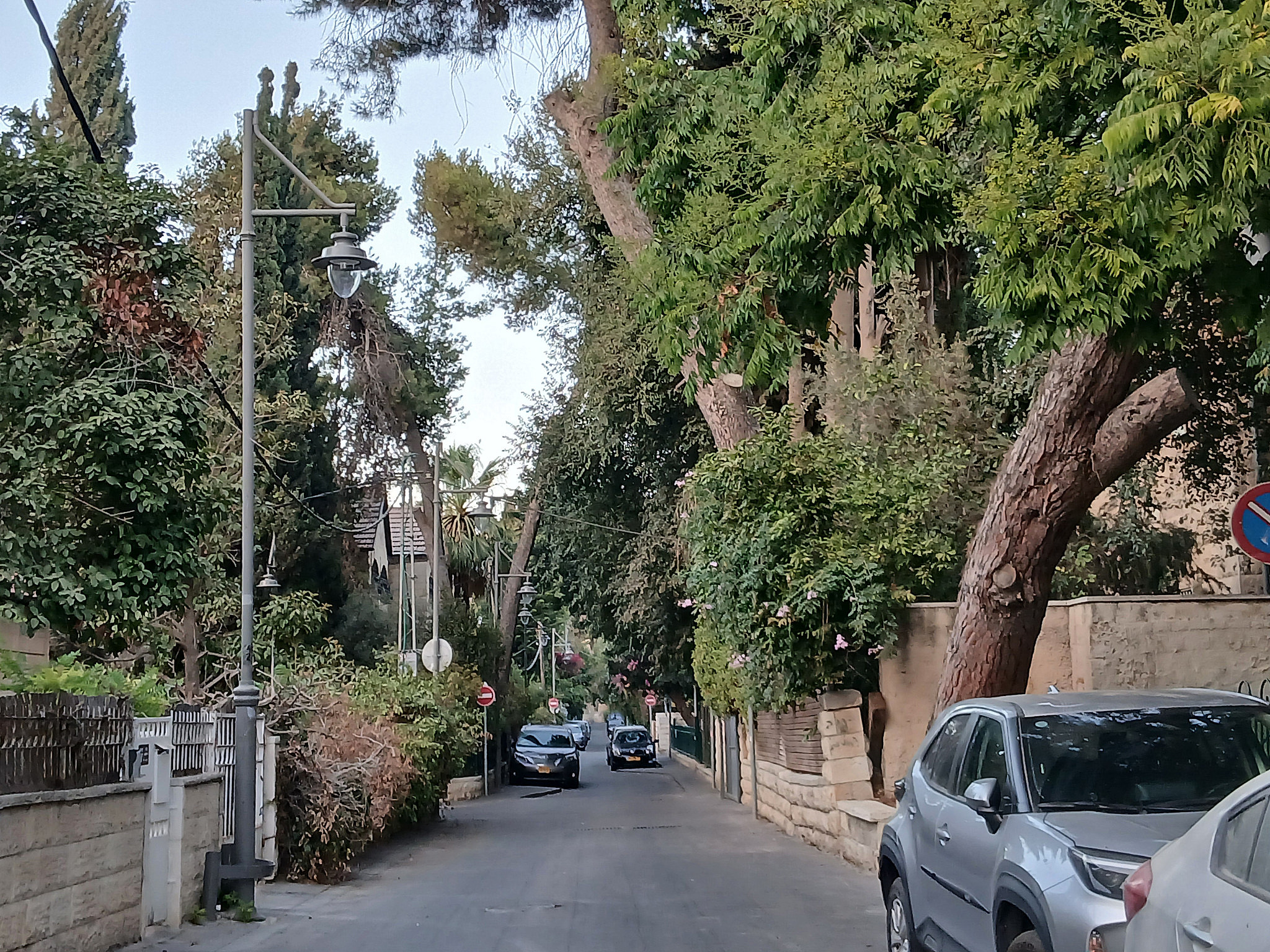
The streets in the German Colony, Jerusalem where quieter in the afternoon of September 18, 2025, than immediately after a siren from a Houthi missile. (Author Photo)
By Bonnie K. Goodman, BA, MLIS
Last night, I walked home through Jerusalem’s German Colony as the echo of the siren still hung in my ears. Half an hour earlier, a Houthi missile had been intercepted on its way to Israel, triggering alarms in central Israel from Tel Aviv to Jerusalem, sending millions running to bomb shelters yet again. The day had already been filled with devastating news. At the Allenby crossing, two Israeli soldiers were murdered in a shooting attack. In Gaza, four young IDF soldiers were killed by a roadside bomb. A Houthi drone hit an Eilat hotel, causing damage, but by some miracle there were no injuries. Six Israeli families were left shattered. And yet, as I made my way down Emek Refaim, returning from a shiur where the siren had interrupted, I saw cafés and restaurants full, couples walking their dogs, and in one backyard, a loud party with Michael Jackson blaring into the night.
That scene left a negative impression on me. I understand people finishing their meals in restaurants—life and commerce must continue. But the backyard revelry, blasting music into a night marked by blood and mourning, felt like something else. Not resilience. Not coping. Instead, there was a tone-deafness that verged on cruelty.
The Psychology of “Back to Normal”
Living in Israel for a year has taught me how quickly life flips. Sirens wail, we shelter; then, as soon as the “all clear” sounds, people return to their routines like the previous 12 minutes never happened. Psychologists describe the phenomenon as rapid return-to-baseline. Studies after October 7 found that re-anchoring in daily rhythms, including school, work, and going to restaurants, was protective for many Israelis. It prevents paralysis. “A population under chronic threat leans on rapid return-to-routine—protective for some, numbing for others,” one researcher wrote.
However, there is a darker side to this survival skill. What looks like resilience may actually be denial. Trauma repeated too often numbs people into brushing off the pain. As one WHO report on Israeli faith communities put it, routine is essential, but it cannot replace ritual mourning.
That is where the line was crossed last night. Completing your meal at a restaurant is a form of coping. Blasting music up and down the street after six funerals were announced is not coping. It is forgetting before remembering.
Jewish Memory: Celebrating Joy Amidst Brokenness
Judaism has always insisted that joy and grief coexist. At a wedding, we smash a glass to recall the destruction of the Temple. “The breaking of the glass asks… a momentary shift to reflect on brokenness in the world.”
The same ritual captures the moral tension I felt on Emek Refaim. By Jewish law and culture, we must choose life—“u’vacharta b’chayim” (Deut. 30:19). After danger passes, we are commanded to live, to eat, to marry, and to celebrate. But our joy is not meant to be seamless. It is meant to include a crack of memory; it is not seamless. “The glass is still shattered,” as one rabbi has written.
If we consider this philosophy and tradition, the backyard party, especially its loudness and blasting music, was not Jewish resilience but a rupture of Jewish memory. To resume life is holy. To resume life without remembrance is profane.
The Diaspora’s Different Tempo
What struck me most was how different the rhythm is here compared to the Diaspora. When tragedy strikes Israel abroad, communities quickly go into mourning mode. They gather in synagogues, psalms are recited, memorial candles are lit, and rabbis speak. Only after the grief is named do people go back to their dinners and routines.
In Israel, where loss is daily, the tempo is accelerated. People sprint back to routine almost instantly, as if to make up for the lost time, even minutes. This tempo reflects davka—defiance in the face of terror. It is admirable. But sometimes defiance turns into dismissal, seeming at times tone-deaf or surreal.
As a new Israeli, my sensibilities still carry Diaspora habits. I seek a pause, a breath, a moment of kavod (honor) for the fallen before the music recommences. I decided to return home rather than continue listening to the shiur. Israelis who have lived with decades of violence may not feel that need—or may feel it but bury it quickly in order to function. Still, the gap is real, and it shapes how we process grief or respect what should be national grief.
Where We Draw the Line
So what is the right response after a siren, after a day of death? Not shutting life down, not locking ourselves in fear that is what our enemies want. But neither is immediate, noisy celebration.
There should be a balance. Restaurants can stay open, dogs can be walked to the dog park, and people can sit at cafés. But loud parties, booming music, and careless laughter in the first hours after soldiers fall violate our collective covenant of memory. With so many families touched by tragedy, there should be respect, even if it’s fear, in Hashem as we enter the Yamim Noraim, because we never know who could be touched next. In Israel, there are no guarantees.
The Jewish community has always known how to balance these opposites. The Talmud prescribed shiva for seven days and shloshim for thirty. Even in joy, remembrance intrudes. The rhythms of Jewish mourning were designed not to paralyze but to give grief its due. We need those rhythms now, even in miniature.
Choosing Life with Memory
Last night’s dissonance left me asking: What does it mean to choose life in Israel today? It cannot mean ignoring the day’s death. Nor can it mean ceasing to live. It must mean living in a way that honors the memory of those who have lost their lives in service, ensuring that we can all continue our routines in this country.
I propose that in the immediate hours following a national loss, we lower the volume. Keep the restaurants open, yes. But add a moment of silence, a candle, and a prayer. Delay the party music until morning. Make space for respect and remembrance even as we resume life.
Our enemies want to destroy us, not only by killing our bodies but also by erasing our humanity. To deny them, we must show that our lives are not empty reflexes but lives filled with memory, ethics, and kavod. To party last night without pause was not resilience. It was a missed chance to sanctify life.
Fact Box: Sept 18, 2025 Events
- Allenby crossing: Two Israeli soldiers killed in a shooting attack.
- Gaza: Four IDF soldiers killed in a roadside bomb attack.
- Eilat: A Houthi drone struck a hotel (damage, no injuries). Later, a Houthi missile was intercepted before it could hit its target.
Sources
- The World Health Organization (WHO) published a report titled “Faith-Based Communities in Israel Responding to Trauma” in 2024.
- Reform Judaism, “The Breaking of the Glass” (2020).
- The Jerusalem Post and Times of Israel covered the attacks and casualties on September 18, 2025.
- Rabbinic reflections on simcha and memory post-destruction are also included.
Related Topics
Related Posts