
Owner of the world's largest Herzl collection
Treasure Trove: Let the Opportunity for Peace Not Fall From Our Hands (1967)
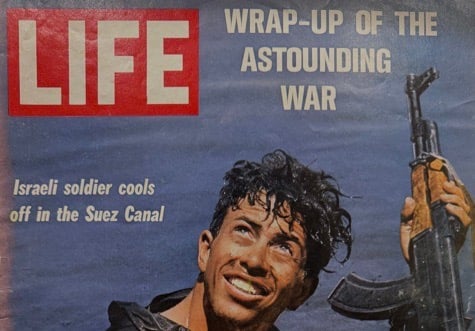
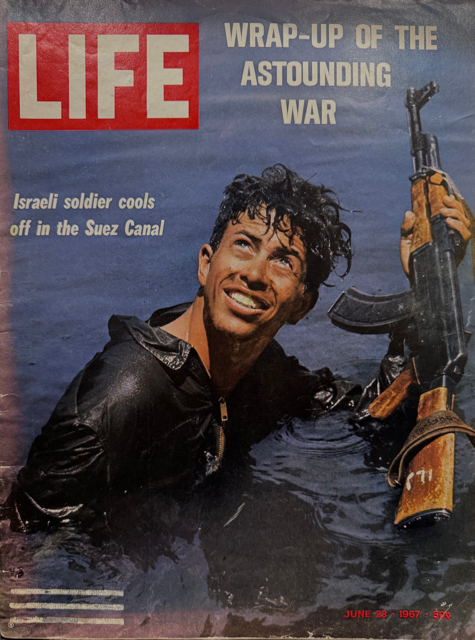
From the Herzl and Zionism Collection of David Matlow, Toronto (www.herzlcollection.com). Photograph of Life Magazine cover by David Matlow.
The six days of the Six Day War were June 5 to 10, 1967. In this edition of Life Magazine, the war was described as astounding and Israel as “a country still suspended between a nightmare and a dream, relishing a moment of ecstasy.”
The nightmare began in mid-May when the Egyptian army moved two divisions and 900 tanks to Israel’s southern border. United Nations peacekeepers were expelled and then Eilat was subjected to a naval blockade which is a casus belli (act of war) under international law. Jordan then announced it was joining with Egypt, and a division of Iraqi soldiers was sent to Jordan.
By early June, Israel’s army was almost fully mobilized. Egyptian airplanes flew over Israel’s airbases almost daily. Egyptian mortar fire set wheat fields on fire. Two Egyptian commando units were transferred to Jordan and control of the Jordanian army was placed under the command of Egyptian President Nasser. The threat to Israel was so severe that thousands of graves were dug in Israel in anticipation of being needed.
Life Magazine describes what happened next as follows:
“What happened on Monday June 5, 1967 was more in the nature of a paroxysm [meaning a burst, explosion or eruption] than war- or rather, as if an awkward and ignorant hand had been toying with the fuse of a strange explosive of unknown power, and thus been blown to bits.”
In a preemptive strike, the Israeli army destroyed 204 Egyptian airplanes within 30 minutes. Over the course of the war, Israel captured the Sinai, the Golan Heights and the area west of the Jordan River that was under Jordanian control, and unified Jerusalem. In the early days of the war, Egyptian radio was deceiving its listeners by broadcasting the Egyptian army’s military successes, which were fictional. It was only on the fifth day that Nasser went on Egyptian television to admit defeat (calling it a “setback’) and said he was resigning. He retracted his resignation the next day.
There are many references in this issue of Life that would sound familiar to us today including that “Israelis are Jews who have declared that they will not ever again be victims” and that Israel’s army “expresses the fundamental politics of survival. As such, it unifies a people who will not die.”
Since the ecstasy of the Six Day War, Israel has fought other wars including the Yom Kippur War (1973), the First Lebanon War (1982), the Second Lebanon War (2006) and the wars against Hamas and Iran (2023 to 2026).
Israel’s military successes in its recent war against Iran were also astounding. As we stand here today, it is reasonable to ask whether anything was really achieved by it? In the long term, is Israel safer as a result? Was this the war that can be the last one?
After the Six Day War, Israel’s Minister of Foreign Affairs, Abba Eban addressed the United Nations General Assembly. He concluded his speech by saying:
“The Middle East, tired of wars, is ripe for a new emergence of human vitality. Let the opportunity not fall from our hands.”
Maybe this time it will be different.
_____________________
Treasure Trove is a program of The Herzl Project.

For more treasures from the Herzl and Zionism Collection of David Matlow, which has appeared weekly in the Treasure Trove column in the Canadian Jewish News (www.thecjn.ca) since February 2021, see https://herzlcollection.com/treasure-trove
Related Topics
Related Posts