English Professor; Executive Director, Writing on the Wall
After Truth: The Courage to Disagree
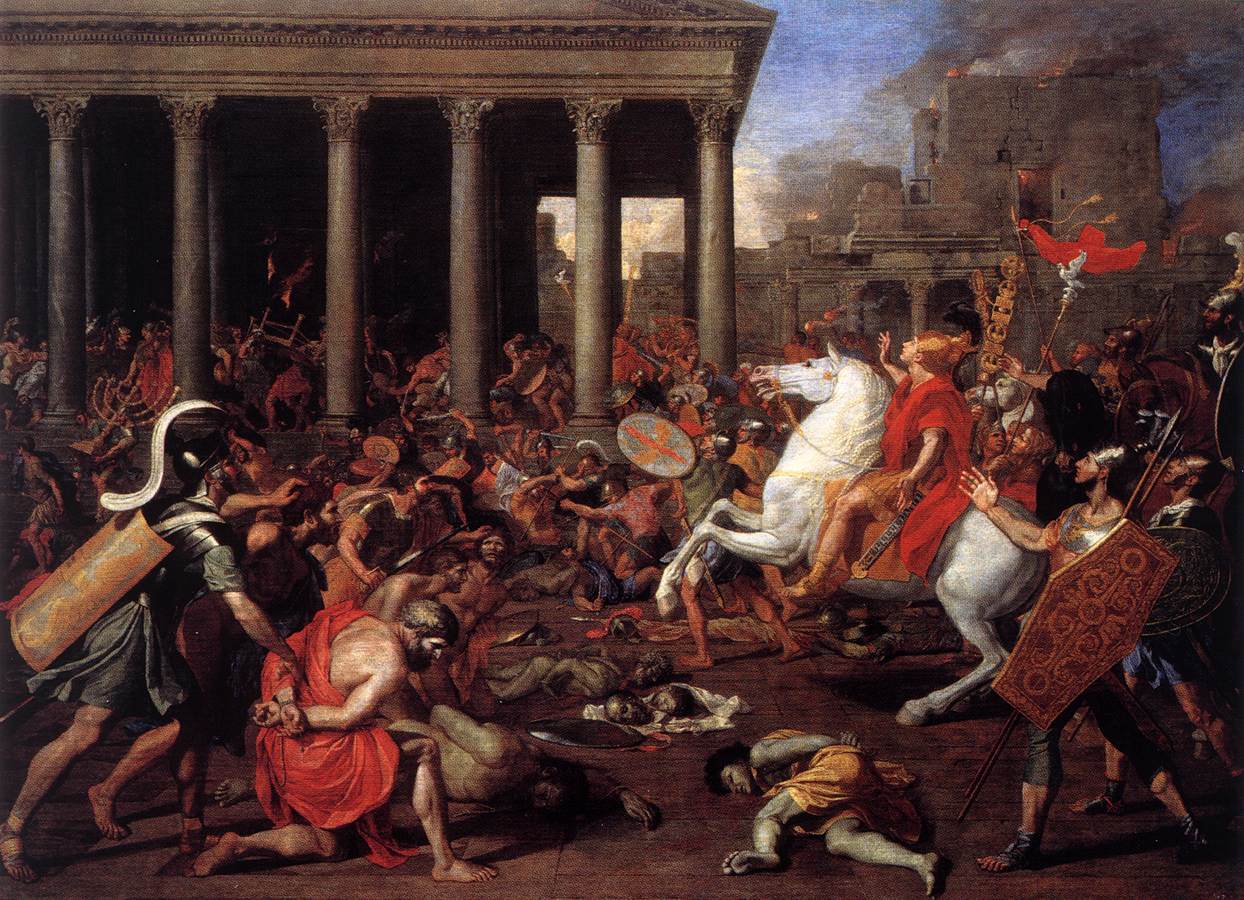
Poussin, Conquest of Jerusalem (Wikimedia)
Forgetting is not the end of a tradition—it’s where tradition begins.
During the Three Weeks leading up to Tisha B’Av, as we mourn the destruction of the Temple, Parshat Pinchas invites us to consider a different kind of loss—what happens when certainty disappears, when memory falters.
In this week’s Torah portion, we encounter Moses in a moment of forgetting. The daughters of Zelophehad approach him, seeking to inherit their father’s property. They argue, “Why should we be worse off than our brothers?” Moses does not know how to answer them. He forgets the law and brings their case before God. In this moment, uncertainty transforms into dialogue. Through their courage to ask, a new law emerges: “The daughters of Zelophehad have spoken correctly. You shall certainly give them a landholding among their father’s brothers, and transfer their father’s inheritance to them.”
Moses’s forgetting is significant. Yet, an even greater loss occurs upon his death: The Talmud recounts that hundreds of laws were forgotten, leaving the people desperate. They beg Joshua, Phinehas, Eleazar, and Samuel to restore the lost teachings. But the answer remained constant: “It is not in Heaven.” The verse from Deuteronomy demands courage—the courage to take responsibility, to interpret, to rebuild.
It is not Joshua, whom Moses repeatedly urges to be courageous, but Otniel from the Book of Judges who fully embraces this task. He conquers “Kiryat Sefer,” the “City of Books,” and through his active devotion, he “multiplies Torah in Israel.”
From Forgetting to Responsibility
Otniel’s courage represents a broader truth: after revelation ends, Truth is revealed only through different perspectives. One of my philosophy professors once remarked, “Enough may not be everything, but enough is enough.” In our own times, we must remain wary of those who claim absolute certainty. The claim to everything usually conceals a deeper emptiness—a reluctance to acknowledge complexity and doubt.
In the weeks leading up to the destruction of the second Temple by the Romans, the zealots in Jerusalem—the baryonim—stood for a kind of purity that left no room for compromise: victory or death. Rav Yochanan ben Zakkai, by contrast, embodies a different kind of leadership.
His staged death and secret escape from the city are not only acts of survival—they mark a fundamental shift in what it means to know: no one can know everything anymore. The truth we carry is no longer singular, but collective, unfolding through many voices. In his world, truth does not descend whole from above, but emerges gradually, sustained through conversation, not certainty.
After Rupture
This generational conversation continues today, as we face yet another profound rupture. October 7 shattered illusions, fragmented language, and left us uncertain about the core of our identity. Yet, Jewish history has faced such ruptures before and emerged stronger. We do not need perfect answers; we need the courage to continue speaking and listening.
During the three weeks before the 9th of Av, the challenge is not to retrieve an intact past. It is about building a future that remains open. Disagreement is not a sign of weakness but a sign that we are still alive, still engaged. This tradition has room for all of us, precisely because it allows for the voices of all of us.
This is not just an intellectual principle, but a strategy for survival.
Related Topics
Related Posts