
What the Torah’s Animal Laws Were Always Pointing Toward
Here is a paradox that Jewish tradition has lived with for centuries without fully confronting it.
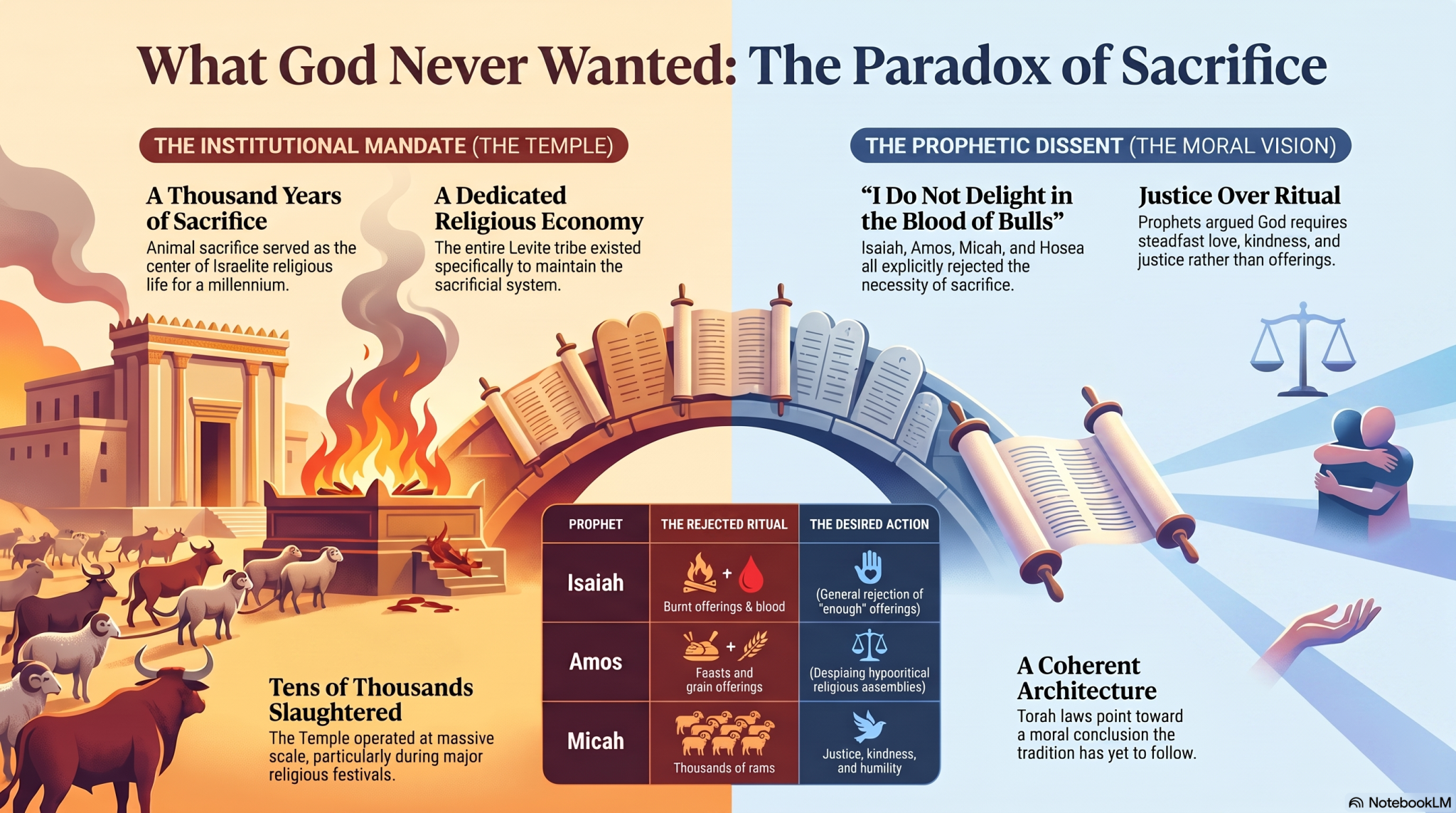
The Torah mandated animal sacrifice as the center of Israelite religious life for a thousand years. An entire tribe — the Levites — existed to maintain the system. The Temple at full operation slaughtered animals by the tens of thousands on major festivals. And yet the tradition’s own canonical prophets, whose words we read every Shabbat as haftarah, said repeatedly, across three centuries, that God did not want it.
Isaiah: “I have had enough of burnt offerings of rams and the fat of well-fed beasts. I do not delight in the blood of bulls.”
Amos: “I hate, I despise your feasts. Even though you offer me your burnt offerings and grain offerings, I will not accept them.”
Micah: “What does the Lord require of you but to do justice, and to love kindness, and to walk humbly with your God?”
Hosea: “I desire steadfast love and not sacrifice.”
These are not fringe voices. They are canonical. The tradition preserved them alongside the very Torah portions that mandate the sacrifices they appear to reject — and never felt compelled to resolve the tension. Most readers assume the prophets were speaking hyperbolically, or addressing a different domain. Neither explanation survives scrutiny. The prophets say what they say, directly and repeatedly, across three centuries and two kingdoms.
So what was sacrifice actually for, if not for what it appeared to be for?
That question turns out to be the key to the entire body of Torah animal law — not just the sacrificial system but the dietary regulations, the welfare provisions, the Akedah, and the troubling parallel between what the Temple market did to Jewish worship and what industrial animal agriculture has done to Jewish food law.
The Torah’s animal provisions are not a collection of individual rules. They form a coherent architecture pointing consistently in one direction — a direction the tradition has always known about and has not yet been willing to follow to its conclusion.
I am not making this argument from outside the tradition. I am a participant in it, writing from inside it, following its own internal logic further than it has been willing to go. The argument draws on Maimonides, on the prophets, on the Akedah read carefully rather than sentimentally, and on Rabbi Kook’s vision of where the tradition’s trajectory ultimately arrives. It makes no appeal to animal rights philosophy or to any framework imported from outside Jewish thought.
It ends not with a verdict but with a question — the question the tradition’s own texts have been asking for three thousand years, which we have mostly found ways to avoid.
What God Never Wanted: Where the Torah Was Always Going is a short book. The argument is complete in one hundred pages.
The Torah knew where it was going. The only question is whether we are willing to follow.