Ahmad Vahidi: The Man Behind Iran’s False Peace
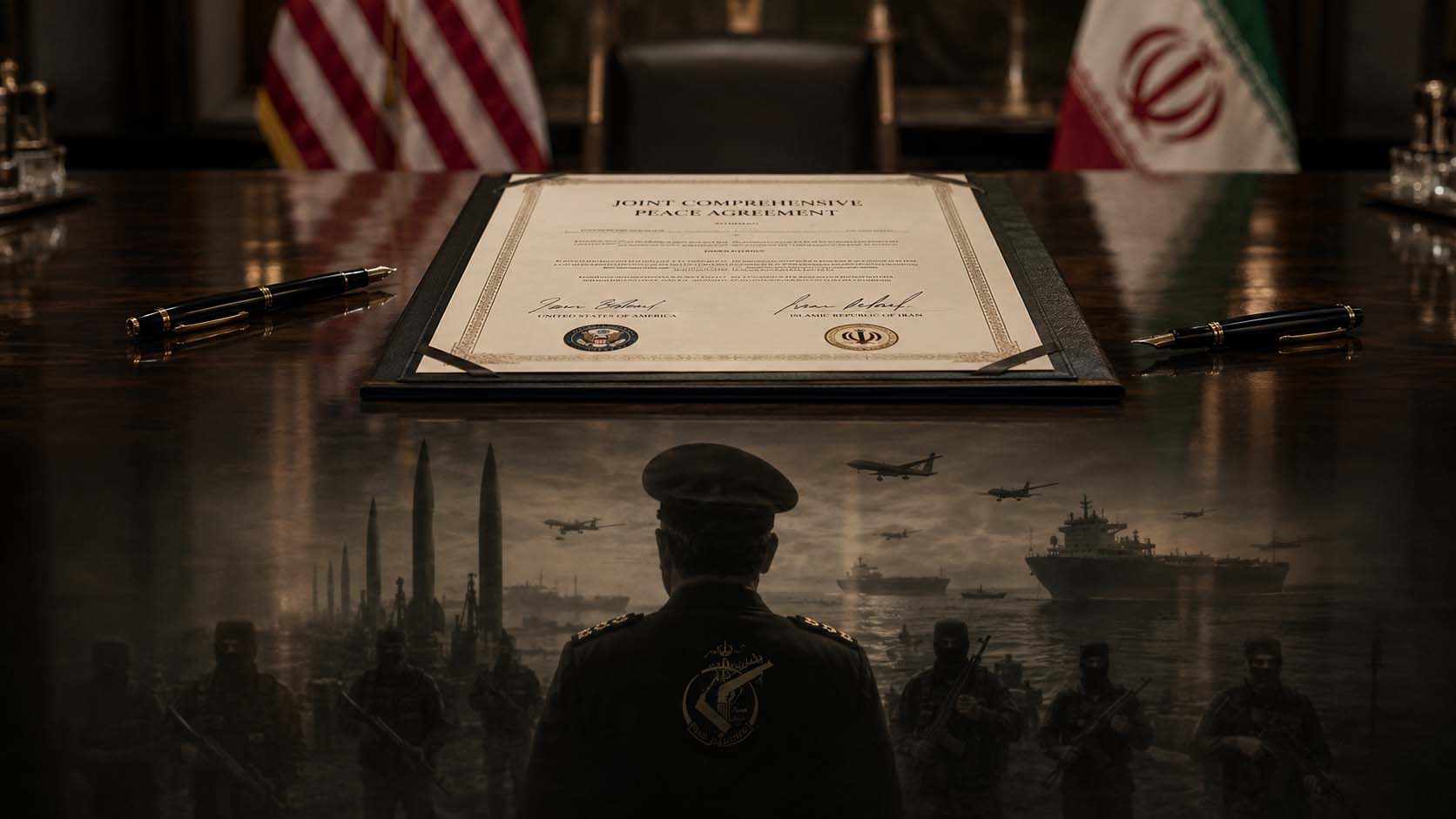
On Friday, in a signing ceremony in Switzerland, the United States and the Islamic Republic of Iran will formally end a war that has run for nearly four months. The document promises the immediate and permanent termination of military operations on all fronts, the reopening of the Strait of Hormuz, sanctions waivers, and a 60-day window to negotiate the fate of Iran’s enriched uranium. On paper, it is the most consequential de-escalation in the region in a generation.
There is one problem, and his name is Ahmad Vahidi.
Just two weeks before the deal was announced, it was Vahidi, now commander-in-chief of the Islamic Revolutionary Guard Corps, who blew up the negotiations entirely. On June 1, IRGC-affiliated Tasnim News declared that Tehran was suspending talks with Washington, ostensibly over Israeli operations against Hezbollah in Lebanon. That the announcement came through Guard-linked media was, analysts noted, all but a signature: the decision was Vahidi’s. The Institute for the Study of War assessed at the time that Vahidi and a small inner circle calculated a frozen status quo, with neither concessions to the United States nor full-scale war, served their interests better than any agreement. That a deal was reached at all, less than three weeks later, raises the question that should worry every party to it: does the most powerful man in Iran actually intend to keep it?
To understand why that question matters, you have to understand the man who now sits at the apex of the IRGC.
For most of his career, the 67-year-old brigadier general operated in the spaces where the Islamic Republic prefers not to be seen: intelligence, covert external operations, the planning offices behind the Ministry of Defense. A growing number of analysts believe he, more than President Masoud Pezeshkian or even the reclusive new supreme leader, is the man steering Iran’s strategy. And a regional official with direct knowledge of the mediation has told reporters that Vahidi became the main point of contact for those trying to broker an end to the war, an extraordinary role for a sanctioned, Interpol-wanted general who holds no diplomatic portfolio. The deal being signed in Switzerland was, in effect, negotiated through him.
Vahidi was appointed commander-in-chief on March 1, 2026, a day after the opening salvos of Operation Epic Fury killed his predecessor, Mohammad Pakpour, in Tehran. He had been positioned for the role since late December 2025, when then-supreme leader Ali Khamenei named him deputy IRGC commander with a dual mandate: prepare Iran’s forces for the strikes everyone knew were coming, and crush the protests that had erupted across all 31 provinces. He did both with the methodical brutality that has defined his rise. The internet went dark, and the crackdown that followed left tens of thousands arrested, wounded by live fire, or dead.
That résumé of repression is not new. Vahidi was interior minister under Ebrahim Raisi from 2021 to 2024, the years that saw the morality police kill Mahsa Amini and his ministry led the lethal response to the Woman, Life, Freedom uprising. Both the United States and the European Union have sanctioned him for human rights violations. But to understand why Western officials now watch him so closely, you have to go back further.
Born Vahid Shahcheraghi in Shiraz in 1958, he joined the Guard a year after the revolution and climbed fast through its intelligence wing, becoming IRGC intelligence chief during the Iran-Iraq War. He helped build the apparatus that became Iran’s Ministry of Intelligence. In the mid-1980s he served as Tehran’s representative in the covert arms-for-hostages talks with the Reagan White House that detonated into the Iran-Contra scandal. His career nearly ended in 1988, when he was arrested after a failed defence of Kermanshah against a Mojahedin-e Khalq offensive; only the intervention of Akbar Hashemi Rafsanjani saved him.
Saved, he was handed the keys to Iran’s most consequential instrument of foreign violence. Around 1990, Khamenei made Vahidi the first commander of the Quds Force, the IRGC’s expeditionary arm, a post he held until Qassem Soleimani succeeded him at the end of the decade. He was Soleimani before Soleimani. Under his command the Quds Force made its first major external deployment, in Bosnia, and, according to Argentine prosecutors, planned the 1994 bombing of the AMIA Jewish community centre in Buenos Aires that killed 85 people. Interpol has carried a red notice for his arrest since 2007. In April 2024, an Argentine court formally ruled that Iran planned the attack and Hezbollah carried it out, and the red notice was reaffirmed weeks later. US intelligence has also alleged that Vahidi cultivated ties with senior al-Qaeda figures in Sudan in the 1990s, meeting Ayman al-Zawahiri on several occasions.
This is the man whose verbal commitments, relayed through Pakistani mediators, now underwrite a peace agreement. The MOU is reported to include an Iranian pledge not to pursue a nuclear weapon and to open the first 60 days of talks with the disposal of Iran’s highly enriched uranium. American officials have been candid that those commitments are, for now, only words. “We will not know until we get in the room,” one told reporters of the nuclear concessions, “which is why we want to do this MOU.” The entire architecture rests on the assumption that the other side negotiates in good faith. The man on the other side has spent four decades demonstrating that he does not.
His leverage flows from proximity to power at a moment when proximity is everything. The supreme leader, Mojtaba Khamenei, has not appeared in public since the February 28 strike that killed his father and reportedly wounded him. In the vacuum, access to Mojtaba has become the regime’s hardest currency, and Vahidi is believed to be among the very few who possess it. He was one of the figures who pushed hardest for Mojtaba’s succession. He has reportedly blocked Pezeshkian’s efforts to name a new intelligence minister after the killing of Esmail Khatib, and pressed the president to install Mohammad Bagher Zolghadr as secretary of the Supreme National Security Council. Pezeshkian, the president who will be presented to the world as Iran’s face of peace, has by many accounts been sidelined.
That gap between who signs and who decides is the deal’s central vulnerability. A ceasefire requires not just a signature but an enforcer willing to hold his own hardliners to it, and the enforcer in this case is a true believer in the doctrine of resistance who literally built the institution that grooms Iran’s military officers into its political elite. Several analysts warn that Vahidi would likely read even a signed peace as a chance to regroup and rearm rather than a path to genuine de-escalation. His own behavior on June 1 is the precedent: when the status quo suited him, he ended the talks with a single news bulletin. Nothing in the Switzerland document prevents him from doing it again.
For thirty years Ahmad Vahidi was the regime’s most effective ghost. The war pulled him into the light, and the peace now depends on him. What it has revealed is a man who may hold Iran’s most important decisions in his hands, including the decision of whether this deal is worth the paper it is signed on.