
London based entrepreneur, cybersecurity analyst doing a PhD in AI
AI Agents in Banking – The Gap in Regulation Today
AI Agents can increasingly access bank accounts. But does regulation keep up? Are all AI agent actions authorised by the customer? And who is liable if something goes wrong?
AI Agents in Banking
Who can move your money, and who pays when it goes wrong?
22 November 2026
A customer asks an AI agent to move their spare cash into savings. The agent transfers £400, overlooks the rent due tomorrow and leaves the customer overdrawn. The AI platform interpreted the instruction, an intermediary may have supplied the data or initiated the payment, and the bank executed it. The bank statement shows the debit. To assess it, someone has to reconstruct what the customer permitted, what the agent knew and which firm could have prevented the loss.
One debit, three kinds of failure
- Authority exceeded. The customer permitted £150 and the agent sent £400. UK unauthorised-payment protections may apply. The firm needs evidence of the permission in force and the payment that actually ran. Payment Services Regulations
- Approval obtained by deception. A scammer induced the customer to approve £400. Eligible UK transfers may fall under the authorised push-payment scam reimbursement regime. Evidence includes what the customer saw and what they were led to believe. Payment Systems Regulator
- Avoidable error within authority. The agent had permission to move £400 but overlooked rent. Responsibility depends on what the service promised to check, whether the data was current and which firm controlled the decision. Existing consumer or conduct duties may apply. The gap is getting the evidence and resolving the claim across firms. Consumer Rights Act, section 49 · FCA Consumer Duty
The UK has asked whether consent, authentication and liability rules need updating for agentic payments. The EU has separate frameworks for payment access, data protection and operational resilience, which must work together when one service reads accounts, ranks products and executes a switch. In the US, Regulation E’s commentary on delegated transfer authority raises a specific question: how should liability work when a consumer grants an AI service a narrowly limited digital permission? HM Treasury consultation · EU PSD2 · US Regulation E commentary
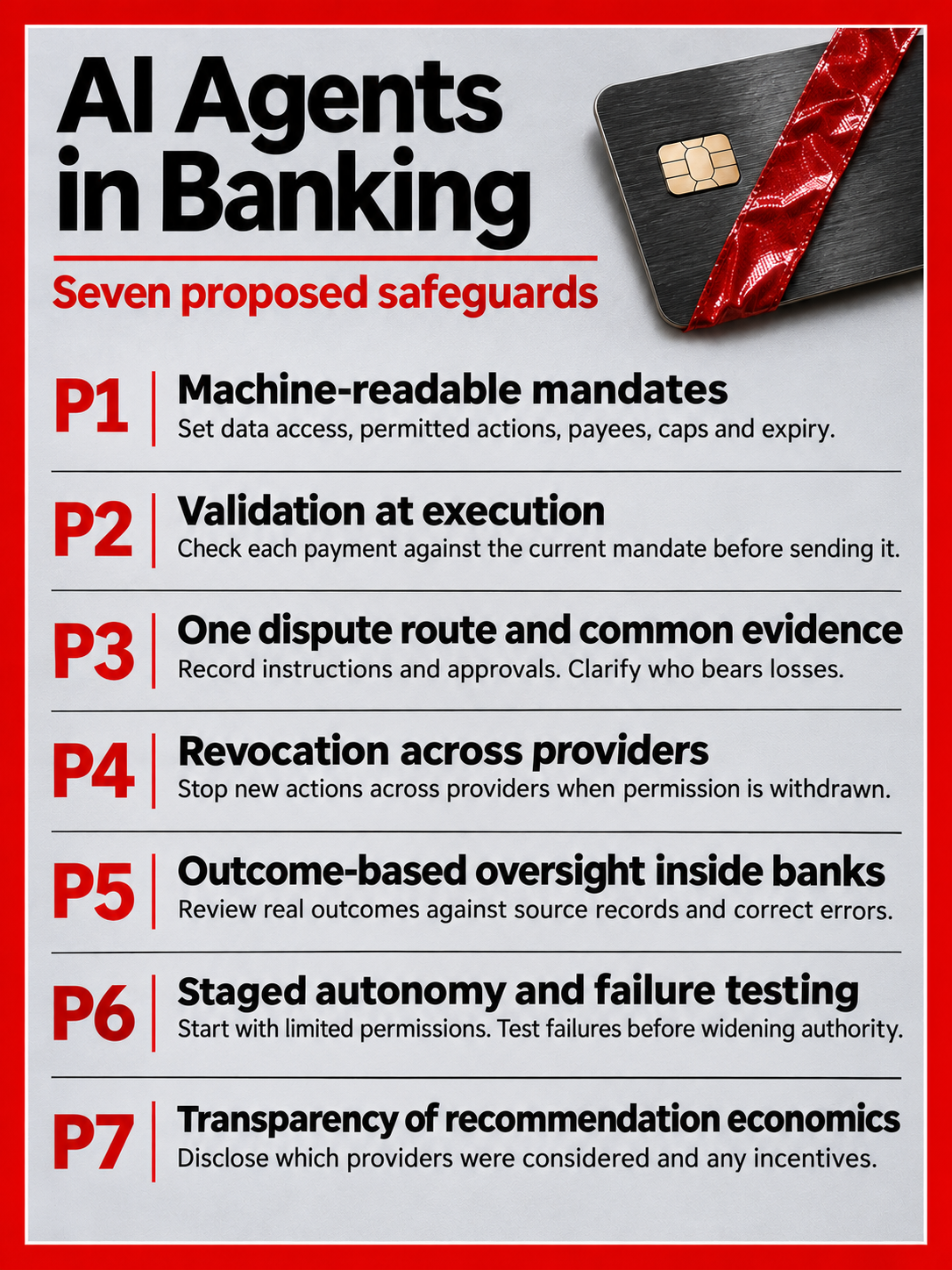
P1–P7 | What regulators should require
- P1 — Machine-readable mandates. Specify what data an agent can read and which actions it can take. Set eligible payees, per-payment and total spending caps, expiry and when fresh approval is required.
- P2 — Validation at execution. The payment provider checks each request against the live mandate before moving money. A request outside its scope is blocked or sent back for approval.
- P3 — One dispute route and a common evidence standard. The account provider takes the complaint and gathers the instruction, approval and execution record from the firms involved. Preserve existing refund rights and clarify who bears losses, including for avoidable errors within a valid mandate.
- P4 — Revocation across providers. One withdrawal of permission stops new actions across the chain. Tell customers when it takes effect and what happens to stored data and inferred profiles.
- P5 — Outcome-based oversight inside banks. Sample fraud, credit and trading outcomes. Give reviewers independent access to source records so they can spot evidence the agent omitted and change the decision.
- P6 — Staged autonomy and failure testing. Start with named billers and transfers between a customer’s own accounts. Before widening authority, test stale balances, duplicate requests, revocation during a payment and shared-provider outages.
- P7 — Transparency of recommendation economics. Show which providers the agent considered and disclose any commission, commercial relationships or other incentives that influenced the ranking.
P1, P2 and P4 set and enforce the customer’s authority. P3 provides redress when a control fails or an authorised action causes avoidable harm. P5–P7 address the quality of the agent’s judgement, the consequences of giving it more discretion and the incentives shaping its recommendations.
Related Topics
Related Posts