AI and the worlds our words create
My friend Rabbi Daniel Bogard recently wrote on Facebook that the conversations we are having about AI are “waaaay too small.” He pointed to a familiar debate among rabbis: Should we credit Claude when we use it to make a study sheet?
Daniel compared these conversations to rearranging the deck chairs on the Titanic. He suggested that the next decade could bring a scale of change comparable to everything that has happened from the time of the Maccabees until now.
I agree that we are struggling to comprehend the scale of what is coming. But the Titanic metaphor assumes a catastrophe. It leaves very little room for the possibility that AI could help us treat diseases that are currently incurable and make food more widely available. I suggested a different image: “We’re discussing where to put the bookmarks while a new chapter of human history is opening.”
Most of us imagine the future as a slightly improved version of the present. We expect a faster computer or a chatbot that makes fewer mistakes. Repeated doubling can eventually produce changes far beyond those expectations, and some measures of AI capability already show that pattern.
METR, a research organization studying advanced AI, has measured an exponential increase in the length of software and research tasks that models can complete at a defined success rate. The findings concern particular tasks under test conditions, so extrapolating them to society requires care. They still give us reason to question forecasts built around gradual improvement. [1]
AI is also helping develop the next generation of AI. Google DeepMind has reported that its AlphaEvolve system improved algorithms involved in AI training, including training the models underlying AlphaEvolve itself. So far, this involves specific improvements within systems people have designed. As AI becomes capable of taking on more of the research, it could accelerate the development of its successors. [2]
I suspect the next few years will bring changes we can barely imagine now. AI could help researchers find treatments for diseases we currently consider incurable and understand the processes of aging well enough to intervene in them. Parts of scientific research that once consumed years could take much less time.
Curing every known disease, including overcoming the damage associated with aging, remains an aspiration with an uncertain timetable. Advances in agriculture, clean energy, materials science, and mathematics could also help us address climate change and make essential goods more abundant.
Getting those benefits to people will require political choices. Hunger involves war and poverty as well as food production. A scientific breakthrough still has to reach the people who need it. I believe AI’s potential benefits far outweigh the harms we associate with today’s systems, and I want us to put far more effort into making those benefits available.
Job losses are an immediate concern. Someone whose livelihood disappears needs income, housing, and healthcare while the economy changes. The connection between losing a job and becoming poor depends on how we distribute the wealth our society produces.
If AI and robotics eventually allow us to produce far more with far less human labor, we could share that abundance through universal basic income, public services, shared ownership, or some combination. With sufficiently large gains, we could aim for a universal high income that gives people enough to live comfortably.
Paid work could become more like growing your own vegetables is for many people today. You choose to do it because you enjoy it or value what you grow. People would continue making music, raising children, studying, building things, and caring for one another. We already devote much of our lives to activities that nobody pays us to do.
Businesses also need customers. If a society produces enormous quantities of goods while depriving much of its population of purchasing power, its owners have a problem along with its workers. The wealthy have an interest in keeping money circulating, though individual companies can keep cutting labor costs while expecting somebody else to sustain demand. A fair distribution of the gains will require public pressure and government action. The IMF has argued that spreading AI’s benefits requires changes to taxation and social protection. [3]
Religious communities have something to contribute here. We could start examining how much of our understanding of human worth depends on employment, and how we would help people find purpose if paid work became optional. We should also be discussing who owns the systems producing this wealth and what obligations ownership brings.
Shabbat gives us a weekly opportunity to spend time with people we love, pray, study, and rest. We treat those hours as valuable in themselves. A society in which people had more time for these things would give us plenty to do as rabbis.
At the end of the Mishneh Torah, Maimonides imagines a world free of famine and war, where goods are abundant and humanity devotes itself to knowing God. [4] His account gives us a starting point for discussing how Jewish communities could help people use greater freedom from paid work.
My optimism also depends on taking the dangers seriously. A superintelligent system pursuing goals incompatible with human survival could be catastrophic. Even without hostility toward us, it could cause harm that we lacked the ability to prevent. I would consider even a one-percent chance of human extinction intolerably high; I use that number hypothetically, since the probability is uncertain.
There are security problems already. In November 2025, Anthropic reported disrupting an espionage campaign in which attackers used AI agents to perform much of the technical work against corporate and government targets. According to the company, people directed the attacks and automated much of their execution. [5] As those capabilities grow, we need to prepare for coordinated agents attacking hospitals, power grids, or financial systems.
Developers should have to demonstrate that their safeguards work. That requires rigorous testing and limits on dangerous capabilities, along with protection of critical infrastructure. Governments will need to cooperate across borders. Stopping development in the United States would leave development in China and elsewhere unresolved; a credible global halt would require agreements backed by verification and enforcement. Announcing that we reject AI gives us little influence over those decisions.
Energy use, exploitation, deception, and the concentration of power deserve attention. So do the lives better medicine could save and the hunger greater abundance could relieve. Those possibilities are why I want to participate in shaping this technology and insist that its benefits reach people who have little influence over its development.
Daniel’s post made me want a more ambitious conversation among rabbis. We should be advocating for common-sense guardrails, including independent safety testing of powerful systems and accountability for the people and companies deploying them. Our teachings about human dignity and our obligations to one another can help guide ethical AI development and use. We should bring those same commitments to supporting people whose livelihoods are disrupted and to policies such as universal basic income that would share the wealth AI produces.
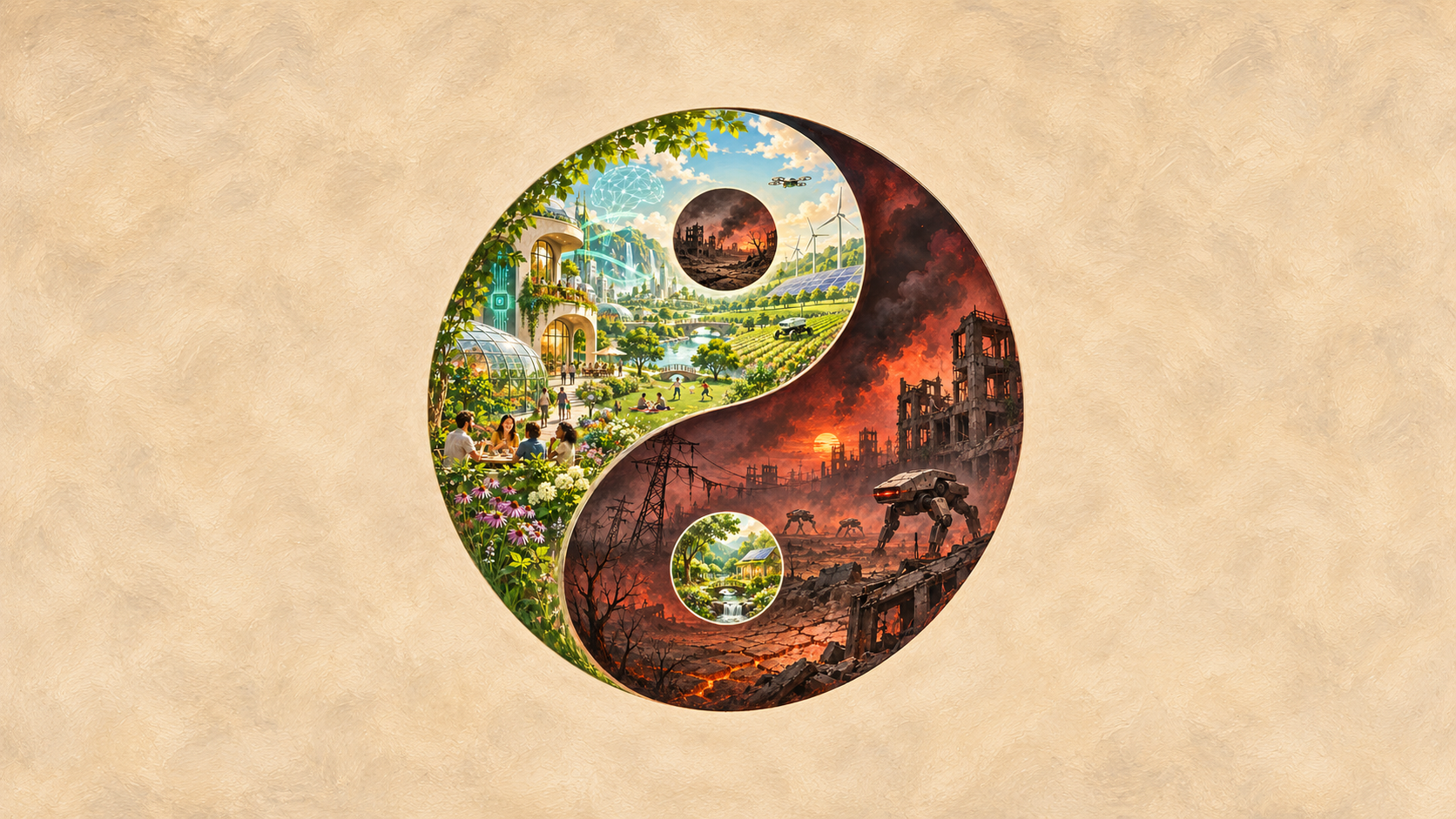
Our tradition teaches that God creates through speech. The Zohar extends that creative power to us, describing how new words of Torah create new heavens and earth. [6] Our words about AI also help shape the world we will inhabit, influencing what we build and the purposes we choose for it. Let’s choose our words carefully, so that we create a world of promise rather than a world of peril.
Sources
[1] METR, “Time Horizon 1.1,” January 29, 2026.
[3] IMF, “Fiscal Policy Can Help Broaden the Gains of AI to Humanity,” June 17, 2024.
[4] Maimonides, Mishneh Torah, Kings and Wars 12:5.
[6] The Zohar, 1:4b–5a, Pritzker Edition, translated by Daniel C. Matt.
Full disclosure: This article was composed with AI assistance. The ideas and final editorial choices are mine.