London based entrepreneur, cybersecurity analyst doing a PhD in AI
The Engineering Legacy which may go extinct.
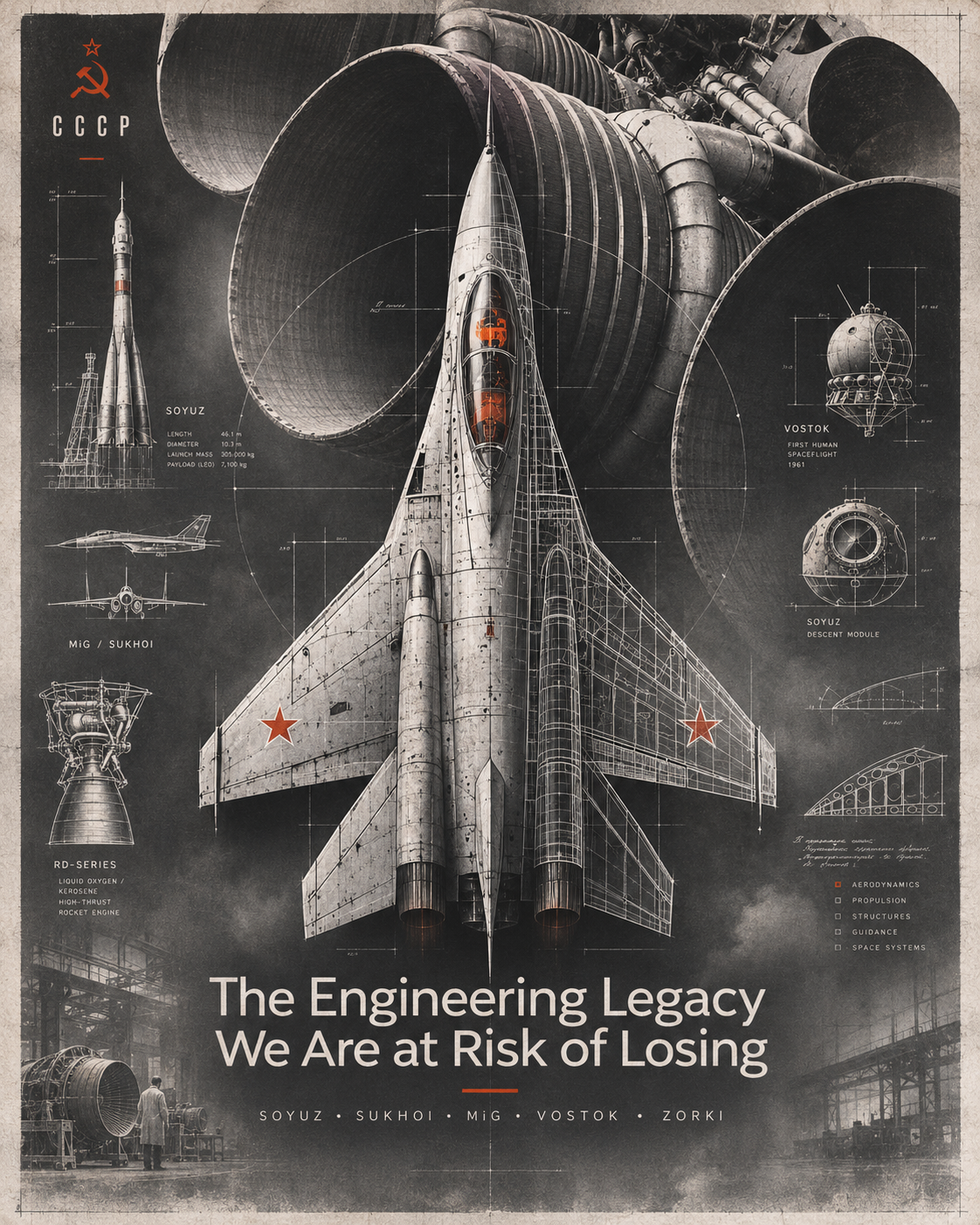
Soviet engineering showed practicality, stable designs and frugality at it's best.
The Engineering Legacy We Are at Risk of Losing
From Sukhoi and MiG to Soyuz, Zorki and Vostok: why the world’s engineering heritage would be poorer without the Soviet philosophy of making more with less.
There is something extraordinary about a mechanical watch manufactured in the Soviet Union fifty years ago that continues to keep time today.
These emerged from an engineering culture that approached technological problems differently from much of the Western world.
It was a culture shaped by scarcity, geopolitical isolation, formidable scientific talent, centrally directed industrial ambitions and an almost obsessive attention to practical engineering.
Its products were not always elegant. They were not always comfortable, commercially successful or particularly refined. Some were outright failures.
But at its best, Soviet engineering demonstrated that technological sophistication did not necessarily require technological extravagance.
An aircraft could be extraordinarily capable without being exceptionally complicated. A watch could resist enormous underwater pressure without the elaborate construction of its Swiss competitors. A spacecraft could be improved repeatedly without being completely reinvented.
Today, this legacy faces an uncertain future.
1. The Soviet Design Bureau: An Alternative to Silicon Valley
To understand Soviet engineering, one must first understand the OKB — the Opytno-Konstruktorskoye Byuro, or Experimental Design Bureau.
Scientific research institutes, known as NIIs, conducted fundamental or applied research. Design bureaus translated scientific knowledge into working prototypes. Industrial factories then manufactured approved designs at scale.
In principle, this divided the innovation process into three interconnected activities: scientific investigation, engineering development and mass production.
The OKB stood at the centre.
Rather than revolving around a corporate brand, many bureaus acquired the personalities and names of their chief designers.
Pavel Sukhoi. Artem Mikoyan. Mikhail Gurevich. Andrei Tupolev. Sergei Korolev.
These were not simply company executives. They were technical leaders who had to understand physics, manufacturing, logistics, human limitations and government priorities.
They also had to persuade the Soviet leadership to finance their ideas.
There was competition, too, particularly in priority defence industries.
The Soviet state did not eliminate competition. In some fields, it relocated competition from the marketplace into the engineering establishment.
2. Sukhoi and MiG: Two Answers to the Same Engineering Question
Consider the Mikoyan-Gurevich MiG-21.
Developed during the 1950s and introduced into service around 1960, the MiG-21 became one of the most widely produced supersonic fighters in aviation history.
Its distinctive delta-wing geometry helped deliver high speed and effective interception performance from a relatively compact aircraft.
It was not an aircraft without compromises. Early versions had limited endurance, restricted avionics and demanding operational characteristics.
But the fundamental design was remarkably successful.
What made it interesting was not simply its speed. It was the relationship between capability, manufacturing scale and complexity.
The designers concentrated on producing a compact, high-performance aircraft whose fundamental architecture could be manufactured repeatedly and adapted over time.
The MiG-21 embodied a philosophy familiar to modern engineering: solve the essential problem before adding unnecessary sophistication.
Sukhoi pursued another path.
The Su-27, which first flew in 1977, was developed in response to increasingly capable Western fighters, particularly the American F-15.
Its engineers investigated advanced aerodynamics, integrated fuselage-and-wing shapes, powerful engines and electronic flight controls.
The final aircraft became the foundation for an extensive family of fighters, demonstrating how a successful platform could support decades of modification.
Here was another Soviet characteristic: design a strong underlying architecture, then extend its usefulness through successive generations.
Neither example proves Soviet engineering was universally superior. American and European aircraft frequently achieved better results in particular technologies, avionics, maintenance systems or combat conditions.
The lesson lies elsewhere.
Soviet designers understood that elegance could emerge from selecting the right technical compromises.
A successful design was not necessarily the one incorporating the greatest number of innovations. It was the one in which the innovations worked together.
3. Soyuz: The Spacecraft That Refused to Become Obsolete
Almost sixty years after its first crewed flight, the Soyuz remains the longest-running operational human spacecraft programme in history.
This distinction deserves considerably more recognition.
The original Soyuz spacecraft first carried a human into space in April 1967.
The programme was conceived under Sergei Korolev’s leadership during the Soviet Union’s ambitions for lunar exploration.
Over the following decades, Soyuz spacecraft transported crews to the Salyut space stations, the Mir station and eventually the International Space Station.
Modern Soyuz MS spacecraft retain the essential three-module architecture of their predecessors, although the technologies inside have been substantially updated.
The design divides the vehicle into an orbital module, a descent module and a service module.
The orbital module provides living and working space during flight. The service module contains systems required for propulsion, power and spacecraft operation. The smaller descent module brings the astronauts safely back through the atmosphere.
Only the descent module needs the full thermal protection required for re-entry.
This is an elegant engineering compromise.
Instead of designing the entire spacecraft to survive atmospheric entry, Soyuz discards the components it no longer needs.
The smaller return capsule is protected by a heat shield, slowed by parachutes and brought to the ground with the assistance of a landing system.
Its structure is compact. Its functions are separated. Its architecture has accommodated successive improvements in guidance, electronics, communications and power systems.
This does not mean the Soyuz is unchanged, or that it is flawless.
The Soyuz 1 mission ended with the death of Vladimir Komarov in 1967 following a parachute failure. In 1971, the three cosmonauts aboard Soyuz 11 died after their spacecraft depressurised.
These tragedies forced major safety improvements, including the introduction of pressure suits for critical phases of flight.
In October 2018, a Soyuz launch vehicle malfunctioned shortly after liftoff. The crewed spacecraft’s emergency escape and recovery systems enabled the two occupants to survive.
These episodes remind us that reliability is not a mystical property bestowed on an old design. It is something that engineers build, test, revise and maintain.
Nevertheless, the endurance of the Soyuz programme is unprecedented.
After NASA retired the Space Shuttle in 2011, Soyuz became the sole means of carrying crews to the International Space Station until SpaceX’s Crew Dragon began operational crew transport in 2020.
For nine years, a spacecraft family originating in the Soviet Union provided the indispensable transport link for an international scientific programme.
Today, Crew Dragon offers capabilities unavailable to Soyuz, including a larger crew capacity and partially reusable architecture.
Yet Soyuz remains operational.
Its significance is not that nobody has invented anything better in individual respects. It is that its fundamental architecture has proved adaptable for nearly six decades.
In a technological industry increasingly attracted to abandoning entire platforms in favour of new generations, Soyuz offers another possibility.
The highest achievement in engineering may sometimes be the design that does not need to be replaced.
4. Zorki Cameras and Vostok Watches: Engineering for Ordinary People
Soviet ingenuity was not restricted to aircraft and spacecraft.
It could also be found in objects small enough to fit inside a coat pocket.
Consider the Zorki camera.
Produced at the Krasnogorsk Mechanical Plant, the original Zorki emerged in the late 1940s from a design lineage that ultimately traced back to the German Leica II.
This is an important qualification. Early Zorki cameras were not entirely original Soviet inventions.
But the development of manufacturing capacity, mechanical expertise and successive improvements enabled Soviet factories to produce accessible photographic equipment on a substantial scale.
The Zorki rangefinders incorporated mechanical shutters, manual focusing mechanisms, precision gears and interchangeable lenses.
Many could operate without batteries.
A properly maintained example can still work today, decades after its manufacture.
One can pick up an old Zorki, advance the film using a mechanical lever, adjust the shutter speed, focus through its rangefinder and take a photograph.
There is no operating system to become unsupported. No cloud subscription to expire. No proprietary firmware preventing a mechanical repair.
Of course, longevity does not mean superiority in every respect. Soviet cameras could suffer inconsistent quality control, awkward ergonomics and poorer finishing than their Western or Japanese competitors.
But they demonstrate how much functionality can be delivered through understandable mechanical systems.
An even more revealing example is the Vostok mechanical watch.
The Chistopol watch factory became associated with the Komandirskie military watches and the celebrated Amphibia diving watch, introduced in 1967.
The Amphibia is a particularly fascinating exercise in resource-constrained engineering.
Its designers, Mikhail Novikov and Vera Belova, faced the challenge of producing a water-resistant watch using manufacturing equipment that could not necessarily replicate the precision processes available to established Swiss manufacturers.
Instead of merely copying the construction of existing diving watches, they developed an alternative system.
The Amphibia employed a distinctive caseback, sealing gasket and acrylic crystal arrangement in which increasing external water pressure helped strengthen the seals.
The original design was rated for water resistance equivalent to 200 metres.
This was not engineering through extravagance. It was engineering through geometry, material selection and an understanding of pressure.
The result became an enduring watchmaking design.
A Swiss luxury watch might emphasise high-precision finishing, elaborate decoration and prestige. The Vostok represented another ambition: a mechanically competent object that could be produced at a practical cost.
Neither philosophy is inherently wrong.
But in an age of disposable consumer electronics, there is something admirable about an inexpensive mechanical watch whose design remains recognisable generations later.
The Zorki and the Vostok reveal an important principle:
Great engineering is not always about creating the most sophisticated object. Sometimes it is about creating the simplest object that reliably performs the required task.
5. Sputnik V: A Scientific Tradition That Survived the Soviet Union
The engineering inheritance did not disappear when the Soviet Union dissolved in 1991.
An interesting modern example emerged during the COVID-19 pandemic.
On 11 August 2020, Russia became the first country to announce national registration of a COVID-19 vaccine, Sputnik V, developed by Moscow’s Gamaleya National Research Centre.
The vaccine used a heterologous adenovirus-vector approach, employing two different vectors for the first and second doses.
This was a scientifically interesting strategy intended partly to reduce the problem of immunity developing against the delivery vector itself.
In February 2021, interim results from a randomised phase III clinical trial were published in The Lancet, reporting efficacy of approximately 91.6% against symptomatic COVID-19 under the conditions studied.
This was a genuine biomedical research achievement.
However, the historical record requires care.
Sputnik V was the first nationally registered COVID-19 vaccine, not the first vaccine conclusively demonstrated to be effective. Its initial Russian approval was announced before phase III trials had begun, attracting legitimate concerns about scientific transparency and regulatory standards.
The subsequent clinical evidence supported the vaccine’s efficacy in the original trial setting, but this did not retrospectively justify bypassing rigorous evaluation.
Nor should Sputnik V be presented as a direct product of a Soviet design bureau. Its development belonged to Russia’s contemporary biomedical research establishment, although that establishment inherited important Soviet scientific institutions and expertise.
What the episode demonstrates is the continued presence of substantial technical capability inside Russia.
Russian scientists could still contribute meaningfully to a global scientific emergency.
A nation’s scientific reputation depends not simply on what its engineers and researchers can build, but on whether its institutions allow their work to be evaluated honestly.
6. The War in Ukraine: An Industrial Inheritance Under Threat
Russia’s full-scale invasion of Ukraine in February 2022 introduced a profoundly destructive new chapter.
The most immediate costs of the war are human: lives lost, families displaced, cities damaged and communities traumatised.
Industrial losses matter too, particularly when they threaten capabilities that took generations to develop.
The Soviet engineering inheritance was never exclusively Russian.
The Soviet Union incorporated an extraordinary network of scientific and industrial centres distributed across its constituent republics.
Ukraine was central to that system.
The Antonov Design Bureau became famous for designing exceptional transport aircraft. The Yuzhnoye design bureau in Dnipro developed rocket and space technologies. Ukrainian factories produced engines, precision equipment and components for the wider Soviet aerospace establishment.
One of the most extraordinary examples was the Antonov An-225 Mriya.
Originally built to support the Soviet space programme, the six-engined aircraft became the world’s largest operational cargo aircraft.
It was destroyed at Hostomel during the opening phase of Russia’s invasion in 2022.
The loss was symbolic as well as material.
An aircraft born from a shared Soviet engineering system, designed and maintained in Ukraine, was destroyed during a war launched by the Russian state.
The conflict has since damaged the scientific environments of both countries, although the direct physical destruction and displacement have fallen particularly heavily on Ukraine.
A 2026 study published in Humanities and Social Sciences Communications documented substantial disruptions to scientific collaboration and researcher migration following the invasion.
The consequences extend beyond the immediate loss of personnel.
When an engineer leaves an institution, knowledge leaves with them.
Some knowledge is recorded in drawings, specifications, equations and manufacturing instructions.
Other knowledge exists only through experience.
It is the machinist who knows why a particular component fails after repeated thermal cycling.
The materials scientist who understands why a substitute alloy performs differently in production.
The technician who recognises a vibration pattern before a bearing fails.
The senior engineer who understands a decades-old design decision that was never fully documented.
These capabilities cannot be recreated simply by purchasing new equipment.
They depend on people working together across generations.
The greater danger, therefore, is not merely that factories might close.
It is that their accumulated knowledge might become fragmented, inaccessible or irrecoverable.
7. The Economic Danger: A Country Living Off Its Engineering Past
As of November 2026, Russia’s economy has not collapsed.
It would be inaccurate to claim otherwise.
But several indicators point towards an increasingly difficult long-term position.
The Bank of Finland’s October 2026 forecast warned of stagnating output, persistent budget deficits, weak investment and growing supply-side constraints. It projected growth slowing to approximately 0.5% in 2027 and 2028, while observing that an immediate full-scale economic crisis remained unlikely.
The World Bank has likewise forecast weak Russian growth in 2026.
War-related spending can sustain production, but a country’s industrial health cannot be judged solely by the quantity of military equipment it manufactures.
There is a fundamental difference between increasing current output and strengthening future technological capacity.
Factories can operate at high utilisation while investment in scientific research, civilian technology and new production equipment deteriorates.
Engineers can be employed intensively while becoming increasingly isolated from international scientific developments.
Russia also faces restrictions on access to advanced industrial equipment, specialist electronics and other technologies following sanctions imposed in response to the invasion.
These restrictions have legitimate strategic purposes, notably limiting the resources available to sustain the war. But they also create substantial pressures across technologically interconnected industries.
A July 2025 Chatham House study described an increasingly difficult position for Russia’s defence-industrial system, including dependence on legacy technologies, obstacles to advanced manufacturing and difficulties achieving genuinely new innovation.
A society can retain the physical products of an engineering civilisation long after it has weakened the conditions necessary to create their successors.
The most troubling possibility is not that Russia stops building things.
It is that Russia continues manufacturing sophisticated equipment while gradually losing the ability to innovate at the same level.
8. The Soviet System Also Contains a Warning
The Soviet system could be coercive, secretive and extraordinarily wasteful.
Sergei Korolev himself suffered imprisonment in Stalin’s labour-camp system before becoming the leading figure in the Soviet space programme.
Andrei Tupolev was also imprisoned and compelled to work within the Soviet system of prison-based technical organisations.
Scientific careers could be determined by political favour.
Design bureaus sometimes competed destructively for resources. Failures could be concealed, investigations compromised and technical decisions distorted by ideological demands.
The Soviet lunar programme, despite formidable achievements elsewhere in space, never successfully launched its N1 Moon rocket into orbit.
Consumer manufacturing frequently suffered from poor quality control, shortages and limited responsiveness to users.
These were not minor exceptions to an otherwise perfect system.
They were structural weaknesses.
The crucial distinction is between the achievements of Soviet engineers and the political institutions that controlled them.
It is possible to admire Korolev’s engineering without admiring Stalin.
Indeed, the political history strengthens the argument for preserving the engineering legacy.
Engineers achieved extraordinary things despite serious institutional constraints.
One is entitled to ask what they might have accomplished with greater intellectual freedom, transparency and international cooperation.
9. What the Modern World Can Still Learn
The contemporary technology industry is often organised around rapid replacement.
Smartphones are superseded annually. Electronics become difficult to repair. Software-dependent products can lose functionality when their manufacturers discontinue support.
Complexity sometimes increases faster than genuine usefulness.
The Soviet engineering tradition suggests several principles worth recovering.
First, begin with the physical problem rather than the technological fashion.
Second, understand the constraints of manufacturing before finalising the design.
Third, treat repairability, durability and maintainability as engineering achievements rather than afterthoughts.
Fourth, distinguish genuine improvements from complexity introduced merely to advertise novelty.
And fifth, preserve the knowledge that connects scientific research with practical production.
We should not have to rebuild the Soviet Union to preserve what its engineers taught us.
And perhaps the greatest tribute to those engineers would be to ensure that their knowledge helps build a more peaceful and technologically capable future — rather than becoming another casualty of history.
Sources and further reading
- European Space Agency, The Russian Soyuz Spacecraft. Technical architecture and historical longevity of the Soyuz programme.
- NASA, Apollo–Soyuz Test Project Overview. Historical cooperation and Soviet spacecraft development.
- Smithsonian National Air and Space Museum, Mikoyan-Gurevich MiG-21F-13. Aircraft design and production history.
- Hodinkee, The Vostok Amphibia. History and mechanical design of the Soviet diving watch.
- Soviet Cameras, Zorki Cameras. Development of the Soviet rangefinder camera family.
- Logunov et al., Safety and efficacy of Sputnik V: phase III trial, The Lancet, 2021.
- Bank of Finland, BOFIT Forecast for Russia 2026–2028, 5 October 2026.
- World Bank, Russia Country Overview. Economic growth projections and structural constraints.
- Chatham House, Russia’s Struggle to Modernize Its Military Industry, July 2025.
- CSIS, A Glimpse of the World’s Largest Aircraft Destroyed amid the Russian Invasion of Ukraine, March 2022.
- Nature Portfolio, Frontlines and Faultlines: How the Russo-Ukrainian Conflict Reshapes Scientific Research, 2026.
- Carnegie Endowment for International Peace, Is There a Place for Russia in the New Race Back to the Moon?, April 2026.
Related Topics
Related Posts