An Engineer’s Perspective on Israel and Jewish Life
AI Can Give Us Answers. But Who Will Know Whether They’re Right?
An ancient Jewish tradition offers a lesson for education in the age of artificial intelligence.
Recently, I read an article in The Free Press about a new kind of school being launched by the Silicon Valley venture capital firm Andreessen Horowitz. They propose a two-year alternative to traditional college, built around real-world projects, hands-on experience, mentoring by practitioners and the use of AI to turn readily available knowledge into useful work.
The argument was appealing. College isn’t for everyone. Traditional universities can be too disconnected from the real world. Students should spend more time solving actual problems, building things and learning by doing.
I found myself agreeing with much of it.
My reaction comes from experience. I spent most of my professional life as an engineer and researcher, first at Bell Labs and later as a university professor. I believe deeply in learning by doing. Some of the most important things I learned as an engineer did not come from a textbook.
Still, something bothered me.
I finally reduced it to one sentence:
Access to knowledge is not the same as mastery of knowledge.
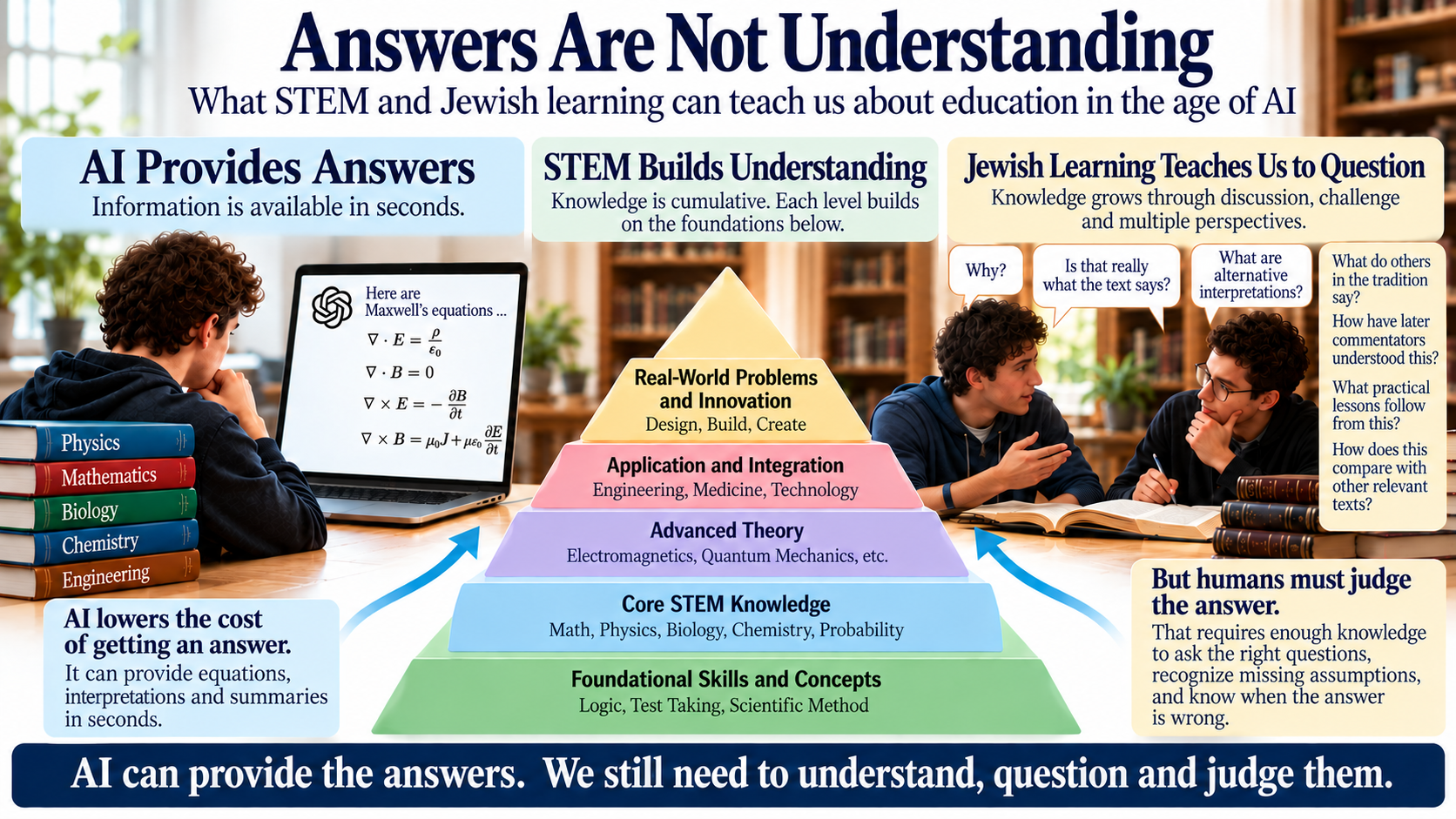
The above graphic captures what I mean: AI can provide answers almost instantly, but understanding still rests on foundational knowledge, questioning and human judgment that take years to acquire. Like a layered engineering system, each level of knowledge builds on the one below it. Remove the foundation and the higher layers eventually fail. That distinction may be especially important for students who have grown up receiving information in seconds, not only from AI, but from social media feeds where speed, brevity and constant novelty have become the norm.
Artificial intelligence makes that distinction more important, not less.
Ask AI for Maxwell’s equations and you have them in seconds. Ask about thermodynamics, DNA replication, semiconductor physics, probability theory or the Fourier transform and you can get a remarkably good explanation almost instantly.
When I was an engineering student, finding some of that information could take hours in a library.
Now it takes seconds. That’s wonderful.
But having an equation on your screen is not the same as understanding it.
You don’t design semiconductors, communications systems, aircraft, drugs or energy systems with entrepreneurial enthusiasm and AI searches. The real STEM world demands deep technical competence. That competence is built cumulatively, and sometimes painfully over the years, through mathematics, physics, biology, chemistry, laboratories and engineering fundamentals.
Calculus comes before differential equations. Basic physics comes before electromagnetic theory. Probability comes before much of communications theory.
Education has layers too.
That thought led me somewhere I hadn’t expected.
To Jewish learning.
Something Judaism understood long before AI
A disclaimer is appropriate here. I am an engineer. I am Jewish. But I am not a rabbi or a scholar of Jewish texts.
In fact, I asked my AI assistant whether Jewish learning offered an interesting parallel, or support, for my argument. It produced the references cited below. Then I did exactly what I hope a student using AI would do.
I checked.
AI pointed me first to Pirkei Avot: “Make for yourself a teacher, acquire for yourself a friend.” Maimonides, commenting on the passage, discusses the value of learning with another person, where ideas can be tested through discussion rather than relying entirely on solitary study.[1]
AI also pointed me to an even more striking passage in the Talmud, attributed to the third-century sage Rabbi Ḥanina bar Ḥama: “I have learned much from my teachers and even more from my friends, but from my students I have learned more than from all of them.”[2]
Teacher, colleague, student. Knowledge moves in every direction.
One traditional Jewish mode of learning is built around this idea. It is called havruta, or paired study, in which two people study a text together, questioning, challenging and explaining it to one another. That is the kind of learning illustrated on the right side of the figure above. The goal isn’t simply to arrive at an answer, but to deepen understanding through the exchange.[3]
The learner isn’t just receiving an answer. It has to be discussed, questioned, explained (often multiple times) and defended. Sometimes, in that process, the learner discovers that what seemed obviously right wasn’t right at all.
That strikes this engineer as a pretty good educational architecture.
It also sounds remarkably appropriate for a world in which a machine can produce a confident answer to almost any question in seconds.
What if we don’t know enough to know AI is wrong?
We hear a great deal about students using AI to write papers, solve homework problems and avoid doing the work themselves. Those are legitimate concerns.
I worry about something deeper.
What happens when students no longer know enough to recognize when the machine is wrong?
AI can generate an equation, but someone still needs enough mathematics to know whether it makes sense.
AI can propose an engineering design. Someone must understand the physics well enough to know whether the bridge will stand or the communications system will work.
AI can summarize a medical paper. Someone needs enough biology, chemistry and statistics to decide whether its conclusion is justified.
Sometimes, though, the problem isn’t the answer.
It’s the question.
After decades in research, I came to appreciate that expertise isn’t simply knowing more answers. Often it is knowing which question to ask.
That is another reason the Jewish tradition of learning interests me.
We Jews like to say that ours is a tradition of questioning. Rabbi Jonathan Sacks emphasized the central role that asking questions has long played in Jewish learning and tradition.[4] But asking questions isn’t automatically evidence of intellectual sophistication. A five-year-old can ask questions all day.
The important question is often the one that emerges because you know enough to notice something that others have missed.
What strikes me about these Jewish traditions of learning is that questioning doesn’t substitute for knowledge. It grows from engagement with knowledge. That distinction matters in the AI era.
AI may become the greatest answer machine humanity has ever created.
Our schools must produce people capable of questioning it.
Learning by doing, but first, learning
The advocates of new educational models are right about something.
Students should build things. Conduct experiments. Write software. Work in laboratories. Start companies. Meet customers. They should discover for themselves that real-world problems rarely look like the carefully constructed exercises at the end of a textbook chapter.
I spent a career in engineering research. I have enormous respect for learning by doing.
But I keep returning to the sentence that prompted my original response to The Free Press article:
“Learning by doing” only works when you have learned enough to know what you are doing.
Which raises a question every student now has to confront: When does AI help us learn and when does it keep us from learning?
That isn’t an argument for preserving universities as they are. Far from it.
AI should force universities to reconsider what students memorize, how we teach, how we test and how quickly students encounter real problems. Some things my generation had to memorize probably don’t need to occupy valuable space in a student’s head anymore.
But which things?
I think that may become one of the hardest educational questions of the AI age.
Remove too little foundational material and we fail to take full advantage of an extraordinary technology. Remove too much and we may eventually produce people who can obtain answers to questions they no longer understand.
The AI paradox
This brings me to a paradox I hadn’t expected when I began thinking about artificial intelligence.
The more powerful AI becomes, the more important human knowledge may become.
Not because humans should compete with machines at memorizing facts. That contest is over.
We need knowledge because somebody still has to judge the answer.
Someone has to spot the nonsense, notice the questionable assumption buried inside a calculation, or connect an answer from one field with something learned in another.
Most importantly, someone has to ask the question that nobody thought to ask the machine.
And occasionally someone must know enough to look at an extraordinarily sophisticated AI system and say:
No. That answer is wrong.
Maybe there is a lesson there for Silicon Valley and our universities.
The educational challenge of the AI age isn’t simply teaching our children how to obtain answers.
It is making certain they know enough to question them.
Author’s Note
In an essay about artificial intelligence, it seems appropriate to acknowledge that I used ChatGPT as an intelligent assistant in developing and editing this essay, including identifying and checking the Jewish sources cited below. The ideas and conclusions are my own.
References
- Pirkei Avot 1:6 and Maimonides’ commentary. Yehoshua ben Perachia teaches, “Make for yourself a teacher, acquire for yourself a friend.” Maimonides’ commentary discusses the value of learning with another person and testing one’s understanding through discussion. Pirkei Avot 1:6, with commentaries, Sefaria
- Babylonian Talmud, Ta’anit 7a. The third-century sage Rabbi Ḥanina bar Ḥama states that he learned much from his teachers, more from his colleagues, and most from his students. Babylonian Talmud, Ta’anit 7a, Sefaria
- Orit Kent, “A Theory of Havruta Learning,” Journal of Jewish Education 76:3 (2010), 215–245. Havruta is paired study and focused conversation around classical Jewish texts, structured around practices including listening and articulating, wondering and focusing, and supporting and challenging. Brandeis University. A Theory of Havruta Learning
- Rabbi Jonathan Sacks, “The Necessity of Asking Questions,” Covenant & Conversation, commentary on Parashat Bo (Exodus 10:1–13:16). The Necessity of Asking Questions
Related Topics
Related Posts