
CEO and Cofounder, Lemonade (NYSE: LMND)
AI Can Have Our Jobs, Not Our Salaries!
 Dream or Nightmare?
In Calvin & Hobbes, a whimsical comic strip, Calvin builds a ‘Duplicator’ out of a cardboard box, and sends his replica to do his schoolwork so he can have fun with Hobbes.
It’s a fantasy as old as time itself. Talos the bronze guardian. The Golem. The alchemists’ homunculus. The German doppelgänger. Different names with the same idea.
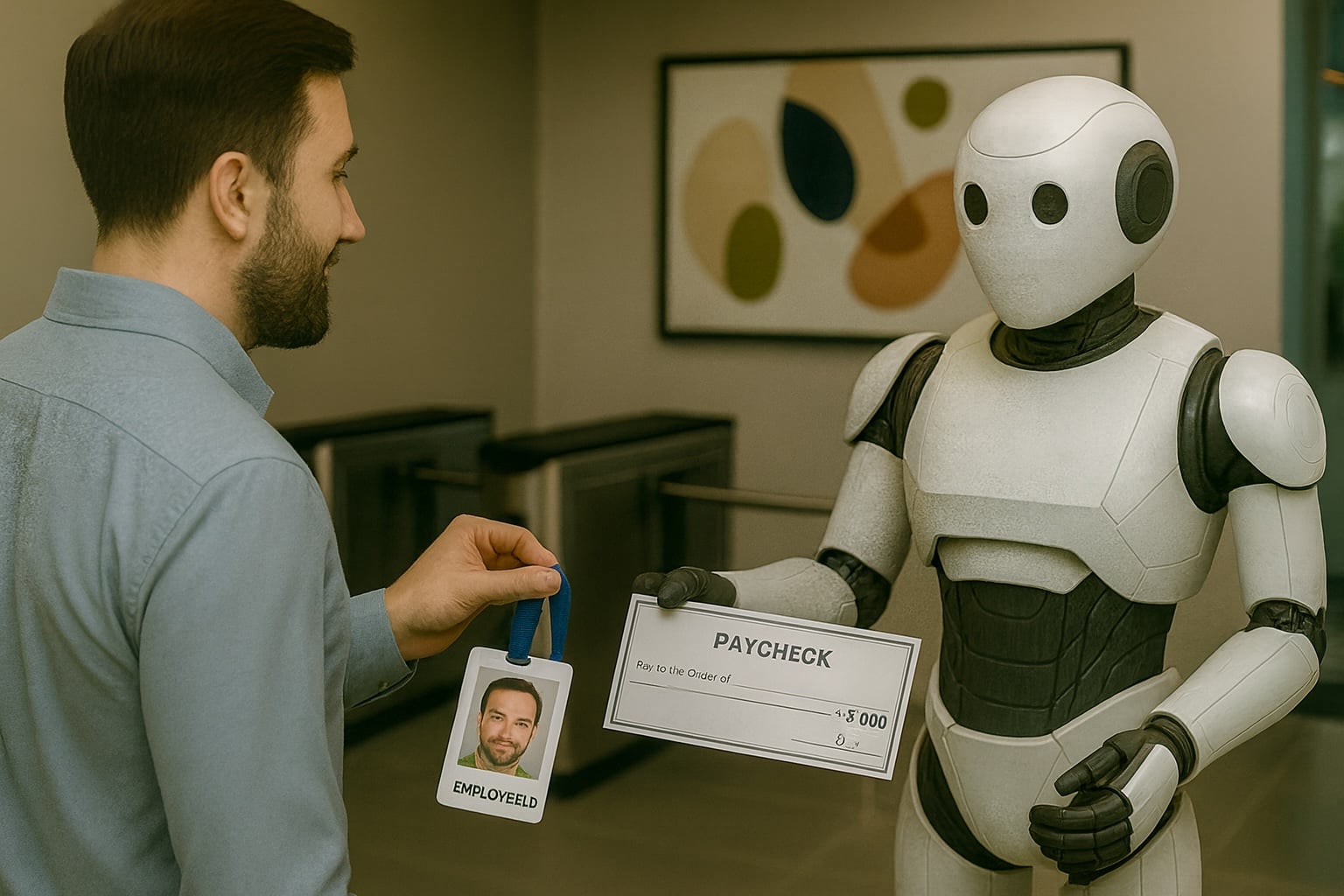
Its appeal is obvious. Imagine you had a digital twin that you could send to the office to do your work, while you collect a paycheck. You’d have leisure. You’d sleep more, see your kids, lift, learn, build. What’s not to like?
And your employer? They’d see a baffling boost in productivity. For the same payout they’d get a version of you that doesn’t doomscroll during Zoom calls, never takes a break, is lightning fast, has a PhD in everything and an IQ of 170. It’s a win-win.
At a time when fear of AI taking our jobs is gathering steam, this flight of fancy begs the question: what’s so terrible with AI working instead of us? Isn’t that what humans have fantasized about since Homer’s Iliad 3,000 years ago? Why anxiety rather than jubilation?
More Work, Less Workers
The first reason may be that our attitude to joblessness is rooted in modern facts rather than ancient myths. In the real world, ‘jobless’ is a synonym for ‘destitute’. Historically, more jobless meant the economy was making less, so there was less to go around, so demand contracted and yet more jobs were lost. The downward spiral led to depression and deprivation.
That chain reaction was true in a world where Talos, Golem, and Homer’s ‘golden handmaids’ were fictional characters. But today’s robots and AIs outperform their mythical forerunners. Our intuitions, forged in the pre-AI era, aren’t helpful for assessing what comes next.
As our ‘digital twin’ thought experiment shows, when our jobs are done by AI, there is more work getting done, not less, so there’s more money in the system, not less. Employers can afford to pay us our full salary and still come out ahead. Far ahead. That means that, with the right policies in place, we could all enjoy much higher standards of living at full unemployment, than at full employment! Counterintuitive, yes; but the math works.
Who owns intelligence?
Which brings us to the second problem: in our hypothetical, we own our doppelganger, so we get paid for its labor. But if our employer has their own supply of super intelligence—which is how things are playing out—they’ll just replace our paychecks with a pink slip, pocketing our salary as their profits. That’s a win-lose.
So it all comes down to this: who should own the fruits of AI’s labor?
In our imagined story, where the AI that replaces you is a perfect incarnation of you, under existing laws you would probably own its work product. Similarly, if it was an amalgam of you and your two friends, the three of you would have a strong collective claim.
But the AI that replaces you won’t be traceable to named individuals—it will be a derivative of all of humanity’s accumulated wisdom. That means that your individual claim dilutes to zero. The good news is that when individual contributions merge into collective works, ownership rights can become collective too: laws like res communis and Cultural patrimony laws treat key natural and cultural artifacts as belonging to everyone.
Today’s powerful models train on the totality of humanity’s intellectual work. Without access to humanity’s rich, collective, heritage, the biggest neural networks in the world would be as dumb as a doorknob, and less useful. When viewed this way, the case that we should all profit from this repackaging of our collective inheritance almost makes itself.
Who pays for pollution?
And there’s another principle at play. When factories make profits by polluting the water, we insist they compensate those harmed. Economists call this the ‘compensation principle’, and it should apply to AI too. Businesses want to boost profits through automation, and so they should, but they have to make whole those harmed by it. Since automation’s gains far exceed the costs of job loss, everyone can end up better off.
If that sounds abstract, let’s spell it out: As AI displaces people, we should increase corporate taxes to fund a guaranteed income for all.
In the hypothetical limit, where 100% of us are replaced by AI, we would have to tax corporations enough to fund the entire national payroll. That sounds onerous, but businesses would still be far better off. After all – today they pay the entire national payroll today for far less! An AI operating 24/7 at 100x human speed could generate 500x the value – making even full payroll-level taxation a bargain.
(Corporate taxation can generate capital-flight, so in practice we may seek international standardization, or to shift some of the tax burden to immovables, like land, estate or consumption.)
Going, going, gone
Calvin eventually stuffed his duplicator back in the closet—but not before learning the central lesson: copies aren’t the problem, control is. The question isn’t whether we’ll be replaced. It’s whether we’ll be bought out or left out. Every system deployed, every job automated, is a vote for who owns the future. We can either scramble for scraps later, or we can claim our share before it is distributed to corporate shareholders.
Technology capable of replacing us is coming—that much is clear. The question is who it works for. Now is the time to make sure it works for us.
Related Topics
Related Posts