
Founder & Principal, Line of State
Europe Buys Israel’s Weapons. Israel Still Builds Its Strategy Around America.
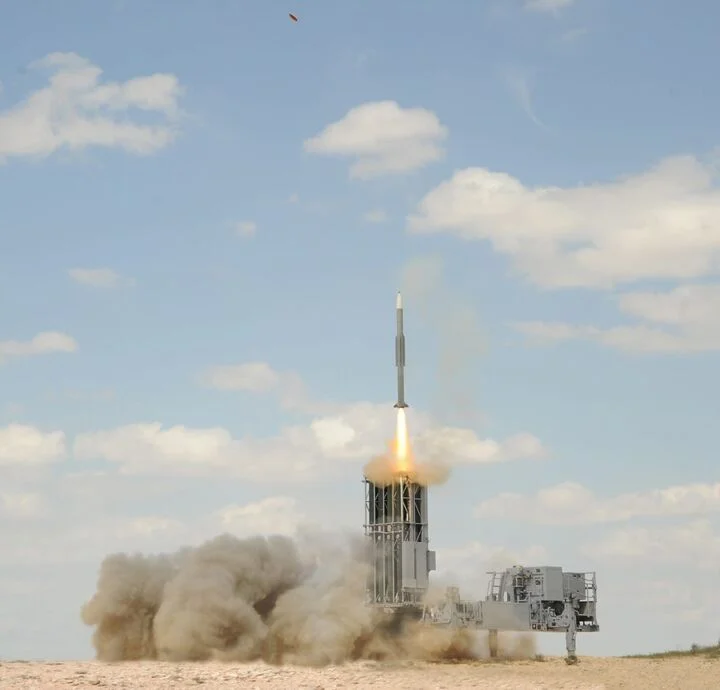
A BARAK MX interceptor launches from a ground-based battery. (Israel Aerospace Industries)
Europe is Israel’s largest defense export market, yet Israel’s industrial strategy remains anchored in America. Shay Gal, former IAI Vice President and Chief of Staff to its Chairman, sets out the alternative: a European industrial architecture with Greece as a principal hub, Israeli intellectual property, independent development and enforceable wartime priority. The obstacle is not demand. It is institutional choice.
In 2025, Israel signed a record $19.2 billion in defense export contracts. Europe accounted for 36 per cent; North America, just 13 per cent. The market shifted. Israeli capital and strategic attention did not.
American industrial activity itself can be misleading. In November 2025, Raytheon-Rafael Protection Systems (R2S), a joint venture between Rafael and America’s Raytheon, secured a $1.25 billion contract to manufacture Tamir interceptors for Iron Dome in Arkansas. The customer, however, was Israel. The technology and demand were Israeli; the production was American.
At Israel Aerospace Industries (IAI), $751 million of its $900 million in North American revenue came from the Aviation Group, principally aircraft conversions, maintenance and components. Work on F-16 and F-15 components likewise constitutes subcontracting within American programs, not the Pentagon’s adoption of an Israeli weapons system.
Europe tells a different story. Approximately $1.28 billion of IAI’s $1.57 billion in European revenue came from its military groups.¹ Even Elbit Systems, which has established a substantial American defence business, generated $2.14 billion in Europe against $1.66 billion in North America.²
National export figures record newly signed contracts; corporate figures record recognised revenue. They are distinct measures, but together reveal the divergence between Israel’s customers and its industrial priorities.
The 2016 US-Israel military assistance memorandum entrenched that divergence. Covering fiscal years 2019–2028, it provides $3.3 billion annually in military financing and another $500 million for cooperative missile defence, while progressively ending Israel’s permission to spend American assistance on domestic production. This exception, known as Offshore Procurement, disappears entirely in 2028.³
In February 2026, Washington formalised the underlying logic through its America First Arms Transfer Strategy: arms transfers would advance American foreign policy, while foreign purchases and capital would expand American production and capacity.
America designed a policy for its own industry. Israel’s failure was to finance that policy as though it were its own.
Israel’s Ministry of Defence made American-funded procurement the default. Executives and boards continued approving US subsidiaries, factories and production transfers even when American demand could not justify the investment. Instead of demand and return, they measured presence.
Worse is what never reaches the decision-making table. Alternatives to American dependence, including independent development, European partnerships and alternative production arrangements, arise within defence companies only to be stopped before reaching the Ministry of Defence. Not because they were examined and rejected, but because rejection is foreordained.
The result is a veto without a decision, without a vote, without minutes. Management censors itself; the state need not formally object. Institutional cowardice manufactures dependence and forecloses dissent.
Behind that veto lies an obsolete conception: America is strategy; Europe is a market.
Washington can choose its theatres, redirect forces towards the Indo-Pacific and regard Turkey as a strategic asset where Jerusalem sees a threat. Israel and Europe cannot escape their geography. The Mediterranean and Red Seas, energy routes, trade corridors, communications infrastructure and threats from Iran and Russia already bind them within a common security environment.
Germany acquired Arrow 3, Israel’s upper-tier ballistic missile defence system, with American approval. In Finland, IAI’s BARAK MX and Rafael’s David’s Sling competed for the same customer. David’s Sling prevailed and also required American approval because it was jointly developed with Washington. Slovakia acquired BARAK MX.⁴
Greece is building a different model. The approximately €3 billion Achilles Shield agreement, signed in August 2026, combines Rafael and IAI systems within a unified Israeli-designed, multilayered air defence architecture, spanning David’s Sling, SPYDER and BARAK MX. Rather than buying isolated batteries, Athens is procuring an integrated defensive framework, alongside Greek industrial participation and technology transfer.
Integration does not erase the American approval requirements attached to individual systems. It establishes a different principle: Israeli capabilities can form the architecture of a European state’s defence, rather than remain separate procurements.
Europe is already converting Israeli technology into European military power. Israel has yet to convert its European market into industrial depth of its own. Its contracts remain disconnected from any common strategy governing capital, ownership, development rights, manufacturing and supply chains.
European politics makes industrial entrenchment essential. Spain has imposed a legal embargo on defence trade with Israel. France restricted Israeli participation at Eurosatory. Italy suspended the automatic renewal of its bilateral defence cooperation agreement.⁵
The answer is not another public relations campaign over an exhibition stand. At the 2025 Paris Air Show, black partitions concealed Israeli displays, prompting President Isaac Herzog to liken the barriers to an “Israeli ghetto.” In June 2026, organisers again boarded up Israeli stands at Eurosatory. Israeli exhibitors said they had complied with French restrictions; organisers disputed their account.⁶
A black wall is not a ghetto. The Holocaust is not rhetorical ammunition for an arms fair.
Israel must instead become embedded in European employment, suppliers, production and capital, so that excluding Israeli industry also imposes costs on European interests.
A deal generates revenue. An architecture creates stakeholders.
The European Union’s Security Action for Europe program, known as SAFE, makes the distinction urgent. It provides up to €150 billion in long-term loans to member states for defence procurement and industrial reinforcement.
Under its rules, components originating outside the EU, the European Economic Area’s EFTA states and Ukraine cannot exceed 35 per cent of the estimated component cost of the end product. For sensitive systems, including air and missile defence, contractors must also possess the legal authority to define, adapt and develop the procured design without restrictions imposed by third countries, including the ability to replace restricted components.⁷
Even an EU-established company under Israeli control may participate, subject to security screening, mitigation measures or prescribed guarantees. Israeli ownership is not automatically disqualifying. Neither does a European address confer eligibility.
SAFE requires genuine industrial substance: management, facilities, production, components and development rights. It finances European industrial capacity, not merely foreign equipment delivered through a European subsidiary.
Every new Israeli defence investment in America should therefore require an identifiable customer, credible procurement demand and measurable value retained in Israel. Without these, it competes directly with European investment that already has a market and a potential route into SAFE-backed procurement.
The first priority is multilayered air and missile defence.
Iron Dome, David’s Sling and Arrow depend on the United States to varying degrees. American financing, joint development, manufacturing, critical components and export approvals have contributed to Israel’s defensive strength. Yet when these dependencies accumulate with one ally, a formal veto becomes unnecessary. Dependence itself becomes an authorisation regime.
Israel needs a parallel architecture that progressively makes American dependence optional: a short-range layer capable of wartime production without American funding or capacity; a medium-range layer Israel can manufacture and export without American approval; and an upper-tier layer it can develop, expand and sell independently or with European partners.
The existing jointly developed systems remain. But they become a choice, not a condition.
Israel has already demonstrated the principle.
BARAK 8 emerged from extensive cooperation with India, including its Defence Research and Development Organisation, creating expertise, infrastructure and a market for IAI. The company subsequently developed and financed BARAK MX independently, retaining greater freedom over the next generation.⁸
The partnership was a springboard, not a lock.
Europe requires the same discipline. Local manufacturing and technology transfer are necessary, but pre-existing Israeli intellectual property must remain Israeli. Development rights must be agreed before transfer, distinguishing the European partner’s authority to adapt the procured system from ownership of the underlying Israeli technology. Israel must retain its ownership interests, royalties, lifecycle support revenues and participation in subsequent generations.
That distinction is essential under SAFE. European partners must possess sufficient design authority to meet the programme’s requirements, without unnecessarily extinguishing Israel’s rights to its existing technology or future developments. What belongs to whom, who may modify it, who may export it and who earns from its successors must be settled contractually, not negotiated after production has moved.
Nor does Israel need a factory in every European country. It needs a few substantial hubs.
It already has footholds across the continent. Greece could become a principal centre: an established customer, an integrated architecture through Achilles Shield and an industrial base capable of supporting wider European demand. Cyprus adds another EU member state within the same strategic geography, with defence requirements of its own and access to European financing mechanisms.
Such hubs can concentrate development, manufacturing, maintenance and capital rather than scatter them across isolated national investments.
But Europe’s industrial base must also serve Israel in war.
Foreign demand can finance capacity that Israel could not economically maintain alone in peacetime. Israeli priority, reserved output and the right to redirect production must be written into contracts beforehand, with the necessary governmental authorisations secured rather than assumed.
A European factory that serves its European customers but cannot supply Israel when war begins is an export asset, not strategic depth.
Time Is Not on Israel’s Side
Europe is not waiting. Since Russia’s invasion, it has rapidly integrated Ukraine into its defence industrial system.
Kyiv brings precisely the advantage on which Israel’s defence reputation was built: fresh battlefield experience, short development cycles and the ability to turn frontline requirements into deployable technology. Europe is already financing that integration through joint production, innovation programmes and defence industrial partnerships.
Ukraine is not simply another competitor. It is becoming a source of battlefield-driven technology within the European industrial system itself.
If Israeli defence companies do not enter European production now, Europe will not wait for them.
It is already building the alternative.
–
This English version, adapted and expanded by the author, is based on an article originally published in Hebrew in Walla Money on October 12, 2026, under the title “אירופה הפכה ללקוחה הראשית של הנשק הישראלי, אז למה אנחנו עדיין מרוכזים באמריקה?”
–
Related by the same author:
- “What Washington Gives – and What It Takes in Return”, Israel Defense, February 1, 2026.
- “Europe’s Missile Illusion: The Gulf Lesson”, The Times of Israel, March 6, 2026.
- “Nasdaq Can Value IAI and Rafael. It Must Not Price Israel’s Freedom of Action”, The Times of Israel, July 20, 2026.
- “Israel Must Stop Competing Against Itself Before It Lists IAI and Rafael”, The Times of Israel, August 12, 2026.
- “Israel Owns the Factory. It Still Does Not Own the Next Interceptor.”, The Times of Israel, September 9, 2026.
–
[1] Israel Aerospace Industries, Consolidated Financial Statements for 2025, Note 33(c), p. 109. North American revenue totalled $900 million, including $751 million from the Aviation Group. European revenue totalled $1.569 billion, including $1.280 billion from the military groups.
[2] Elbit Systems, “Fourth Quarter and Full Year 2025 Results”, geographical revenue breakdown. European revenue reached $2.1395 billion; North American revenue reached $1.6593 billion.
[3] Congressional Research Service, U.S. Foreign Aid to Israel, discussion of the 2019–2028 memorandum and the phase-out of Offshore Procurement. The MOU provides $3.3 billion in annual Foreign Military Financing and $500 million for cooperative missile defence, with Offshore Procurement scheduled to end in fiscal year 2028.
[4] Israel Ministry of Defense, “German Approval of the Commitment to Initiate Necessary Steps to Acquire Arrow 3”, June 15, 2023; US approval of Finland’s David’s Sling procurement, August 2, 2023; and delivery of BARAK MX to Slovakia, April 23, 2026.
[5] Government of Spain, arms embargo announcement, September 23, 2025; Israel Ministry of Defense, Eurosatory 2026 participation restrictions, June 2, 2026; ANSA, Italy’s suspension of the automatic renewal of its defence cooperation agreement, April 14, 2026.
[6] The Times of Israel, “Israeli Defense Industry Booths Walled Off at Leading French Arms Exhibition”, June 15, 2026; AFP, “Armements: l’accès à des stands israéliens à nouveau interdit lors d’un salon en France”, June 15, 2026. The Israeli Defence Ministry maintained that exhibitors had complied with French conditions; organiser Coges Events cited non-compliance.
[7] Council of the European Union, Regulation (EU) 2025/1106 establishing SAFE, May 27, 2025, Article 16(3)–(11). The regulation sets geographical, control and security conditions, permits qualifying EU-established companies under third-country control subject to safeguards, limits non-qualifying component costs to 35 per cent and establishes design-authority requirements for specified defence categories.
[8] Government of India, Press Information Bureau, “BARAK Missile System”, February 3, 2017, confirming joint Indian-Israeli development; Israel Aerospace Industries, BARAK 8 cooperation with India, October 2018; and IAI, BARAK MX Integrated Air and Missile Defence System.
Related Topics