
London based entrepreneur, cybersecurity analyst doing a PhD in AI
AI, Humans and Industrial Change.
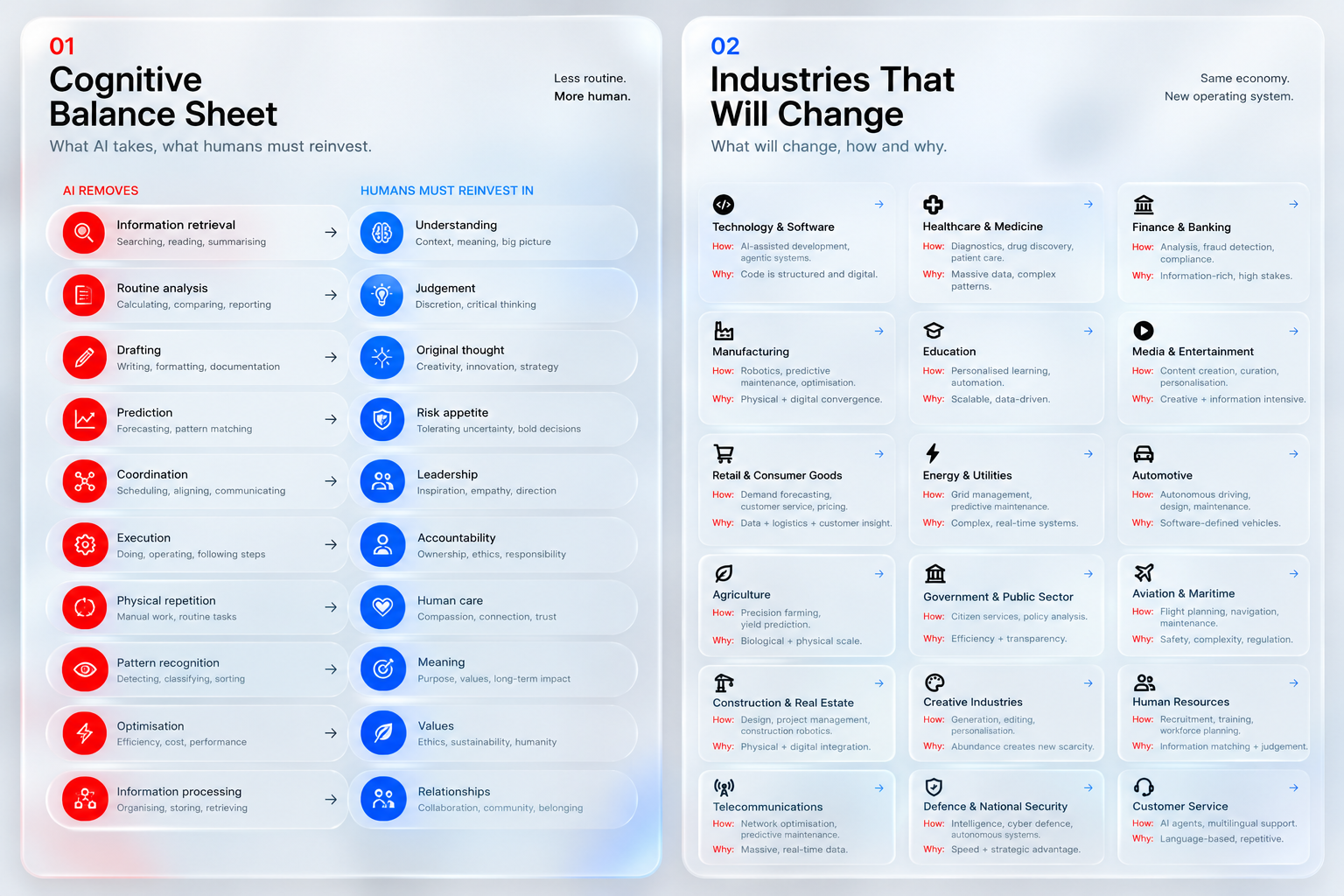
The Cognitive Balance Sheet
What happens when the amount of useful cognition available from machines becomes extremely large?
We need to start thinking about it as a new participant in the allocation of cognitive labour.
That is what I call the Cognitive Balance Sheet.
The Cognitive Balance Sheet
The Cognitive Balance Sheet is not literal accounting.
AI increasingly allows us to offload cognitive work:
Information retrieval
→ Summarisation
→ First drafts
→ Routine calculation
→ Comparison
→ Organisation
→ Formatting
That creates a cognitive saving.
Some of the capacity can be reinvested:
Deeper understanding
→ Critical analysis
→ Synthesis and insight
→ Learning and expertise
→ Verification and judgement
→ Creativity and original thinking
The distinction becomes increasingly important as AI becomes more capable.
Because the more cognition we can outsource, the more important it becomes to decide which cognition should not be outsourced.
The Cognitive Balance Sheet Changes With Capability
Imagine three stages.
Stage One: AI as Tool
The human remains firmly in control.
I ask:
“Summarise this document.”
The AI responds.
I decide what to do.
Human intention → AI assistance → Human judgement
Stage Two: AI as Agent
Now I say:
“Find the relevant documents, analyse them, prepare the report and send it to the team.”
The machine may perform multiple operations.
The cognitive saving becomes larger.
But so does the governance problem.
The AI now needs tools, permissions, boundaries and escalation rules.
Stage Three: AGI or More Capable Autonomous Systems
Imagine a system capable of outperforming most employees across a wide range of intellectual work.
It might plan, research, code, negotiate, optimise and coordinate.
The question changes from:
How should I prompt it?
to:
Which decisions should remain human?
Which powers should never be granted merely because a system is intelligent enough to exercise them?
That is why the Cognitive Balance Sheet eventually becomes a Governance Balance Sheet.
We are allocating not merely thought.
We are allocating:
Cognition + Access + Authority + Responsibility.
Prompting Is the First Governance Layer
At the individual level, governance begins surprisingly simply.
It begins with the prompt.
The more clearly we can delineate what we want from what we do not want, the order of the process, the boundaries of the task and the required output, the less unnecessary inference we delegate to the machine. The operative word is specificity.
For high-quality prompts, tools such as WisePrompts on iOS, Fahm.uk, and other prompt-structuring systems can help convert ordinary language into a clearer specification.
But no prompting technique eliminates the fundamental problem:
a perfectly instructed AI can still be wrong.
Moving from “what happens to human cognition?” to “what happens to the economy?”
The Industries AI Will Change
The Cognitive Balance Sheet does not stop at the individual worker.
The important question is not:
Which industries will AI affect?
Almost all of them.
The better question is:
What part of the industry’s value chain moves from human cognition to machine cognition—and what becomes more valuable because of that shift?
1. Technology & Software
What changes:
Software development moves from writing code line-by-line toward specifying systems, reviewing generated code, testing, architecture and managing AI agents.
Why:
Code is unusually compatible with AI because it is structured, digital, testable and executable.
The programmer increasingly becomes the architect and verifier, rather than the typist.
The future software engineer may say:
“Build this system.”
rather than:
“Write these 2,000 lines of code.”
This is one of the sectors where the Cognitive Balance Sheet is clearest: AI removes enormous amounts of implementation friction, making system understanding and architectural judgement more important.
The WEF lists software and applications developers among the fastest-growing occupations toward 2030, even while AI changes how software is produced. (World Economic Forum)
2. Cybersecurity
What changes:
Security moves from humans manually analysing alerts toward AI continuously monitoring networks, software, identities, models and behaviour.
Why:
The scale and speed of cyberattacks exceed human monitoring capacity.
But there is a paradox.
AI will simultaneously become:
the defender and the attack surface.
AI can detect anomalies, generate threat intelligence and test systems adversarially.
But malicious actors can use AI to automate reconnaissance, social engineering, vulnerability discovery and attacks.
Cybersecurity therefore becomes an AI-versus-AI environment.
The new security question becomes:
Can defensive AI predict what offensive AI is going to do?
3. Banking & Financial Services
What changes:
Research, financial analysis, customer service, compliance, fraud detection, underwriting, reporting and investment research become increasingly AI-mediated.
Why:
Finance is fundamentally an information industry.
It contains enormous quantities of:
- structured data;
- documents;
- transactions;
- regulations;
- historical patterns;
- customer information;
- financial models.
AI can process these at extraordinary scale.
But the Cognitive Balance Sheet creates a new division of labour:
AI: analysis, monitoring, pattern recognition.
Human: risk appetite, fiduciary judgement, ethics, accountability and decisions under uncertainty.
The greatest danger is therefore not simply AI making a bad prediction.
It is many institutions making the same AI-mediated prediction simultaneously.
That creates systemic risk.
4. Insurance
What changes:
Underwriting, claims processing, fraud detection, pricing and risk assessment become increasingly automated.
Why:
Insurance is essentially the mathematics of uncertainty.
AI can analyse enormous quantities of information to estimate risk.
But it also changes the risk itself.
If every insurer uses similar models, correlated errors can emerge.
And if AI becomes better at predicting individual behaviour, society faces difficult questions around:
What should be predictable?
What should remain private?
What should never determine access to essential services?
The insurer of the future may therefore be partly an AI company—and partly a governance institution for algorithmic risk.
5. Legal Services
What changes:
Legal research, document review, contract analysis, discovery, drafting and case preparation become heavily AI-assisted.
Why:
Law contains enormous quantities of language, precedent and structured reasoning.
AI can search and compare legal material at a scale no individual lawyer can match.
The lawyer’s Cognitive Balance Sheet consequently shifts toward:
- interpretation;
- strategy;
- negotiation;
- advocacy;
- ethical judgement;
- client relationships;
- and responsibility.
The junior lawyer’s traditional apprenticeship—spending years doing repetitive document work—may be disrupted.
That creates a major educational question:
How do you become an expert when AI performs the beginner’s work?
6. Accounting & Audit
What changes:
Bookkeeping, reconciliation, reporting, document extraction, compliance checks and anomaly detection become increasingly automated.
Why:
Accounting is highly structured information processing.
But auditing illustrates the importance of verification.
AI can identify anomalies.
It cannot simply be permitted to certify its own conclusions.
The auditor increasingly becomes the person who asks:
What did the system miss?
That means the profession evolves from checking numbers toward checking systems that produce numbers.
7. Consulting & Professional Services
What changes:
Research, market analysis, benchmarking, slide creation, financial modelling and report writing become dramatically faster.
Why:
Much of professional consulting consists of assembling information into an argument.
AI can compress that process.
The scarce resource therefore shifts from:
information
to
judgement.
The consultant’s competitive advantage becomes the ability to identify the right problem, not merely produce an impressive answer.
8. Healthcare & Medicine
What changes:
Diagnostics, medical imaging, clinical documentation, drug discovery, patient triage, personalised medicine and administrative work.
Why:
Medicine produces extraordinary quantities of information.
AI can compare symptoms, images, medical literature and patient histories at scale.
But medicine contains something AI cannot simply automate:
the human relationship with illness.
Doctors will increasingly become interpreters and decision-makers operating alongside AI.
The question becomes:
Does AI make the doctor less necessary—or make a good doctor vastly more capable?
The answer will vary by task.
9. Pharmaceuticals & Life Sciences
What changes:
Drug discovery, molecular modelling, clinical-trial design, literature review and biological research.
Why:
AI can search enormous biological possibility spaces.
Instead of asking:
“Which molecule should we test?”
researchers can increasingly ask:
“Search millions of possibilities and identify the most promising candidates.”
The laboratory remains essential.
But AI dramatically expands the number of hypotheses humans can investigate.
This is one of the clearest examples of AI expanding the frontier of human science rather than merely automating labour.
10. Scientific Research
What changes:
Literature review, hypothesis generation, simulation, coding, data analysis and experimental design.
Why:
Science is fundamentally an information-processing system.
AI can increasingly become a research assistant capable of reading enormous scientific corpora and connecting ideas across disciplines.
The scientist’s scarce contribution moves toward:
What question should we ask?
That may become more important than:
How quickly can we calculate the answer?
11. Education
What changes:
Tutoring, lesson preparation, personalised exercises, assessment and administrative work.
Why:
Education traditionally requires one teacher to serve many students.
AI potentially gives every student a personalised tutor.
But this creates the Cognitive Balance Sheet again.
If students use AI merely to produce answers, they lose learning.
If they use it to interrogate ideas, receive explanations, test themselves and challenge assumptions, AI becomes a cognitive multiplier.
The teacher therefore becomes less of an information distributor and more of a:
mentor, evaluator, motivator and architect of learning.
12. Media, Journalism & Publishing
What changes:
Research, transcription, translation, editing, summarisation, image creation, video generation and increasingly news production.
Why:
Media is overwhelmingly information and language.
But this creates a new scarcity:
trust.
When anyone can generate an article, photograph or video, the value of verified provenance increases.
The media organisation of the future may therefore sell less information and more credibility.
13. Advertising & Marketing
What changes:
Copywriting, creative production, customer segmentation, personalisation, campaign testing and media optimisation.
Why:
AI can generate thousands of creative variations and test them continuously.
The marketer becomes less of a producer and more of an orchestrator of attention.
But this is also where the “intention multiplier” becomes dangerous.
AI can personalise persuasion at unprecedented scale.
That makes psychological safeguards particularly important.
14. Retail & Consumer Goods
What changes:
Customer service, merchandising, demand forecasting, inventory, advertising, pricing and shopping interfaces.
Why:
Retail combines information processing with physical logistics.
AI can understand the customer while simultaneously optimising inventory and supply.
McKinsey estimates particularly large potential value from GenAI in retail and consumer packaged goods, including customer service, marketing, sales and supply-chain activities. (McKinsey & Company)
The store itself therefore becomes increasingly intelligent.
15. Manufacturing
What changes:
Design, quality control, predictive maintenance, robotics, supply-chain optimisation and production planning.
Why:
Manufacturing is where AI begins crossing from the digital world into the physical world.
The combination is powerful:
AI + robotics + sensors + industrial automation.
AI determines what should happen.
Robotics performs it.
Sensors report what happened.
AI adjusts the next action.
This is the beginning of genuinely autonomous production systems.
16. Automotive
What changes:
Vehicle design, manufacturing, autonomous driving, predictive maintenance, fleet management and in-car assistants.
Why:
The automobile is becoming a software-defined machine.
The competitive advantage increasingly shifts from:
engine + transmission
toward:
compute + sensors + software + AI.
Autonomous vehicles could eventually transform transportation economics.
17. Logistics & Supply Chains
What changes:
Routing, warehousing, demand forecasting, inventory, procurement and autonomous delivery.
Why:
Logistics is an optimisation problem.
AI can continuously calculate enormous numbers of possible routes and decisions.
The next stage combines this with robotics and autonomous vehicles.
The supply chain becomes an adaptive nervous system rather than a sequence of manually coordinated operations.
18. Aviation
What changes:
Flight planning, maintenance, air-traffic optimisation, training, customer service and eventually increasing autonomy.
Why:
Aviation is simultaneously:
- information intensive;
- safety critical;
- highly regulated;
- increasingly automated.
AI therefore has enormous potential—but requires exceptionally strong verification.
A hallucination in an email is inconvenient.
A hallucination in an aircraft-control system is catastrophic.
19. Maritime & Shipping
What changes:
Route optimisation, predictive maintenance, autonomous navigation, port operations and cargo management.
Why:
Ships operate in complex environments with enormous amounts of sensor and logistical data.
AI can optimise routes and detect mechanical anomalies while autonomous systems increasingly manage navigation.
The industry moves toward semi-autonomous and eventually autonomous logistics.
20. Agriculture
What changes:
Crop monitoring, disease detection, irrigation, autonomous machinery, yield prediction and precision agriculture.
Why:
Agriculture combines biological complexity with enormous physical scale.
AI can analyse satellite imagery, soil data, weather patterns and plant conditions.
Robotics can then act upon the information.
The farmer becomes increasingly a manager of biological systems augmented by machines.
21. Energy & Utilities
What changes:
Grid management, demand forecasting, predictive maintenance, energy trading, exploration and optimisation.
Why:
Energy systems are massive optimisation problems.
As grids become more distributed—with solar, batteries, electric vehicles and variable generation—the coordination problem becomes dramatically more complex.
AI becomes the intelligence coordinating the grid.
22. Oil, Gas & Mining
What changes:
Exploration, geological analysis, predictive maintenance, autonomous equipment and safety monitoring.
Why:
These industries contain enormous quantities of geological, engineering and sensor data.
AI can identify patterns humans would struggle to see.
Robotics can increasingly operate dangerous environments.
The result is potentially less human exposure to hazardous physical work.
23. Construction & Real Estate
What changes:
Architectural design, cost estimation, project management, surveying, property valuation, construction robotics and building management.
Why:
Construction contains both cognitive and physical components.
AI can design and optimise.
Robotics can increasingly build.
Sensors can continuously monitor buildings.
Real estate becomes more data-driven, while construction becomes more automated.
24. Architecture & Engineering
What changes:
Design generation, simulation, optimisation, engineering calculations and documentation.
Why:
AI can explore thousands of design alternatives.
The engineer moves from calculating one solution toward evaluating a design space.
Creativity becomes less about drawing the first design and more about curating.
25. Telecommunications
What changes:
Network optimisation, customer service, predictive maintenance, cybersecurity and infrastructure planning.
Why:
Telecommunications already operates as a giant computational system.
AI can continuously optimise networks based on demand and faults.
Eventually networks become increasingly self-healing.
26. Media & Entertainment
What changes:
Film, television, music, games, animation, special effects and personalised entertainment.
Why:
Generative models dramatically reduce production costs.
A small team may eventually produce what previously required a studio.
But abundance creates a new scarcity:
attention and originality.
When everyone can create, the creator’s ability to create something worth caring about becomes more valuable.
27. Gaming
What changes:
Game development, NPC behaviour, world generation, dialogue, testing and personalised experiences.
Why:
There is no need to dwell on this. It’s a waste of human life. The only games that should be allowed are those that help cognitive development guard railed with functional and useful things like STEM education, developing human empathy and better societies.
28. Travel, Hospitality & Tourism
What changes:
Booking, itinerary creation, customer service, translation, pricing, hotel operations and personalised travel.
Why:
Travel involves massive amounts of fragmented information.
AI can assemble the entire journey around an individual’s preferences.
The human value shifts toward hospitality itself—the experience of being cared for.
29. Government & Public Administration
What changes:
Forms, case management, citizen services, translation, policy analysis, tax administration and public-sector knowledge management.
Why:
Government contains enormous bureaucratic information flows.
AI can dramatically reduce administrative friction.
But government cannot outsource legitimacy.
A citizen must ultimately be able to ask:
Why did the state make this decision about me?
Explainability and human accountability therefore become essential.
30. Defence & National Security
What changes:
Intelligence analysis, logistics, cyber defence, simulation, surveillance, autonomous systems and decision support.
Why:
Modern warfare is increasingly an information contest.
AI compresses the time between:
detect → analyse → decide → act.
This is simultaneously one of AI’s greatest strategic opportunities and one of its greatest dangers.
The faster the loop becomes, the greater the danger that humans lose meaningful decision time.
31. Policing & Security
What changes:
Investigation, video analysis, fraud detection, intelligence analysis and emergency response.
Why:
AI can process information that no human team could analyse manually.
But this is a sector where the Cognitive Balance Sheet must be accompanied by a rights balance sheet.
False positives can affect liberty.
Biased data can reproduce historical discrimination.
Predictive systems can create feedback loops.
Therefore:
capability without due process is not progress.
32. Human Resources & Recruitment
What changes:
CV screening, job descriptions, interviewing, employee support, training and workforce planning.
Why:
Much of HR is information matching.
AI can match skills to roles and personalise learning.
But hiring is also a social judgement.
The risk is that organisations automate historical preferences and call the result “objectivity.”
33. Customer Service
What changes:
A massive transformation.
Why:
Customer service is highly language-based, repetitive and information-rich.
AI agents can potentially operate continuously, across languages and across millions of interactions.
The human employee increasingly handles:
exceptions, emotional situations, negotiation and escalation.
34. Real-Time Translation & Language Services
What changes:
Translation, interpretation, transcription and localisation.
Why:
Language models can translate at enormous scale.
This could reduce one of the oldest barriers between societies.
But high-stakes interpretation—law, diplomacy, medicine—still requires verification.
35. Creative Industries
What changes:
Writing, illustration, photography, design, music and video.
Why:
The marginal cost of producing a creative artefact approaches zero.
That means creativity becomes abundant.
And when creativity becomes abundant, taste becomes scarce.
The human advantage moves from producing every component to deciding:
What deserves to be made?
36. Scientific & Technical Engineering
What changes:
Simulation, CAD, optimisation, research and technical documentation.
Why:
AI can search enormous design spaces and identify solutions humans might never manually investigate.
This could accelerate aerospace, materials science, electronics and industrial engineering.
37. Insurance, Healthcare, Finance and Other High-Stakes Sectors
These deserve a category of their own.
Because here the question is not merely:
Can AI perform the task?
It is:
Who carries the liability when it is wrong?
That question will become one of the defining questions of the AI economy.
38. Physical Labour Itself
And finally comes the category that is easiest to underestimate.
Today, generative AI primarily attacks cognitive friction.
But AGI combined with robotics could attack physical friction.
That changes:
- construction;
- agriculture;
- warehousing;
- manufacturing;
The economic transformation becomes much larger once intelligence can move through the physical world.
Related Topics
Related Posts