AI, Pharaoh, and the fight for the human soul
As artificial intelligence rises at breathtaking speed, we are witnessing a global wave of fear, eagerly amplified by thinkers from many different fields. The celebrated Israeli historian Yuval Noah Harari, for example, laments on his online platform Future of Being, in a series of talks, that “within just six years, almost everything you consider normal, stable, and lasting in your daily life will simply cease to exist.” Harari casts himself as a prophet warning us of an approaching apocalypse. He asks: “What happens to the idea of personal choice? How do we preserve any sense of autonomy when we are constantly being optimized by algorithms?” In his view, we are witnessing “the end of a distinct geological epoch in human history,” one in which Homo sapiens was the sole bearer of intelligence.
The Prophet of Materialism
Harari’s observations are often brilliant. But the philosophical structure he builds around them is deeply misleading. A close reading of his earlier books shows that these “warnings” are, in fact, a kind of disguise. In his foundational work Sapiens, Harari presents human history as the product of blind evolutionary forces. He denies the existence of any true subject — divine or human — endowed with genuine agency and free will. So when he looks at AI, he does not really see a tragedy. He sees confirmation.
In Harari’s worldview, humanity was never truly in a position to compete with AI in the first place. That helps explain the almost triumphant undertone in his apocalyptic vision of the end of “humanity as we know it.” At bottom, his message is: I told you so. There is no human spirit. There never was.
I believe the opposite. Far from signaling the end of humanity, the breakthrough of AI offers our society a rare opportunity for spiritual and religious renewal. By radically expanding our cognitive tools, AI may finally force us to distinguish more clearly between intelligence as instrument and the agency of the human subject.
Is AI really “the greatest revolution in human history”? I doubt it. It represents another step in the long scientific-technological march of quantity over quality. Yes, AI processes data and recognizes patterns faster than any human being. But there is nothing fundamentally new about that. For decades, even a simple hard drive has been able to store more information than a human brain could ever hold.
AI and Torah
What, then, does all this have to do with Torah? And what does it have to do with Passover? Quite a lot.
If AI were truly poised to replace human agency, it would reveal itself as an incarnation of the biblical Tree of Knowledge. Like the primordial serpent in Eden, the prophets of AI offer human beings the illusion of omnipotence and immortality: “You shall surely not die … but shall be like God” (Genesis 3:4–5). In other words: upgrade your processing power, and you become divine.
To grasp the existential challenge of AI, we should look not to Silicon Valley, but to biblical Egypt. That ancient empire was built on slavery and the ruthless exploitation of human beings reduced to instruments of material gain. We were reminded of that worldview only recently, when the deaths of countless workers during construction for the 2022 World Cup in Qatar were effectively treated as an acceptable price.
Pharaoh, the Biblical Darwinist
Biblical Egypt represents the ultimate materialist empire, and Pharaoh is its Darwinian priest. He believes it is his natural right to enslave the weak in the service of accumulating wealth (see Exodus 1:11). Moses, by contrast, stands for the values of the Eternal, rooted in the biblical principle that every human being, as bearer of the divine Anochi — the “I,” the self — possesses an inviolable worth.
The confrontation between Israel and Egypt stages a clash between two opposing worldviews. Pharaoh appears as an embodiment of the primordial serpent, tempting humanity to prefer the power of information, flow, and accumulation — the Tree of Knowledge — over the true self, the Tree of Life. Pharaoh proclaims: “The Nile is mine, and I made myself” (Ezekiel 29:3). This denial of the fundamental contingency of existence is one of the most radical expressions of human arrogance. By denying his own origin, Pharaoh elevates the fulfillment of his desires into the only valid principle of life.
When Moses confronts Pharaoh, the dictator responds with genuine shock: “Who is the Eternal, that I should obey Him? … I know not the Eternal” (Exodus 5:2). His cry comes from the depths of his being. Elohim — the divine source of nature and its deterministic laws — Pharaoh may know. But Hashem, the Eternal, he does not know. And because he does not know the Eternal, he cannot recognize the uniqueness of the human being, whose body and soul bear that name. He remains trapped in the narrowness — meitzar — of Egypt, Mitzrayim, unable to escape the prison of deterministic thought.
The Real and the Fake
Harari’s a priori materialist reduction of the human being leads him to another conclusion: because AI’s linguistic and artistic output is increasingly indistinguishable from human speech and creativity, AI will defeat Homo sapiens not only intellectually, but creatively as well.
I see the opposite. AI presents us with a remarkable opportunity to rediscover the authenticity of language and art — an authenticity already under assault long before the arrival of artificial intelligence.
Take music. For years, most people have consumed it first through CDs and then through digital streaming. Only a small minority still retains a living awareness that real music is played by musicians. Fewer still occasionally make the effort to attend a chamber concert and experience music up close. But those few will not be confused by AI-generated music. They know how authenticity is recognized: through one’s own embodied, soulful response — not only to the timbre of an instrument, but to the unique physical, emotional, and spiritual aura of the human being playing it.
Staff and Serpent: Defining the Tool
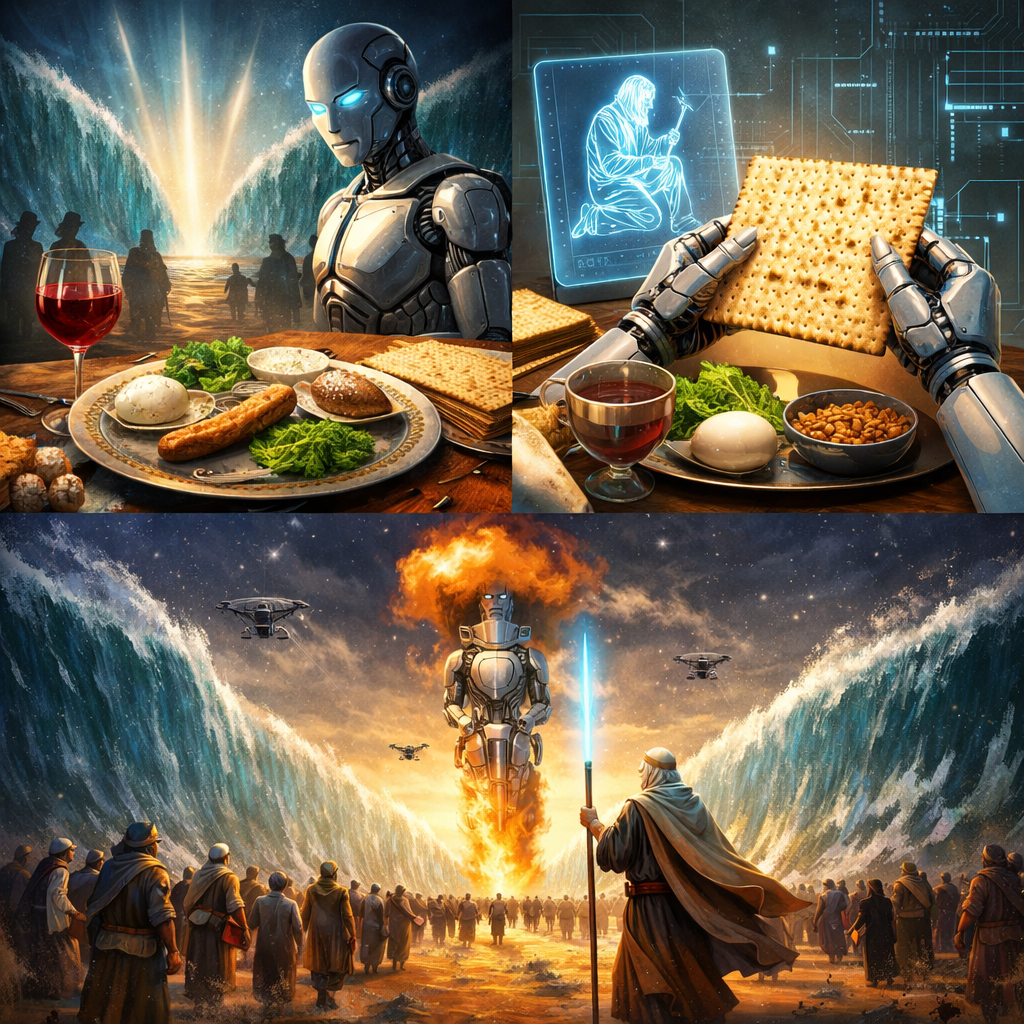
The confusion between the authentic and the merely reproduced did not begin with the “AI revolution.” Already in the 1930s, Walter Benjamin argued in his classic essay The Work of Art in the Age of Mechanical Reproduction that the unique “aura” of a work of art can only be encountered in the embodied presence of the original. But long before Benjamin, the Bible explored the same tension in the confrontation between Moses and Pharaoh’s magicians, the chartumim. Moses performs wonders at the royal court — acts that, in biblical symbolism, may be understood as the breakthrough of the divine subject into the objective world. Yet the Egyptian magicians “did the same” (vaya’asu ken — Exodus 7:22). It looked real — but it was false.
What AI does is push this familiar confusion to an unprecedented extreme. Thinkers like Harari worry that AI may perfectly simulate empathy. And indeed, the genuine and the brilliantly counterfeit are sometimes separated by no more than a hair’s breadth. To sense the difference requires a sensitivity that must be cultivated. A chatbot may sound like a subject — but it is not one. It undergoes no experience and reflects on nothing. Because it is not a subject, it possesses no agency. And in the face of true agency, even the magicians of Egypt ultimately surrender: “This is the finger of God” (Exodus 8:15).
The decisive image is the transformation of the staff (Exodus 7:8–13). When it is cast down, it becomes a serpent — the biblical symbol of the mindless accumulation of knowledge and data. But when a truthful human being grasps the serpent, it becomes a staff again: a tool in the service of the acting subject. That is what AI, at its best, can be: an advanced tool. The danger lies not in “the machines,” but in their developers and users. And that, of course, is nothing new.
The Two Trees
Harari warns that we are facing not just technological change, but “the possible dissolution of everything that has made human life recognizable.” He fears that we will become “irrelevant.” That fear is justified only if we accept Harari’s materialist worldview — a worldview in which human beings are destined for obsolescence in a blind process of development. AI has changed nothing fundamental. It has merely raised the stakes.
The Zohar teaches that humanity’s tragedy lies in the separation of the Tree of Knowledge from the Tree of Life. Technology without spiritual reflection mutates into a venomous serpent. Religion without science withers into superstition. At their best, however, scientists and theologians can work together in clarifying the scope and limits of their respective callings.
Human purpose belongs to the spiritual and religious realm. The Torah teaches that beyond mere being stands Ehyeh — “I shall be” (Exodus 3:14). The ensouled human being shapes the mode of his existence and confers meaning on experience through reflection. Artificial intelligence may thus help us recover a forgotten truth: what ultimately matters is not encyclopedic knowledge, but the intention “to keep the way of the Eternal, to do righteousness and justice” (Genesis 18:19).
And perhaps that is the hidden blessing of the extraordinary technologies of our age: that they offer us one more opportunity for religious clarification and spiritual renewal.