
Akeidah: Finding a Way in the Dark
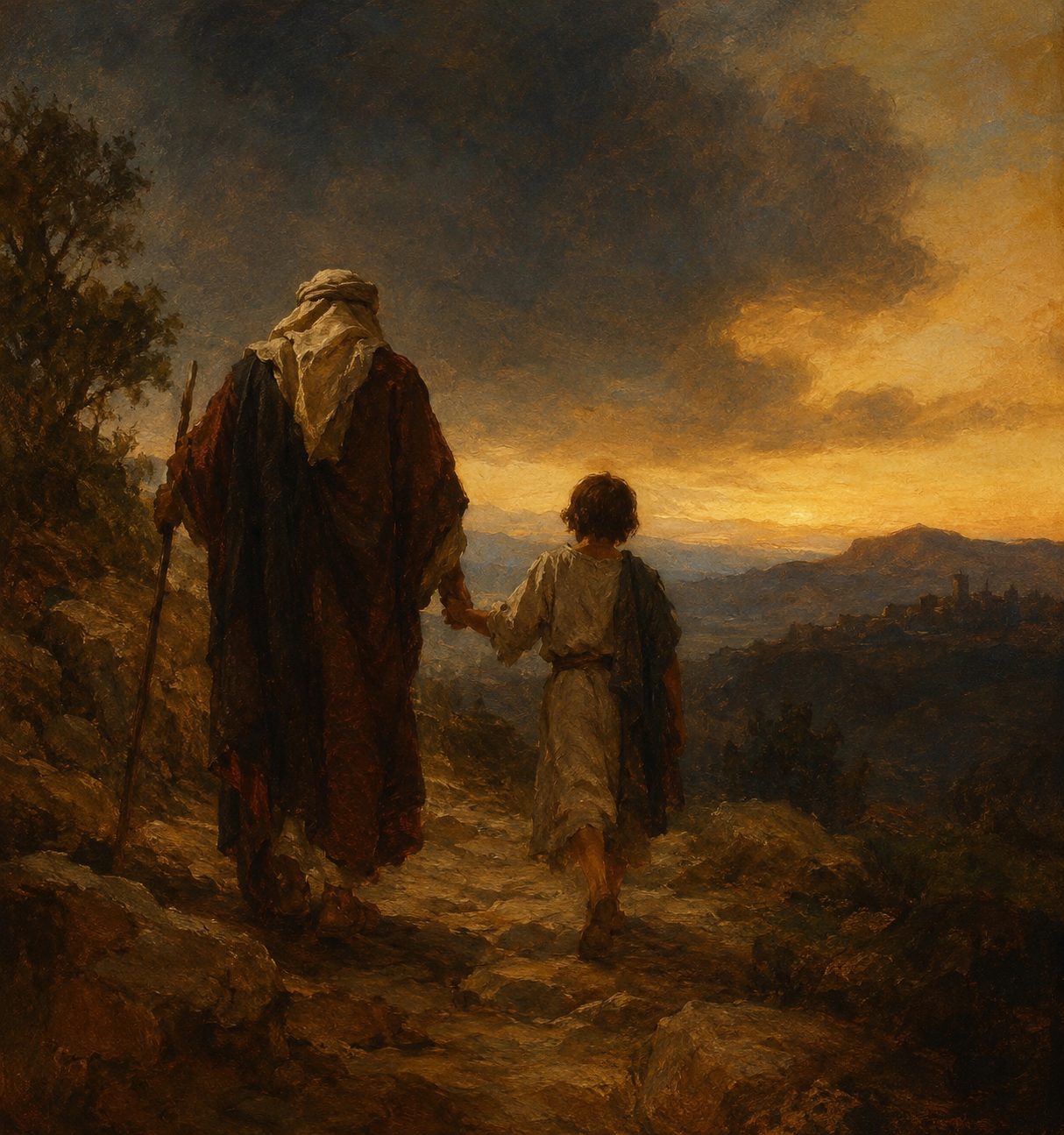
Much ink has been spilled in attempts to understand the Akeidat Itzhak, the Binding of Isaac. How could Avraham, after waiting for a promised son and raising him, simply obey and offer him up as a sacrifice? How can G-d demand this of Avraham? And how can Itzhak comply?
All’s well that ends well. At the last moment, Avraham is told that this was a test, that he passed it, and that now there is a ram that can be offered instead. Avraham returns back to his life, and we are left forever to wonder and piece together what could have happened, what should have happened, and what does this story teach us.
For many, the story gets shoehorned into a nice tidy message: this is simply a test of Avraham’s devotion and Itzhak’s emuna, faith, and they both passed with flying colors. Yet the midrashim preserve the ambivalence. On the way to the location, Itzhak innocently inquires about the glaring lack of an animal suited to be sacrificed. Avraham responds cryptically: Hashem will choose it, as necessary. The text emphasizes twice: וַיֵּלְכ֥וּ שְׁנֵיהֶ֖ם יַחְדָּֽו: they walked together. The simple meaning of the text is that the conversation did not change anything for Avraham and Itzhak: they were a unified front to do G-d’s will, and the terrible revelation with its possible implications of a human sacrifice did not alter anything. Midrash Breshit Rabba states twice in both places: וילכו שניהם יחדיו: זה לעקוד וזה להעקד זה לשחוט וזה להשחט Two of them walked together: this one to bind and this one to be bound, this one to slaughter, and this one to be slaughtered.
In contrast, Midrash Hagadol senses a different tone emerge in the relationship after the conversation. אחז בידו והלכו כאחד–Avraham grabbed Itzhak by the hand and walked with him as one person. According to this Midrash, Avraham fears that if he does not physically hold on to Itzhak, his son will pick himself up and run away. This appears to reflect a much more expected response of a son who realizes that this is not a game or a challenge, but that his own father is ready to carry out the Divine will, even if it conflicts with his own moral instincts.
From a logical perspective, the midrashim are contradictory: either Itzhak is of a united mind with Avraham, or he is conflicted enough to flee, prompting Avraham to physically restrain him. Yet, in my opinion, the midrashim are picking up on a subtle psychological dimension of the parent-child interactions.
Rearing children is not easy and simple. There are good reasons why many parenting books become sparse with clear-cut wisdom and advice once children reach school age. Often, while the parent might want the best for the child, this is not what the child wants for themselves. Conflicts arise as the child differentiates themselves from the parent, and the parents are often caught by surprise when their formerly pliable and compliant offspring begin to refuse to obey and follow what the parents see as the clearly superior path. At a certain point, the parents are left hoping that the values they emphasized while their children were young are strong enough to carry them through as they navigate their own lives and make their own decisions.
The promise made to Avraham that he will have numerous descendants was given twice: once likening the offspring to the dust of the earth, and the second time, likening them to the stars. I believe that the two promises suggest two distinct approaches to two potential future scenarios. The promise of multitudes like dust was given during the day, when the path is clear, and one simply follows in the footsteps of those who came before. The promise of stars requires darkness, a time when the stars can be seen. Nighttime is a realm of confusion and uncertainty. It is no longer clear which path to take, how to raise these children, and what will become of them.
Additionally, dust is near, easy to reach, and has a tactile physicality. In contrast, the stars of the heaven appear more as aspirations and concepts, something to strive for but perhaps never to achieve.
I would posit that the two conflicting midrashim about the unity of Avraham’s and Itzhak’s path reflect this dual nature of raising children. There are moments of deep connection and beauty when parental expectations are met or exceeded by the child. One can even envision an image of closeness of purpose and revel in the ease and simplicity of interaction. But there are inevitable moments when the parental and the child’s wills diverge. The interaction becomes strained, words might be exchanged in anger, and the child physically or metaphorically pulls away. In those moments, it is natural for the parent to reassert authority and try to bend the child to the stronger will.
I wonder whether Avraham and Itzhak experienced this encounter in radically different ways. To one, this mission may have carried the clarity and simplicity of a bright day; to the other, the darkness, difficulty, and uncertainty of the night. Perhaps one of them felt drawn close by this interaction, and marveled at the depth of faith and unity of purpose. Perhaps the other one felt skittish, cornered, uncertain, and uncomfortable. The midrashim preserve the full range of emotions, but they do not clarify which patriarch experienced which.
The midrashim are not presenting a definite reality of what had transpired on the way to Akeidah. They preserve two possibilities that coexist in the experience of raising children: the possibility that we are walking together, and the possibility that we are only walking together because one of us is holding on.
Even the Avot encountered the limits of parental certainty. I take comfort in knowing that child-rearing was not easy even for them, and, therefore, I am not the first one to struggle in this realm.