Aleppo’s Kurdish Areas Under Siege
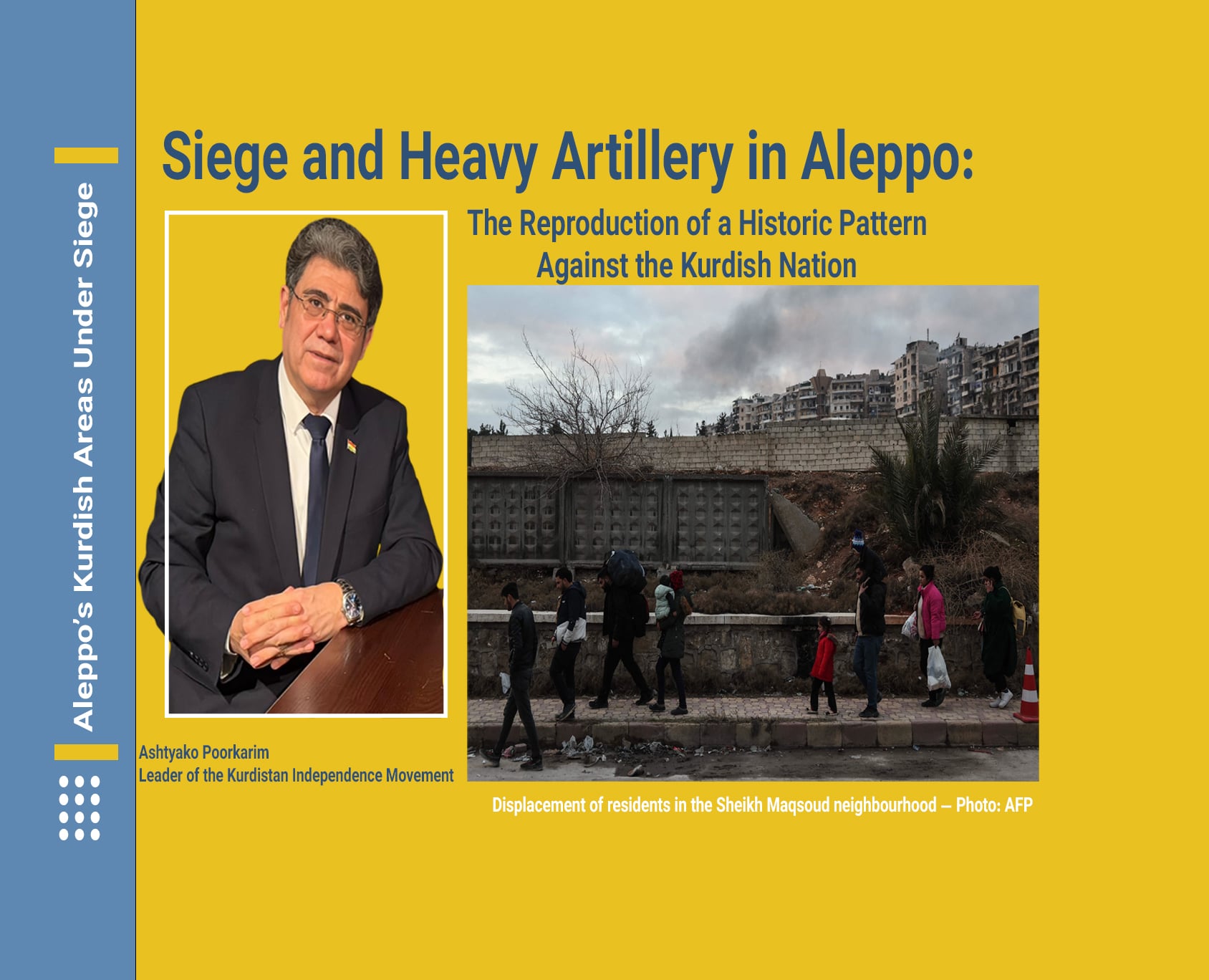
Ashtyako Poorkarim
Leader of the Kurdistan Independence Movement
In Aleppo—within the neighbourhoods of Sheikh Maqsoud, Ashrafiye, and Bani Zayd—we are once again witnessing what the Kurdish nation has learned through decades of lived experience: siege, shelling of residential areas, threats of occupation, and pressure to surrender or flee. This must not be reduced to a mere “security confrontation” or an “administrative dispute” between forces. What is unfolding is the re-emergence of a historical pattern repeated across the region: whenever central governments and authoritarian regimes feel they have regained power and initiative, the first place they strike is Kurdistan, and the first people they seek to “punish” are Kurds.
Since the beginning of January 2026, credible field reports have described continuous attacks and the use of heavy weapons in densely populated areas—where approximately 400,000 civilians live and where tens of thousands face immediate danger. When heavy firepower is employed in compact urban environments, the boundary between “target” and “home” collapses, and the primary victims are women, children, and families. From the standpoint of international humanitarian law, this reality—regardless of the claims made by the parties involved—raises a fundamental question: How can the use of heavy weapons in civilian neighbourhoods be reconciled with the principles of distinction between civilians and combatants, proportionality, and the obligation to take precautions to protect civilians?
The Kurdish nation’s experience shows that such crises are rarely “sudden.” They follow a traceable sequence: first, intense securitisation and explicit threats; then siege and restrictions on movement; then the interruption or disruption of services and the obstruction of humanitarian access; and ultimately, displacement. That is why Aleppo today is not merely a flashpoint—it is a warning: a warning of a trajectory which, if not contained, can rapidly become a major humanitarian catastrophe—one in which military pressure becomes an “instrument of politics” and civilians effectively assume the role of collective hostages.
What makes this situation even more dangerous is that—according to reports—these developments are occurring despite earlier understandings and arrangements intended to de-escalate tensions and protect the civilian population. When de-escalation agreements are set aside and the language of fire and siege returns, the meaning is clear: the central government or aligned forces are testing a “solution by force” rather than a political solution. And regional experience has shown that “solutions by force” in Kurdistan almost always serve a recurring objective: pushing the Kurdish nation away from its right to self-administration and self-defence, and turning civic and political achievements into a “security issue” in order to justify repression.
At the same time, reports have pointed to the presence and activity of armed actors with known records of undermining local arrangements and fuelling instability. The experience of northern Syria has repeatedly demonstrated that when there is no decisive, timely, and coordinated international response, the outcome can rapidly move toward forced displacement, large-scale human rights violations, and the deepening of ethnic and sectarian tensions. In other words, silence or minimal reactions are not simply “neutrality”; in practice, they encourage the continuation of violence—because the implicit message is that there will be no serious cost.
One of the most alarming indicators in this crisis—according to reports—is the transformation of civilian areas into functional military nodes. It has been stated that, following the forced evacuation of a nearby Assyrian-Christian neighbourhood, heavy equipment and military assets were positioned in that area, effectively turning a civilian environment into a launch platform and a pressure point adjacent to densely populated neighbourhoods. This matters profoundly because if such a process becomes entrenched, it will push not only Kurds but the entire multi-ethnic and multi-faith fabric of the city toward collapse—after which “security” becomes the pretext for cleansing, demographic engineering, and the imposition of silence. In such a context, the risk of sliding into collective punishment also increases: punishing an entire population because of the presence or actions of another group, or using civilian suffering as an instrument of political coercion. Legally and morally, this is a red line. Protection of civilians—especially in dense cities—is not a recommendation; it is a foundational obligation, and persistent violations can amount to grave breaches and legal responsibility.
Therefore, the urgent and practical course of action is clear and must be stated without hesitation: an immediate halt to military operations in civilian areas and full adherence to a ceasefire; the removal of heavy weapons from residential neighbourhoods; guaranteed, complete, safe, and unimpeded humanitarian access; and an independent, transparent, and professional investigation of events with clear accountability for any harm to civilians. These are not partisan or propagandistic demands—they are minimum humanitarian requirements; if they are not implemented today, tomorrow we will be forced to confront them on the scale of disaster.
Yet Aleppo is only one chapter in an old book. The larger issue is the return to the same historical trap repeatedly imposed on the Kurdish nation under different names: whenever central regimes are weakened, they speak of “dialogue,” “integration,” “reforms,” “national reconciliation,” or “decentralisation” to relieve pressure; but whenever they regain strength, they discard those promises and return to their core policy: occupation and repression.
Here a bitter truth must be stated plainly: the historical experience of the Kurdish nation across all four parts of Kurdistan has shown that if Kurds place their future within frameworks such as “paper federalism,” “symbolic autonomy,” or propaganda projects labelled “brotherhood”—whether Kurdish-Arab “brotherhood” in Syria, Kurdish-Turkish “brotherhood” in Turkey, Kurdish-Persian “brotherhood” in Iran, or Kurdish-Arab “brotherhood” in Iraq—they often commit a great and historic mistake. Not because coexistence and participation are inherently wrong, but because the regimes ruling these states do not truly believe in these concepts in practice. They accept them only when they are weak and need time and legitimacy; but as soon as they gain power, they violate those arrangements under various pretexts and revert to a policy of exclusion and control.
This is the “unity of substance and diversity of pretexts”: one regime acts in the name of religion and jihadist fatwas; another in the name of national security; another in the name of territorial integrity; another in the name of ideology. Sometimes the project is called “cleansing,” sometimes “security operations,” sometimes “restoring state authority.” But the outcome on the ground is the same: imprisonment, abduction, displacement, repression, and the attempt to break the political will of the Kurdish nation. If today we see siege and threats of occupation in Aleppo, it is the same logic of “whenever we gain power, we strike Kurdistan”—a logic repeated across the four parts of Kurdistan, each time paid for in blood and forced displacement.
For this reason, the conclusion must be stated clearly: the only sustainable path to liberation for the Kurdish nation in all four parts of Kurdistan is struggle for independence and the establishment of a Kurdish nation-state—Kurdistan. Independence here is not an emotional slogan; it is a rational response to the repetition of history. As long as Kurdish security and the right to decide Kurdish affairs remain hostage to the capitals of Damascus, Ankara, Tehran, and Baghdad, every achievement will remain temporary and every calm fragile. If a political framework is designed such that the central state can revoke Kurdish gains at any moment under “hollow pretexts,” that structure will ultimately return Kurds to zero. Independence means ending the cycle in which, whenever an occupying regime regains strength, it attacks again—and then seeks to normalise the same violence with a few words and a few signatures.
This position is not a call for militarism. It is an insistence on the right of self-determination and on the necessity of a durable framework for human and political security. Defending the Kurdish nation means defending the very principles the world claims to uphold: protection of civilians; prohibition of collective punishment; prohibition of forced displacement; accountability for grave violations; and refusing to legitimise violence.
A further demand follows directly: if the international community is truly committed to human rights, it must abandon double standards. One cannot call attacks on civilians a “war crime” in one crisis and then retreat into “ambiguity” and “caution” in another—especially when the victims are the Kurdish nation. Responsible policy means: reassessing political, diplomatic, and economic engagement with governments that do not guarantee civilian protection; conditioning future financial assistance on clear standards of civilian protection and legal accountability; recognising and supporting local democratic governance structures that have demonstrated capacity for community protection and civic management as part of any durable solution; and applying effective pressure—within international alliances and frameworks—on states whose military interventions and cross-border attacks intensify the war against Kurds. Attacks on minorities must also be called by their real name: crimes against civilians must not be concealed behind softened language. Ultimately, protecting Kurds and other endangered minorities—from Yazidis to Christians, Alawites, and Druze—must become a genuine محور (core) of democratic states’ regional policy, not a marginal footnote in statements.
Alongside Syria, we must not forget that the same logic of repression is active within the geography of Iran. According to widespread reports, protests have continued in Iran in recent weeks, and severe, organised repression—especially in Kurdistan—has involved the killing of dozens, the wounding of hundreds, and the arrest of thousands. If the world remains silent before such repression, the message to all occupying regimes is clear: there is no real cost. And that becomes the green light for yet another attack, another siege, and another wave of forced displacement.
And now there is a contradiction that can no longer be hidden: Kurds, with courage and immense sacrifice, stood on the front lines against ISIS; the world witnessed that without Kurdish resistance, the region could have become a permanent slaughterhouse. Yet today, in the face of sieges and shelling of Kurdish neighbourhoods and threats of forced displacement, that same world often settles for a policy of “limited attention, limited response”—as if collective memory is shorter than Kurdish suffering. The painful but necessary question is this: Why does the world tolerate cruelty toward Kurds with such coldness, when Kurds have been among the most democratic peoples and forces in the Middle East—again and again proving they can fight extremism and build civic order?
The answer is not a single sentence: it is a combination of the cold realism of power politics, security-economic bargaining, fear of refugee flows, anxiety over regional balances, and pressure from powerful allies. Yet deeper still, a chronic structural error persists: the Kurdish question is often framed not as a matter of rights, but as a “manageable file”—a file that can be postponed, traded, or sacrificed to “apparent stability.” But stability built on the denial of a nation’s rights collapses sooner or later, and returns with multiplied costs.
In conclusion, I unequivocally condemn the crimes and ongoing violence against civilians in Aleppo—under any name or justification. Syria today is governed by a structure whose head is Ahmed al-Sharaa, a figure associated with a jihadist past and a trajectory linked to Islamist and violence-driven currents. The international community sees this and cannot simultaneously speak of a “transition” while remaining silent about siege and heavy fire against densely populated neighbourhoods. A regime that, instead of protecting people, subjects residential areas to fire, turns siege into a political instrument, and answers the rights of the Kurdish nation with the language of force must face political and legal pressure—not normalisation and legitimacy. The first step is an immediate cessation of attacks and an end to the siege; followed by guaranteed humanitarian and medical access, the release of detainees and abducted persons, and a return to genuine dialogue—not negotiations under the shadow of tanks. But the larger lesson remains clear: as long as Kurds are forced to live within structures that treat them as a “security problem” rather than a nation with rights, every ceasefire will be temporary and every agreement vulnerable to betrayal.
Occupying regimes strike whenever they have the opportunity—sometimes under the banner of religion, sometimes ethnicity, sometimes territorial integrity, sometimes ideology. The only way to end this cycle is for the Kurdish nation to own its destiny. And that right is neither a privilege nor a favour—it is the natural right of a nation that has paid for it repeatedly, and continues to pay.